Open and Peep Sights Only in Muzzleloader-Only Hunts
Navigating the specific regulations for hunting in Idaho can feel like trying to untangle a particularly stubborn knot. One area that often trips up even seasoned hunters, especially those new to or returning to muzzleloading, is the strict limitation on sights during designated "muzzleloader-only" seasons. It's incredibly frustrating to invest in a fantastic modern muzzleloader, only to realize that the state expects you to dial it back to a more traditional setup for certain hunts. Many assume that if they can legally use a muzzleloader, any optic is fair game, but that's a mistake that can cost you a tag or worse. This guide is here to cut through the confusion, explaining exactly why Idaho limits sights to open and peep designs, what that means for your equipment, and how to master these traditional sighting systems for a legal and successful hunt.
Understanding Idaho's Muzzleloader Sight Regulations
Idaho has a rich tradition of hunting, and part of preserving that heritage involves specific rules for certain weapon types and seasons. Muzzleloader-only hunts are designed to offer a unique challenge and opportunity, and the sight restrictions are a key component of that traditional experience. It's not about making things harder, but about leveling the playing field and honoring a specific style of hunting.
The Strict Definition of Muzzleloader-Only Sights
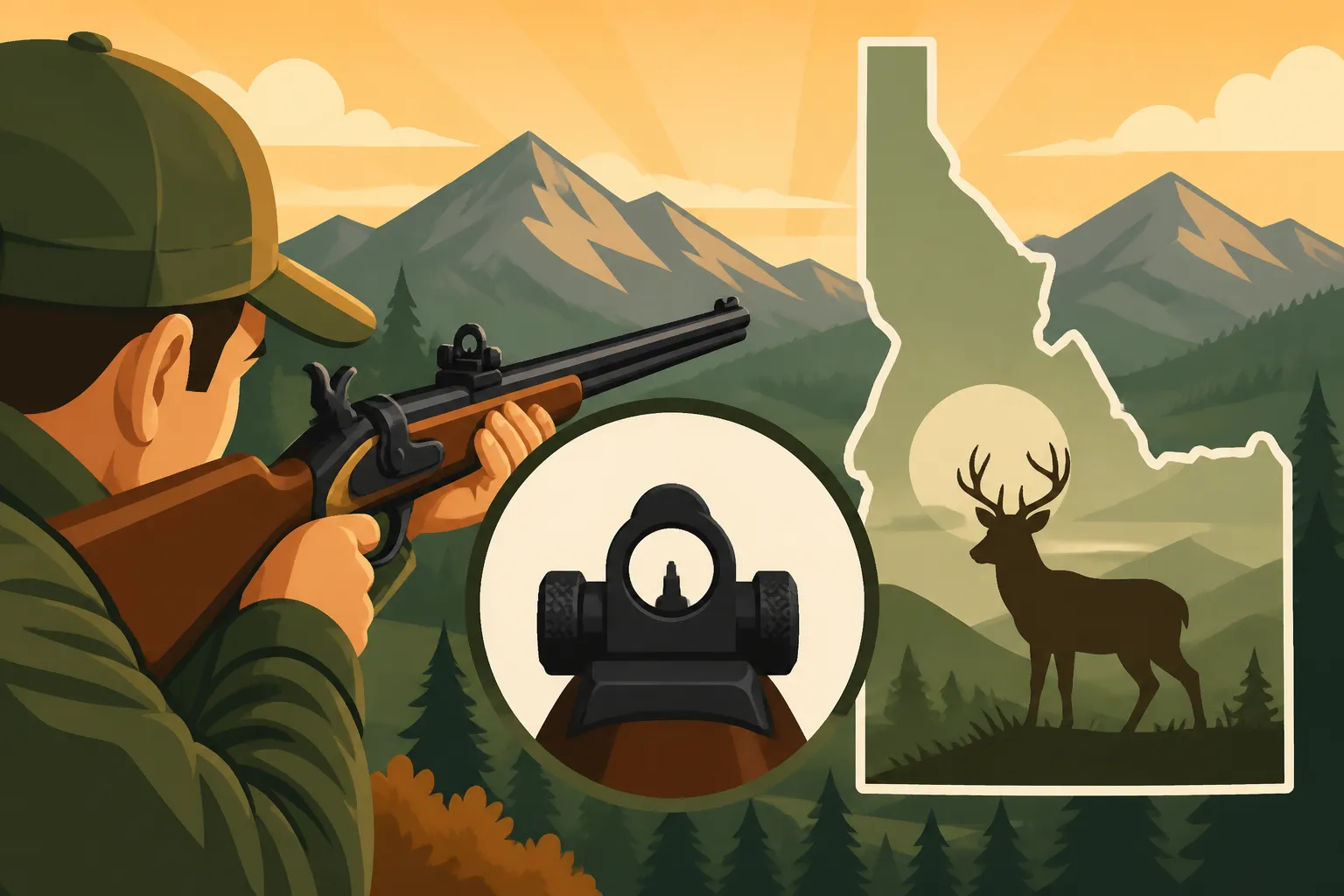
When Idaho Fish and Game says "muzzleloader-only" season, they mean it, right down to the sights you're allowed to use. For these specific hunts, you are strictly limited to open sights or peep sights. This means no scopes, no red dots, no holographic sights, and certainly no battery-powered illumination. An open sight generally consists of a front bead or post and a notched rear sight. Peep sights, on the other hand, feature a front post and a rear aperture (a small hole) through which you look. Both rely on basic principles of aiming without magnification or electronic assistance, offering a simpler, more traditional aiming solution. The simplicity is part of the challenge, pushing hunters to refine their marksmanship and get closer to their quarry.
Why Scopes and Inline Ignition Are Banned in Specific Seasons
The reasoning behind banning modern scopes and inline ignition systems in muzzleloader-only hunts is rooted in the spirit of traditional hunting. Scopes, with their magnification and light-gathering capabilities, dramatically extend a hunter's effective range and accuracy, especially in low light conditions. The Idaho Fish and Game wants to ensure that these special seasons maintain a higher level of difficulty and require hunters to develop different skill sets, such as effective close-range stalking. Similarly, inline ignition systems, which enclose the primer and often use modern 209 shotshell primers, offer a more reliable and weatherproof ignition compared to traditional percussion caps or flintlocks. This modernization reduces some of the historical challenges associated with muzzleloading, like misfires in damp weather. By restricting both scopes and inline ignition, Idaho aims to ensure that "muzzleloader-only" truly means a more primitive, challenging hunt. If you want to learn more about this specific regulation, check out our deep dive on Why Idaho Muzzleloader-Only Hunts Ban Scopes and Inline Ignition.
Distinguishing Muzzleloader-Only vs. Any-Weapon Seasons
It's crucial to understand that Idaho's sight restrictions for muzzleloaders are season-specific, not blanket rules for all muzzleloader hunting. Many general big game seasons in Idaho are "any-weapon" hunts, which means you can use a scoped muzzleloader, or even a centerfire rifle or archery equipment. The distinction lies in the season description on your tag and in the regulations. If your tag specifies "Muzzleloader Only," then the traditional sight rules apply. If it's a general season where muzzleloaders are simply one of several legal weapons, you're often permitted to use a scope. Always double-check the specific regulations for the unit and season you're hunting to avoid any misunderstandings. This nuance is why understanding when Using a Muzzleloader in Any-Weapon Season is allowed with modern optics is so important.
The Philosophy Behind Traditional Muzzleloader Restrictions
These rules aren't arbitrary; they stem from a deeply held philosophy about preserving the essence of hunting. Idaho, like many Western states, values the challenge and connection to history that traditional methods offer.
Preserving the Challenge and Traditional Hunting Experience
At its heart, the limitation to open and peep sights is about preserving a traditional hunting experience. Imagine Daniel Boone or Lewis and Clark with their trusty long rifles; they weren't peering through high-magnification scopes. Muzzleloader-only seasons harken back to that era, demanding a different kind of skill set. It's about stalking closer, reading terrain more effectively, and making that first shot count from a more intimate distance. This heightened challenge creates a sense of accomplishment that many hunters cherish, fostering a deeper appreciation for the animals and the wilderness. It’s an opportunity to slow down, connect with ancestral hunting methods, and test your woodsmanship in a way that modern firearms often don't demand. This is often why these tags are offered during prime times, offering a unique chance for hunters willing to embrace the traditional path.
Ensuring Fair Chase and Limiting Effective Range
Another critical aspect of these regulations is the concept of fair chase. By limiting hunters to non-magnifying sights, the effective range of a muzzleloader is inherently reduced. While a skilled shooter might stretch an open-sighted muzzleloader to 100-150 yards, a scoped rifle can easily double or triple that distance. This shorter range forces hunters to close the distance to their animal, relying on stealth, tracking, and calling instead of relying on long-range shooting prowess. This creates a more "fair" engagement between hunter and hunted, giving the animal a greater chance to evade. It also encourages hunters to be more selective with their shots, waiting for ideal broadside opportunities at closer distances, which generally leads to more ethical harvests. For instance, achieving a clean kill on an elk requires a careful understanding of The Effective Range of a Muzzleloader on Elk with traditional sights.
Managing Pressure and Opportunity Across Hunt Types
Idaho Fish and Game also uses these specific rules as a tool for wildlife management and distributing hunting pressure. By creating different "types" of hunts—archery, muzzleloader-only, any-weapon rifle—they can offer diverse opportunities while balancing herd populations. Muzzleloader-only seasons often fall during periods when general rifle seasons are closed, providing additional hunting days without adding overwhelming pressure to the herds. These seasons attract a dedicated subset of hunters who appreciate the unique challenge, thus spreading out the overall hunting effort. It also means that a hunter might choose to apply for an A Tag, which often favors archery and muzzleloader hunters, understanding the specific limitations and opportunities associated with that choice. For more on tag types, consider reviewing A Tags Favor Archery and Muzzleloader Hunters.
Mastering Open Sights for Idaho Muzzleloader Hunts
While open sights might seem basic, mastering them requires practice and attention to detail. They are a perfectly viable and ethical way to hunt, and countless animals have been harvested successfully with them.
Selecting the Right Open Sights for Your Muzzleloader
Not all open sights are created equal. For a muzzleloader, you'll typically be looking at a front sight (often a post or a bead, sometimes fiber optic for better visibility) and a rear sight (usually a U-notch or square notch).
- Fiber Optic Sights: These can be a game-changer, especially in the low light conditions common during early morning or late evening hunts. The bright, glowing pins (green or red) draw your eye quickly to the front sight, making target acquisition faster. Brands like Truglo and Williams Gun Sight Company offer excellent fiber optic options that are fully compliant with Idaho's traditional sight rules.
- Traditional Metal Sights: Many muzzleloaders come equipped with classic metal sights. While not as bright as fiber optics, they are robust and reliable. Ensure they have clear definition between the front post and the rear notch.
- Adjustability: Look for sights that offer windage and elevation adjustments. This is crucial for sighting in your rifle accurately for different distances and loads. Some traditional sights might require drifting the rear sight for windage and filing the front sight for elevation, which is a bit more involved but still effective.
When choosing, consider the type of hunting you'll be doing. For dense timber, a highly visible front sight is paramount. For more open country, precise sight picture is key. Most importantly, ensure the sights are durable enough to withstand the rigors of a backcountry hunt in Idaho.
Sighting In and Practice Drills for Open Sights
Sighting in a muzzleloader with open sights is a process that demands patience and repetition. Unlike a scope where you can easily see impacts at 100 yards, you'll want to start much closer.
- Start Close (25 yards): Begin at 25 yards. This short distance allows you to get on paper quickly. Shoot a three-shot group, adjust your sights, and repeat until your shots are consistently hitting the bullseye.
- Move Out (50-75 yards): Once you're accurate at 25 yards, move back to 50 or 75 yards. Remember, the goal with traditional sights is often to have a point-blank range out to about 100-125 yards, meaning you hold dead on, and your bullet trajectory stays within the vital zone.
- Practice Various Positions: Don't just practice from a bench. Practice shooting offhand, from a kneeling position, and using natural rests like tree trunks or rocks. Hunting situations are rarely perfect, and you need to be proficient from various real-world scenarios.
- Simulate Hunting Conditions: Practice with the clothing you'll wear hunting. If you're wearing a heavy coat, practice with it on. Simulate quick target acquisition, aiming at a target for only a few seconds, as you might in a real hunting encounter.
- Focus on Sight Picture: For open sights, the goal is to align the top of the front sight post (or the center of the bead) perfectly within the notch of the rear sight, then place that aligned sight picture on your target. The front sight should be clear, while the rear sight and target might be slightly blurry.
Real-World Scenarios and Limitations of Open Sights
Open sights are highly effective within their limitations, but it's crucial to understand what those are.
- Reduced Effective Range: As mentioned, your effective range will be significantly shorter than with a scoped rifle. For most hunters, this means confidently taking shots out to 75-100 yards on deer, and perhaps 100-125 yards on elk with ample practice. This mandates closer stalks, which can be exhilarating but also more challenging.
- Low Light Conditions: This is where open sights truly struggle compared to optics. A fiber optic front sight helps, but precise aiming in deep timber at dawn or dusk can be very difficult. You might need to pass on shots that you would comfortably take with a scope.
- Weather Conditions: Rain, snow, or fog can obscure open sights, making it hard to get a clear sight picture. Practice in adverse conditions if possible, and carry lens cloths or a small cloth to wipe them clean.
- Target Acquisition: Quick target acquisition can be slower than with a modern red dot or scope, especially on a moving animal. This requires more deliberate practice and patience in the field.
Embrace these limitations as part of the challenge. This style of hunting demands greater attention to wind direction (see Reading Wind in Steep Timbered Country), animal behavior, and terrain, similar to what you'd experience with archery.
Embracing Peep Sights for Enhanced Accuracy
For many traditional muzzleloader hunters, peep sights represent the best balance between traditional rules and practical accuracy. They offer a significant advantage over open sights without violating the spirit of the "muzzleloader-only" regulations.
Choosing a Peep Sight System for Your Muzzleloader
Peep sights, also known as aperture sights, consist of a small disc or ring with a tiny hole (the aperture) that replaces your rear open sight, paired with a post or bead front sight.
- Receiver-Mounted Peep Sights: These are the most common and generally considered the most accurate. They mount directly to the receiver of your muzzleloader, closer to your eye. Brands like Williams Gun Sight Company and Lyman offer excellent receiver-mounted peep sights designed for various muzzleloaders. Look for micro-adjustments for both windage and elevation for precise zeroing.
- Tang-Mounted Peep Sights: Less common on modern inline muzzleloaders but popular on traditional style muzzleloaders, these mount on the tang (the metal strap extending from the receiver to the stock). They offer a longer sight radius, which can aid accuracy, but are more delicate.
- Front Sight Pairing: Regardless of the peep sight you choose, ensure it pairs well with your front sight. Many hunters prefer a crisp, thin post front sight with a peep, as it allows for precise alignment. Fiber optic front sights also work exceptionally well with peep sights, providing a bright aiming point through the aperture.
Consider adjustability, durability, and ease of installation. A solid, reliable peep sight will become an extension of your rifle.
The Advantages of Peep Sights Over Open Sights
Switching from open sights to a quality peep sight offers several noticeable benefits:
- Increased Accuracy: The primary advantage is accuracy. Your eye naturally centers the front sight in the rear aperture, creating a very precise sight picture. This eliminates the "three-plane" alignment challenge (front sight, rear sight, target) of open sights and simplifies it to aligning the front sight on the target within the blurry ring of the peep. This can translate to tighter groups and increased confidence at your maximum ethical range.
- Longer Sight Radius: Most receiver-mounted peep sights are closer to your eye than traditional open sights, effectively lengthening your sight radius (the distance between your front and rear sight). A longer sight radius inherently improves aiming precision.
- Better in Low Light: While not as good as a scope, peep sights generally perform better in low light than open sights. Your eye naturally "looks through" the aperture, and the focus remains on the front sight and target. There's less metal to obscure the view compared to a U-notch.
- Faster Target Acquisition: With practice, many hunters find target acquisition with a peep sight to be surprisingly fast. Your eye instinctively finds the center of the aperture and focuses on the front sight and target.
- Reduced Parallax Error: While not true parallax in the optical sense, the way your eye naturally centers the front post in the aperture makes minor head movements less impactful on point of aim compared to open sights.
Practice Regimen for Consistent Peep Sight Performance
Just like any new sighting system, a peep sight requires dedication to practice.
- Fundamental Drills: Start with the basics: dry firing to build muscle memory, focusing on a consistent cheek weld, breathing, and trigger squeeze. Your eye needs to get used to looking through the peep, not trying to focus on the peep itself.
- Sight-In Carefully: Take your time at the range. Start at 25 yards, ensuring you're on paper and making small adjustments. Then move to 50, 75, and 100 yards. Document your loads and adjustments in a shooting log. Remember, some states, like Idaho, also have Idaho Muzzleloader Caliber Minimums: .45 for Deer, .50 for Elk, so ensure you're practicing with legal loads.
- Vary Aperture Size: Many peep sights come with interchangeable apertures. Experiment with different sizes. A larger aperture might be faster for close shots or in low light, while a smaller one offers greater precision for longer distances. Find what works best for your eyes and hunting style.
- Practice Quick Shots: Set up targets at varying, unknown distances (within your ethical range) and practice quickly shouldering the rifle, finding the sight picture, and taking the shot. This mimics hunting conditions where animals don't often stand still for long.
- Holdovers and Hold-unders: Understand your bullet's trajectory. If you zero at 75 yards, know where it will hit at 50 yards and 125 yards. Use a ballistic calculator for your specific load and bullet to create a cheat sheet, especially for The Effective Range of a Muzzleloader on Elk. Knowing your holds allows you to make confident shots at varying distances.
GoHunt often has excellent resources and forums where hunters discuss specific sight choices and practice techniques for traditional muzzleloaders, providing invaluable real-world insights from other hunters in Idaho and beyond.
Equipment Considerations and Compliance
Beyond just the sights, there are other crucial equipment considerations to ensure you're fully compliant with Idaho's muzzleloader-only season rules.
Legal Muzzleloader Accessories Beyond Sights
Idaho's traditional muzzleloader seasons extend beyond just the sights. Hunters often overlook other regulations that govern the muzzleloader itself.
- Ignition System: For muzzleloader-only hunts, you generally need an exposed percussion cap or flintlock system. This means inline muzzleloaders using sealed 209 primers are typically not allowed. The primer must be visible and exposed to the elements. This is a critical detail covered in The Exposed-Cap Ignition Rule Idaho Enforces.
- Powder: Black powder or black powder substitutes are required. Smokeless powder is a definite no-go. When using substitutes, remember the rule: measure by volume, not by weight. Many inexperienced hunters mistakenly measure substitutes by weight like smokeless powder, which can lead to dangerous overloads. It’s important to know about Measuring Blackpowder Substitutes by Volume, Not Weight.
- Bullets: Conical bullets, saboted bullets, or round balls are generally acceptable. Always check the specific regulations for any restrictions on bullet type, material, or weight, especially when matching them to Idaho Muzzleloader Caliber Minimums: .45 for Deer, .50 for Elk.
- Fixed vs. Permanent Components: No components that attach optics (like scope bases or rings) are permitted to be on the muzzleloader during a muzzleloader-only hunt, even if the scope itself is not mounted. The spirit of the rule is to avoid any advantage.
Checking Your Gear Against Idaho Regulations Before the Hunt
The absolute worst time to discover your gear isn't legal is when you're standing in the field, either facing a game warden or missing an opportunity because you're unsure.
- Read the Regulations Annually: Regulations change. What was legal last year might not be this year. Always download and thoroughly read the most current Idaho Big Game Regulations specific to your species and unit. Don't rely on memory or hearsay.
- Cross-Reference Your Tag: Double-check your actual hunting tag against the regulations. Does it say "Muzzleloader Only" or "Any Weapon"? That distinction is everything.
- Inspect Your Muzzleloader: Before you even leave home, perform a thorough inspection of your muzzleloader. Are there any scope bases attached? Is your ignition system exposed? Are your sights open or peep-style? Remove anything that could be misinterpreted as illegal.
- Ask Idaho Fish and Game: If you have any doubt whatsoever, contact Idaho Fish and Game directly. Their conservation officers are there to help clarify regulations, not just enforce them. It's far better to ask a question beforehand than to face a citation later.
- Utilize Online Resources: Websites like GoHunt provide regulation summaries and forums where experienced Idaho hunters discuss compliance. While not official legal advice, these communities can help you understand common interpretations and best practices.
Common Mistakes to Avoid with Muzzleloader Sight Choices
Many hunters fall into predictable traps when it comes to muzzleloader-only regulations.
- Assuming Modern Optics are Universally Allowed: This is probably the most common mistake. The existence of "any weapon" muzzleloader seasons often leads to the false assumption that scopes are always fine. Always verify the season type.
- Leaving Scope Bases On: Even if you remove the scope, leaving the bases mounted on your muzzleloader can lead to a citation. The regulations are often written to prevent any advantage or even the appearance of being able to quickly mount an illegal optic.
- Using Inline Primers: The convenience of 209 primers in modern inline muzzleloaders makes them popular, but they are typically forbidden in traditional muzzleloader-only seasons due to their enclosed, weatherproof design. Remember the exposed cap rule.
- Not Practicing Enough: Hunters often spend less time practicing with their muzzleloaders and traditional sights compared to their scoped rifles. This is a critical error. The reduced range and different sight picture demand more practice, not less, to ensure ethical and accurate shots. Your ethical range with traditional sights will likely be shorter than you're accustomed to.
- Ignoring Bullet Trajectory: With slower muzzleloader velocities and often heavier projectiles, bullet drop is more pronounced. Failing to understand your specific load's trajectory and practice shots at varying distances can lead to missed opportunities or, worse, unethical shots.
Preparing for a Successful Muzzleloader-Only Hunt in Idaho
Hunting with a traditional muzzleloader, especially under sight restrictions, requires a different mindset and preparation than a general rifle hunt. It's a journey into a more challenging, rewarding experience.
Physical and Mental Preparation for Close-Range Hunting
Because muzzleloader-only seasons demand closer shots, they inherently require more stalking and often more physical exertion.
- Physical Conditioning: You'll likely be covering more ground on foot, navigating rugged terrain to get within that 100-yard window. This is where your physical fitness truly pays off. Incorporate hiking with a loaded pack, incline training, and stretching into your routine. Remember, Physical Conditioning for Idaho Backcountry is essential for any Western hunt, but even more so when you need to get close.
- Mental Toughness and Patience: Stalking an animal to within bowhunting range with a muzzleloader requires immense patience and mental fortitude. There will be busts, there will be animals that slip away, and there will be times you simply cannot close the distance for an ethical shot. Being able to remain calm, persistent, and to know when to pass on a shot are crucial mental skills.
- Developing Tracking Skills: Closer encounters mean more opportunities to cut fresh tracks and interpret sign. Brush up on your tracking and observation skills. Look for recent rubs, scrapes, and feeding areas.
- Wind Awareness: More than ever, playing the wind is critical. An animal's nose will bust you long before its eyes will see your muzzleloader at 75 yards. Constantly check wind direction and plan your approach accordingly. This is particularly relevant in the varied terrain of Idaho, where the wind can swirl unexpectedly.
Scouting Strategies for Muzzleloader-Only Zones
Scouting for a muzzleloader hunt is similar to archery scouting—you're looking for different patterns and areas than you might for a long-range rifle hunt.
- Focus on Cover and Funnels: Animals in muzzleloader-only seasons (which often overlap with archery seasons or early rifle seasons) are usually more pressured and will gravitate towards thicker cover. Identify natural funnels, pinch points, and dense bedding areas that animals use to move undetected.
- Water Sources and Feed: Pinpoint reliable water sources and preferred feeding areas. Animals will move between these crucial resources, often at dawn and dusk, providing prime opportunities for ambush or careful stalks.
- Bedding Areas: Learning to identify and approach bedding areas is key. With traditional sights, you want to try and catch animals moving from bed to feed, or vice-versa, or even make a deliberate, slow stalk into a bedding area with favorable wind.
- Utilize E-Scouting Tools: Before you even set foot in the field, use tools like GoHunt to e-scout. Look for areas with dense timber, natural benches, and drainages that would allow for a close approach. Identify potential access points, but also areas of limited access where animals might feel safer. This kind of preparatory work is detailed in guides like E-Scouting an Idaho Unit Before the Season.
- Boots on the Ground: Nothing beats physical scouting. Walk the terrain, look for fresh sign, and identify specific ambush points or stalking lanes. Pay attention to how the wind swirls in different drainages.
Shot Placement and Ethical Considerations with Traditional Muzzleloaders
When you're hunting with traditional sights, precise shot placement is paramount.
- Know Your Vitals: Be intimately familiar with the anatomy of the animal you're pursuing. Understand exactly where the heart and lungs are located, and how they relate to the shoulder and leg bones.
- Broadside is Best: For muzzleloaders, a broadside shot is almost always the most ethical choice. It offers the largest target area for the vitals and minimizes the chance of hitting heavy bone that could stop a slower, heavier muzzleloader projectile.
- Patience is Key: It can be incredibly tempting to take a marginal shot when an animal is finally within range. Resist the urge. Wait for the animal to present the best possible ethical shot. If it doesn't happen, let the animal walk. A clean kill is always the goal, and that means choosing your shot carefully.
- Follow-Up: A muzzleloader is a single-shot weapon. While you can reload, it's not a fast process. This makes the first shot even more critical. However, if you do hit an animal, be prepared to reload immediately and follow up if necessary.
- Blood Trailing: Even with a perfect shot, animals can run. Develop strong blood-trailing skills and be prepared to track an animal well into the evening or the next morning. Understanding How Close a Bowhunter Needs to Get on Elk is a good parallel, as both methods require similar approaches to shot distance and follow-up.
Disclaimer
Please be aware that hunting regulations, including those for muzzleloader sights and equipment, can change annually. While this guide provides comprehensive information, it is not a substitute for reviewing the current official Idaho Fish and Game regulations for the season and unit you plan to hunt. Always consult the official Idaho Fish and Game website or printed regulations booklet before heading afield to ensure full compliance.