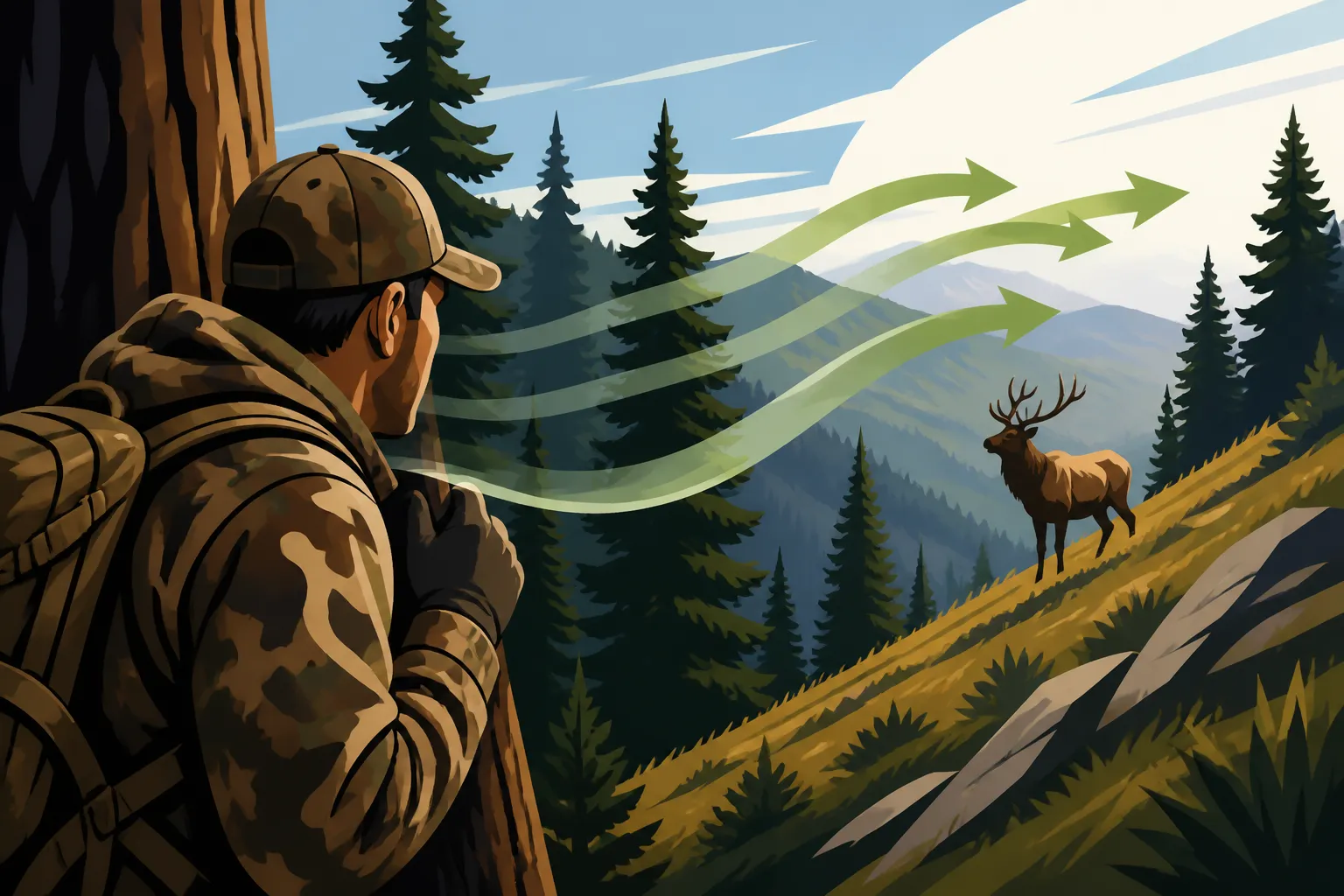
Reading Wind in Steep Timbered Country
Oh, the wind in steep, timbered country. If you've spent any time chasing elk or deer through Idaho's mountains, you know the soul-crushing frustration of having a perfect stalk blown by a sudden swirl of scent. It feels like the mountain itself is conspiring against you, changing its mind every few minutes. This guide is all about helping you decode those tricky wind patterns so you can get closer to your quarry, rather than inadvertently waving a "hello, here I am!" flag with your scent.
The Unique Challenge of Wind in Steep, Timbered Terrain
Hunting in the mountains of Idaho, especially in areas like the Clearwater or Frank Church Wilderness, is a completely different beast than hunting flatter ground. The wind, which is often a predictable factor in open country, becomes a chaotic, swirling adversary when it interacts with steep slopes, deep canyons, and dense timber. It's not enough to just check a weather app; you need to understand the micro-climates and the subtle dance between air currents and terrain.
How Thermals and Katabatics Interact with Topography
At the heart of mountain wind dynamics are thermals and katabatics. Thermals are those rising currents of air, usually as the sun warms the slopes during the morning. They pull your scent up the mountain. Katabatics, on the other hand, are the cool, heavy air masses that slide down the mountain as temperatures drop, typically in the evenings and overnight. This basic understanding is crucial, but it's just the starting point in steep, timbered areas where the terrain is rarely a simple slope. Imagine a sunny morning in a deep canyon. The sun hits one side, warming it rapidly and creating a strong thermal, while the shaded side remains cool, still potentially pushing cold air down. Your position relative to these differing slopes can mean the difference between getting winded immediately or closing the distance undetected. Knowing which way the air is likely to move, especially when you're glassing breaks and benches for mule deer, can inform your entire approach.
Beyond the general up and down, these air movements are incredibly sensitive to the specific contours of the land. A small bench, a draw, or a rock outcrop can act like a dam or a funnel, redirecting these currents in ways that a weather forecast simply can't predict. One moment you might feel a steady thermal pushing uphill, only to step around a ridge and have your milkweed puff indicate a sudden downdraft caused by a shadowed pocket of cold air. This constantly shifting environment is why you can't just rely on broad strokes; you need to become hyper-aware of your immediate surroundings.
The Swirling Chaos of Timbered Drainages
If general thermals and katabatics are the main currents, then timbered drainages are where the rapids and eddies really kick in. Picture a steep, narrow canyon choked with pines and firs. When the wind hits the ridge top, it doesn't just flow smoothly down the canyon. Instead, it gets broken up, deflected, and funneled by the trees and the canyon walls. This creates a dizzying array of micro-currents. Your scent might travel straight for a hundred yards, then hit a dense patch of timber, get pushed sideways, then curl back on itself, or even get sucked up a small side draw against the general flow. It's incredibly frustrating, and it's where many a hunter has been busted by an elk that seemed to be directly downwind.
The density of the timber plays a huge role here. Thick stands of mature trees create more friction and more turbulence, breaking up steady winds into unpredictable gusts and swirls. If you're still hunting timber for bedded mule deer, you're constantly pushing into this chaotic environment. Add to that the effect of elevation changes within the drainage itself – even a subtle dip or rise can create a pocket where air lingers or takes an unexpected turn. Understanding these complex interactions is key to planning your approach, allowing you to anticipate where your scent might travel and adjust your path accordingly. It often means taking a longer, more circuitous route to maintain a favorable wind, rather than the most direct path.
Tools and Techniques for Better Wind Detection
Given the unpredictable nature of mountain winds, you simply cannot rely on feel alone. You need to constantly test the wind and have a few tricks up your sleeve to get a clearer picture of what's happening at all elevations around you. These tools and techniques are your best friends in navigating those tricky Idaho winds, especially when you need to know how close a bowhunter needs to get on elk.
Low-Tech Indicators: The Puff Bottle and Milkweed
Forget fancy gadgets; the best wind indicators are often the simplest. A small squeeze bottle filled with unscented powder (like talcum powder or even baking soda) or a bag of milkweed seeds are absolute essentials in your hunting pack. These indicators show you the wind's direction and strength not just where you're standing, but also several feet above you and how it might drift around obstacles. When you puff out a cloud of powder, watch it carefully. Does it go straight? Does it swirl? How quickly does it dissipate or get pulled in an unexpected direction? This visual feedback is invaluable for "reading" the air.
Milkweed pods, if you can find them and gather them before the season, offer an even more subtle reading. The fine, silken strands of milkweed are incredibly light and will float on the slightest air current, sometimes drifting for hundreds of yards. This allows you to see the long-range drift of your scent and identify those tricky eddy currents that might otherwise go unnoticed. When you're trying to figure out if your calling elk on pressured National Forest ground will work, knowing exactly where your scent is going is paramount. Always check the wind before taking another step, especially when crossing exposed areas or approaching what you believe is dead ground. These small, consistent actions drastically improve your chances of success.
Understanding Digital Wind Forecasts and Limitations
While low-tech indicators are king in the immediate moment, digital wind forecasts from apps like GoHunt can provide a crucial macro-level understanding before and during your hunt. These apps often provide wind speed and direction by elevation, which can give you a general idea of what to expect on ridge tops versus valley bottoms. They are fantastic for planning your initial approach to an area or deciding which drainages might be more favorable on a given day. For instance, if you see a strong westerly wind forecast, you might plan to hunt an east-facing slope in the morning, knowing the thermal will generally push your scent uphill into the crosswind, rather than directly at any animals on the opposite slope.
However, it's absolutely vital to understand their limitations, especially in Idaho's rugged terrain. Digital forecasts rely on broad meteorological models and don't account for the hyper-local interactions with specific mountains, canyons, or dense timber. A forecast might say "wind from the west at 5 mph," but deep in a timbered drainage, that west wind might be entirely blocked, creating a completely different micro-climate with its own swirling patterns. Use these forecasts as a general guide and a starting point, but always, always defer to your low-tech indicators once you're on the ground. Think of the forecast as telling you the dominant current in the river, but your puff bottle reveals the eddies and undertows right where you're trying to cross.
Strategic Movement Based on Wind Patterns
Once you understand how wind behaves and you've got your wind checker ready, the next step is to integrate that knowledge into your actual movement through the hunting grounds. This isn't just about walking into the wind; it's about making deliberate choices about your route and timing to maintain the upper hand.
Stalking Uphill with Rising Thermals
Hunting uphill with rising thermals is often the preferred strategy, especially in the mornings when those air currents are strong and consistent. As the sun warms the slopes, air naturally begins to rise, carrying your scent away from any animals below you. This allows you to move cautiously up a ridge or through a drainage, knowing that your scent cone is generally moving in a favorable direction. However, this isn't a license to be careless. Thermals aren't always perfectly straight. They can be influenced by small side draws, rock features, or even a sudden patch of shade that creates a temporary pocket of cooler air.
When you're climbing, constantly check your wind. If you encounter a slight dip or a bench that's still in shadow, the thermal might weaken or even briefly reverse. This is where you might need to adjust your line, perhaps skirting around the cold air pocket or waiting for the sun to hit it. Also, remember that eventually, you'll reach the top of the rise. As you crest a ridge, the thermal can become less reliable, sometimes swirling or getting caught by broader winds. Always use these moments to re-evaluate and ensure you're still in the clear. Thinking about how far to stalk a bedded mule deer, an uphill thermal approach is often your best bet, but it still requires constant vigilance.
Navigating Downhill with Falling Katabatics
Conversely, hunting downhill with falling katabatics, usually in the late afternoon and evening, can also be highly effective. As the sun begins to set and the slopes cool, the heavy, cold air starts to slide downhill, again carrying your scent away from animals below you. This can be an excellent time to move into an area where animals might be bedding for the night or moving down to feed in lower elevations. However, just like thermals, katabatics have their nuances. They tend to be slower and can be more easily disrupted by terrain.
When moving downhill, pay close attention to the steepness of the slope and the density of the timber. A very steep, open slope might have a strong, consistent downdraft, but a more gradual slope or one heavily timbered will break up and slow the katabatic flow, making it less reliable. Side draws and small canyons can still create swirling eddies. The biggest risk with katabatics is if you get too low too quickly and then have to climb back up. If the air currents reverse even slightly, or you hit an unexpected pocket of rising air, your scent can be carried directly back up the slope. Using benches and draws to close distance downhill requires a keen eye on how that cold air is truly behaving.
Crossing Contours and Dealing with Crosswinds
The trickiest wind situations often arise when you're not moving directly up or down a slope, but rather traversing across a contour line, which puts you in a perpetual crosswind situation. Here, your scent might get carried horizontally across a hillside, increasing the risk of it hitting an animal directly downwind of your path. This is where a subtle shift in elevation can make a huge difference. If you're slightly above the game, and the wind is generally blowing across the slope, you have a better chance of your scent carrying over them. If you're below them, the wind will carry your scent directly into their zone.
When dealing with crosswinds in steep, timbered country, you need to become adept at reading the subtle terrain features that can influence wind direction. A small point of land or a micro-ridge might create a temporary updraft or downdraft that either pushes your scent up and over, or pulls it down and through. This is where those puff bottles become your best friend, constantly checking the subtle shifts. Sometimes, it's better to make a larger loop, either dropping lower or climbing higher, to get into a more favorable upwind or downwind position, rather than risking a direct crosswind approach. This might mean adding significant time to your stalk, but patience often pays off. Knowing the "hot spots" for animals by reading fresh elk sign in dark timber can help you pre-plan these longer wind-advantageous routes.
Playing the Eddies and Micro-Currents
The general rules of thermals and katabatics provide a framework, but in truly steep, broken country, you have to master the art of navigating the small, localized wind currents – the eddies and micro-currents – that can make or break a stalk.
Using Ridgelines and Benches to Your Advantage
Ridgelines and benches are like highways and rest stops for both animals and wind. Animals often travel and feed along benches, which offer easier walking and good vantage points. Ridgelines, on the other hand, often act as a dividing line for broader wind patterns. When you're on a ridgetop, the wind can be incredibly fickle. It might blow from one side, then the other, or swirl directly over the top. The key is understanding that these features create predictable anomalies. A bench, for example, can hold a consistent eddy of air, especially if it's sheltered. If the main thermal is pushing uphill, a bench might momentarily hold a pocket of still or even reverse-moving air.
When hunting along a ridgeline, try to stay just below the crest on the lee side (the side sheltered from the main wind). This often provides a more consistent, less turbulent air current. When approaching a bench, especially a promising one for game, slow down dramatically and check the wind multiple times from different angles. You might find that by dropping just a few feet below the bench, your scent is carried over it, or by staying tight to a specific rock formation, you can keep your scent contained. These subtle adjustments on features like those you'd encounter when glassing breaks and benches for mule deer are critical.
Reading Vegetation for Subtle Wind Shifts
Beyond terrain, the vegetation itself can be a powerful indicator of wind direction and strength, especially when dealing with micro-currents. Pay attention to the subtle movements of leaves and branches. Are they swaying consistently in one direction, or are they twitching erratically? Even the smallest, most delicate leaves, like those on aspen or willow, can show you a current that your skin might not feel. Look for dust or dry leaves being pushed around on the forest floor. These granular details give you real-time feedback that no app can provide.
The types of trees can also tell a story. In very dense, old-growth timber, the air currents on the forest floor can be almost entirely cut off from the canopy, creating a separate wind system. This means your scent might be swirling around at ground level, even if the treetops are swaying in a consistent direction. In more open timber, the wind will have more penetration. Learning to "read" the rustle and sway of the forest is an acquired skill, but one that drastically improves your situational awareness. When you're trying to figure out the effective range of a muzzleloader on elk, understanding these subtle wind cues will prevent you from getting busted before you even get a shot opportunity.
Adapting Your Hunt Plan to Unpredictable Wind
Ultimately, dealing with wind in steep, timbered country is about adaptability. No amount of planning will completely remove the element of surprise, but you can build flexibility into your strategy.
When to Push and When to Back Out
There will be days, especially in Idaho's rugged mountains, when the wind simply isn't cooperating. It's swirling unpredictably, switching directions every few minutes, and refusing to settle. These are the days when you need to make a tough call: do you push on and risk blowing every animal in the vicinity, or do you back out and try again later? A good rule of thumb is this: if you can't get a consistent wind reading for more than 30 seconds at a time, or if your puff bottle shows constant swirling at your chosen approach, it's probably time to re-evaluate. Pushing hard into an unpredictable wind is a low-percentage play that often leads to frustration and educating the animals.
Sometimes, backing out doesn't mean quitting. It might mean changing your strategy entirely. Perhaps instead of an aggressive stalk, you shift to a quiet still hunt through particularly dense timber, moving only a few steps at a time when the wind is momentarily favorable. Or maybe you relocate to a different part of the unit that has different topography, hoping for more consistent air currents. Checking resources like GoHunt for detailed topographical maps and public land access layers can help you quickly identify alternative areas. It's about recognizing when the odds are stacked against you and choosing a smarter battle, rather than stubbornly forging ahead.
Developing a Contingency Plan for Wind Shifts
Every good hunt plan needs a contingency, and wind is often the primary reason you'll need one. Before you even begin a stalk, consider what you'll do if the wind suddenly shifts. Which way will you move? Is there a natural escape route that keeps you out of the animal's direct scent cone? This foresight can save a hunt that would otherwise be blown. For example, if you're stalking a ridge with an uphill thermal, and the wind suddenly begins to drift sideways or even down, your contingency might be to quickly drop over the backside of the ridge to get out of the direct scent path, or to hunker down and wait for the thermal to re-establish itself.
It's also crucial to remember that your chosen rifle for Idaho's timber and breaks, while powerful, won't compensate for poor wind discipline. If you're a bowhunter, understanding these shifts is even more critical, as you rely on much closer encounters. When you're making your initial approach, always have a secondary exit strategy. What if you get within range, but the wind does an unexpected 180? Can you quickly move to a different shooting lane or a more sheltered position? Developing this kind of "if-then" thinking will make you a much more adaptable and successful hunter in Idaho's challenging, windy terrain.
Wind Direction and Scent Control: A Hunter's Table
Understanding wind is just one piece of the puzzle; managing your scent is the other. Here's a quick look at how various wind directions impact your scent, and the best ways to counter them.
| Wind Direction Relative to Game | Scent Path | Best Approach/Action | Scent Control Importance |
|---|---|---|---|
| Directly Into Wind (Headwind) | Blows scent away from game. | Ideal for direct approach. | High, but less critical for immediate detection. |
| Directly Downwind (Tailwind) | Blows scent directly to game. | Avoid at all costs. Circle widely. | Extremely high, scent will carry directly. |
| Crosswind (Left/Right) | Blows scent across game's path. | Approach parallel, slightly uphill if possible. | High, game can intercept scent easily. |
| Thermal (Uphill, Morning) | Scent rises with air. | Approach from below game, moving uphill. | Moderate, but rising air can swirl. |
| Katabatic (Downhill, Evening) | Scent falls with air. | Approach from above game, moving downhill. | Moderate, falling air can pool or shift. |
| Swirling Wind | Unpredictable, chaotic scent path. | Hold position, relocate, or hunt very slowly. | Extremely high, scent goes everywhere. |
This table shows why the default "hunt into the wind" isn't always enough in complex terrain. You need to combine that with understanding thermals, katabatics, and the local topography to truly maximize your chances. No matter how good your plan, consistent wind checking and vigilance are key to preventing game from getting a whiff of you.
Disclaimer
The information provided in this article is for educational and informational purposes only and is not intended as professional advice. Hunting regulations, seasons, and access rules can change frequently. Always consult the latest Idaho Fish and Game regulations and official sources before planning any hunting trip. Hunter safety and ethical hunting practices should always be your top priority.