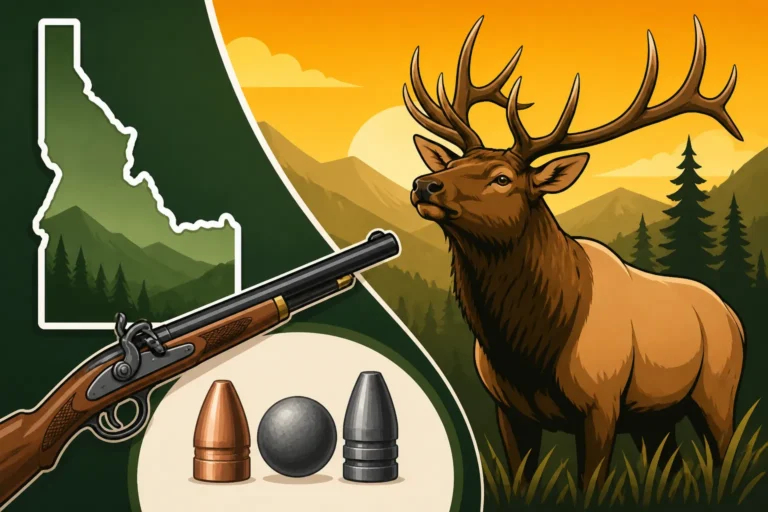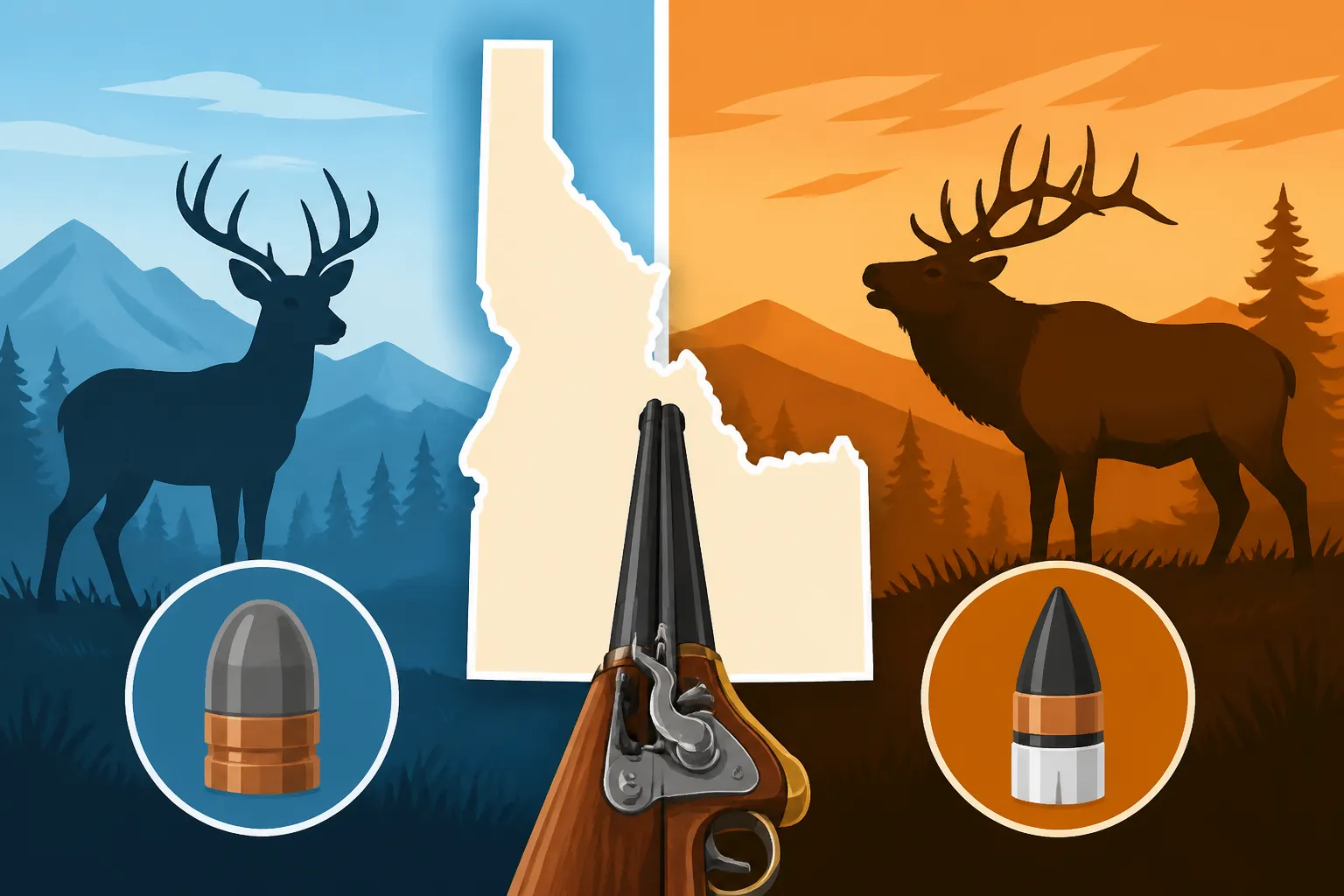
Why Idaho Splits Muzzleloader Caliber by Species
Trying to figure out Idaho's muzzleloader regulations can feel like navigating a dense thicket without a compass, especially when it comes to caliber minimums. It's not always a one-size-fits-all situation, and the rules differ depending on what magnificent animal you're pursuing. This guide is here to clear the air, explaining not just what the minimum muzzleloader calibers are for various big game species in Idaho, but more importantly, why these distinctions exist, helping you understand the logic behind the regulations and ensure an ethical, successful hunt.
Understanding Idaho's Muzzleloader Philosophy
The Idaho Department of Fish and Game (IDFG) doesn't just pull regulations out of a hat; there's a deep-seated philosophy behind every rule, especially concerning ethical hunting. When it comes to muzzleloaders, this philosophy centers on ensuring that hunters use equipment capable of dispatching game quickly and humanely. It’s about more than just making a big boom; it's about delivering enough energy and creating a sufficient wound channel to ensure a swift, clean harvest.
The Core Principle of Ethical Harvest
At the heart of Idaho's hunting regulations, and specifically its muzzleloader rules, is the unwavering commitment to an ethical harvest. This means that when you pull the trigger, the projectile you send downrange must have a high probability of causing a quick, humane death. Nobody wants to wound an animal and have it suffer or escape, only to be lost. The IDFG's mandate is to manage wildlife resources responsibly, and a significant part of that is promoting hunting practices that minimize suffering.
This isn't just about hunter preference; it's a legal and moral obligation. The chosen caliber, projectile type, and powder charge all contribute to the effectiveness of your shot. A smaller, lighter projectile might be perfectly adequate for a smaller animal, but for a larger, tougher species, it could easily fail to penetrate vital organs or deliver sufficient shock, leading to a prolonged and painful demise. Idaho's regulations are designed to preemptively address this, ensuring that hunters are equipped with a minimum standard of power for the game they pursue.
Balancing Tradition with Modern Performance
Muzzleloading is, for many, a deeply traditional pursuit, connecting hunters to the historical roots of the sport. There's a certain romance in loading powder and ball, taking a single shot, and experiencing the hunt in a way that feels timeless. Idaho Fish and Game certainly recognizes and values this tradition. However, the world of muzzleloaders has also evolved significantly, with modern in-line rifles, saboted bullets, and advanced propellants offering performance that rivals, and sometimes exceeds, traditional firearms.
The challenge for regulators is to maintain the spirit of muzzleloading — often associated with shorter ranges and a greater emphasis on stalking — while also acknowledging the enhanced capabilities of contemporary equipment. The caliber requirements reflect an effort to ensure that even with these advancements, the fundamental principle of ethical harvest remains paramount. They seek to balance the desire to preserve the traditional aspects of muzzleloader hunting with the practical reality of ensuring effective, humane kills in the field, leveraging the best of both worlds without compromising either. This balance is key to understanding why certain rules exist, like why Idaho Muzzleloader-Only Hunts Ban Scopes and Inline Ignition, while general seasons might be more lenient.
Specific Caliber Requirements and Why They Exist
Idaho’s regulations are quite clear on the minimum muzzleloader calibers required for different big game species. These aren't arbitrary numbers; they're based on scientific understanding of animal anatomy, bullet ballistics, and the necessary energy transfer to achieve a clean kill. Let's break down the specifics.
The .45 Caliber Minimum for Deer
For deer hunters in Idaho, the minimum legal muzzleloader caliber is .45. This applies to both mule deer and whitetail deer, which are commonly found across different regions of the state. The choice of .45 caliber as a minimum is well-founded when you consider the size and physical characteristics of deer.
Deer, while robust, are generally much smaller and lighter-boned than their elk cousins. A .45 caliber projectile, whether it's a patched round ball, a conical bullet, or a saboted bullet, when propelled by an appropriate powder charge, generates sufficient kinetic energy and momentum to penetrate the vital organs of a deer. The larger diameter and mass of a .45 caliber projectile create a wound channel that is adequate for rapid blood loss and organ damage, leading to a quick and humane harvest. Think about the typical shot: a broadside hit through the lungs or heart. A .45 caliber, with proper bullet construction designed for expansion and weight retention, is more than capable of reaching and destroying these critical areas. When considering your options, it's always good to understand the Minimum Muzzleloader Caliber for Idaho Deer and ensure your setup meets these requirements.
Stepping Up to .50 Caliber for Elk
When you turn your attention to elk, Idaho's minimum muzzleloader caliber requirement jumps to .50. This increase isn't just for show; it’s a critical distinction driven by the sheer size, robust bone structure, and formidable muscle and hide of an elk. An adult bull elk can weigh upwards of 700 to 1,000 pounds, and even cows are significantly larger than any deer species. Their bone structure, particularly the shoulder blade, is dense and can easily stop or deflect a lighter, smaller projectile.
A .50 caliber muzzleloader delivers a substantially greater amount of kinetic energy and momentum compared to a .45. This extra power is essential for deep penetration through thick muscle and potentially heavy bone, ensuring the projectile reaches the vitals and creates a devastating wound channel. An elk's lungs and heart are larger and more protected than a deer's, requiring a projectile with sufficient mass and diameter to cause extensive damage quickly. Failing to use an adequate caliber could result in a superficial wound, a lost animal, and an unethical outcome. Therefore, the .50 caliber minimum is a non-negotiable standard for ethical elk hunting in Idaho, ensuring hunters have the necessary tool for the job. You can find more details on this, including the specific Idaho Muzzleloader Caliber Minimums: .45 for Deer, .50 for Elk.
Larger Bores for Moose, Bighorn Sheep, and Mountain Goat
While Idaho’s regulations specifically state .50 caliber as the minimum for elk, this minimum effectively extends to other larger, tougher big game species like moose, bighorn sheep, and mountain goat. Though there isn't a separate, higher numerical minimum explicitly listed above .50 for these species, the underlying principle remains: use a projectile of sufficient power to ensure a clean kill. The .50 caliber, with a well-constructed bullet, is generally considered the appropriate ethical minimum for these formidable animals as well.
Moose, for instance, are the largest members of the deer family, often weighing well over a thousand pounds with extremely thick hide, dense bones, and massive musculature. Bighorn sheep and mountain goats, while not as heavy as elk or moose, possess incredibly robust frames and are often found in extremely rugged terrain where tracking a wounded animal is incredibly difficult, if not impossible. The need for maximum penetration and energy transfer is paramount for these species. While a .50 caliber is the legal minimum, many experienced hunters targeting these species might even opt for heavier .50 caliber projectiles or consider even larger calibers if available and practical for their specific muzzleloader setup, prioritizing terminal performance above all else. Understanding Why Moose and Sheep Need a Larger Bore truly underscores this point, even if the legal requirement doesn't numerically increase beyond .50 for elk.
The Science Behind Caliber and Knockdown Power
It might sound like a lot of technical jargon, but there's solid science behind why specific calibers are recommended or mandated for different game. It all boils down to how a projectile interacts with an animal's body to cause a quick, humane death. When we talk about "knockdown power," we're really discussing kinetic energy, momentum, and the resulting wound ballistics.
Kinetic Energy and Momentum Explained
Let's break down the physics without needing a whiteboard and a calculus textbook. When a bullet leaves the muzzle of your muzzleloader, it possesses two key physical properties: kinetic energy and momentum.
Kinetic Energy is essentially the energy of motion. The faster and heavier your projectile, the more kinetic energy it carries. Think of it like a hammer striking a nail: a heavier hammer swung faster will drive the nail deeper. In hunting, kinetic energy is crucial for transferring a tremendous amount of force to the target, causing tissue damage and, ideally, hydrostatic shock that rapidly incapacitates the animal. A .50 caliber bullet designed for elk will carry significantly more kinetic energy at typical hunting ranges than a .45 caliber, giving it the raw power needed to break through dense bone and muscle.
Momentum is a measure of an object's mass in motion. Unlike kinetic energy, momentum is more about the ability of a projectile to maintain its path and push through resistance. A heavier, slower bullet can actually have greater momentum than a lighter, faster one, giving it excellent penetration capabilities, especially at closer ranges. For a big animal like an elk, momentum helps the bullet push through layers of hide, fat, muscle, and bone to reach the vital organs. It's the "steamroller" effect, maintaining its forward drive even when encountering tough obstacles. Both kinetic energy and momentum work hand-in-hand to ensure a projectile can effectively and ethically dispatch game.
Penetration and Hydrostatic Shock
Beyond the raw numbers of energy and momentum, what really matters on the receiving end is how the projectile performs inside the animal. This is where penetration and hydrostatic shock come into play, forming the core of what we call terminal ballistics.
Penetration is arguably the most critical factor for a clean kill. For a bullet to be effective, it must penetrate deep enough to reach and damage the central nervous system (brain, spine) or major organs (heart, lungs). A bullet that fails to penetrate adequately, getting stuck in non-vital muscle or bone, results in a wounded animal that can escape and suffer. Larger calibers, especially those with good bullet construction, are designed to penetrate deeply, often expanding to create a larger wound channel while retaining enough weight to push through to the far side of the animal or exit, ensuring maximum damage. This is why for species like elk, where vitals are deep within a large body cavity protected by tough musculature and bone, that increased caliber and bullet mass are absolutely essential.
Hydrostatic Shock is a secondary, but still significant, effect, particularly with high-velocity projectiles. When a bullet passes through tissue, especially fluid-filled tissue like organs, it creates a temporary cavity far larger than the bullet's actual diameter. This rapid expansion and contraction of tissue creates a shockwave that can temporarily (or sometimes permanently) incapacitate the nervous system, leading to a much faster collapse even if the primary wound isn't immediately fatal. While muzzleloaders typically operate at lower velocities than modern centerfire rifles, well-designed muzzleloader bullets can still create a substantial hydrostatic effect, especially if they are designed for rapid expansion upon impact. Together, superior penetration to reach vitals and the concussive effect of hydrostatic shock contribute to the rapid and ethical dispatch of big game.
Practical Implications for Hunters
Understanding the "why" behind Idaho's muzzleloader caliber regulations is one thing, but putting that knowledge into practice is what truly matters in the field. It affects everything from the gear you choose to how you prepare for your hunt.
Choosing the Right Muzzleloader and Projectile
Once you understand Idaho's caliber requirements, your gear choices become much clearer. If you're primarily hunting deer, a .45 caliber muzzleloader is perfectly adequate, but if there's any chance you'll be pursuing elk or other larger species, opting for a .50 caliber from the outset makes the most sense. Many hunters choose a .50 caliber as a versatile option that meets both the deer and elk minimums, allowing them to participate in a wider range of hunts without needing multiple firearms.
Beyond the caliber itself, the choice of projectile is paramount. Modern muzzleloader bullets come in a dizzying array of types:
- Saboted bullets: These consist of a smaller caliber bullet (e.g., .45 or .40 caliber) encased in a plastic sabot that allows it to be fired through a larger bore (e.g., .50 caliber). They often offer superior ballistic coefficients and accuracy, mimicking centerfire rifle performance. Brands like Hornady's SST or Federal's B.O.R. Lock MZ are popular choices for their accuracy and terminal performance.
- Full-bore conical bullets: These are typically heavy lead or copper bullets that match the bore diameter, like a .50 caliber conical in a .50 caliber rifle. They tend to be very heavy, offering excellent momentum and penetration, especially in traditional setups.
- Patched round balls: The most traditional option, a lead ball wrapped in a lubricated cloth patch. While effective for deer at close ranges, they offer less kinetic energy and penetration than modern bullets, making them less suitable for elk or longer shots.
When selecting your projectile, always prioritize those designed for big game, ensuring they will expand reliably without fragmenting and retain enough weight for deep penetration. Testing different bullet and powder combinations with your specific muzzleloader is crucial to find the most accurate and effective load for your hunt. Remember that The Effective Range of a Muzzleloader on Elk will also depend heavily on your projectile choice and how well your rifle shoots it.
Ethical Considerations Beyond the Minimums
Idaho's caliber minimums are exactly that: minimums. They represent the bare legal threshold for an ethical harvest. However, a truly ethical hunter always strives to exceed the minimums and ensure the highest probability of a clean kill. This means taking personal responsibility that goes beyond simply meeting the letter of the law.
First and foremost, it means knowing your limitations. This applies to both your personal shooting skills and the effective range of your specific muzzleloader setup. Just because a muzzleloader can shoot out to 200 yards doesn't mean you should take that shot if you haven't practiced consistently and reliably at that distance. Practice extensively from various field positions, in varying weather conditions, to understand your maximum ethical range. This also involves understanding bullet drop and wind drift.
Secondly, shot placement is critical. Even with the largest legal caliber, a poorly placed shot will result in a wounded animal. Take the time to study animal anatomy, understand where the vital organs are, and commit to only taking high-percentage shots. Patience in the field, waiting for the animal to present a clean, broadside shot, is often the most important factor in a successful and ethical hunt. Remember, you might use a Muzzleloader in Any-Weapon Season, but the ethical considerations of shot placement remain paramount.
Finally, understanding regulations beyond just caliber is important. For instance, knowing When No Muzzleloader Validation Is Needed versus when it is, or what constitutes legal sights in muzzleloader-only seasons (like avoiding scopes), ensures you're always hunting within the rules. These additional layers of regulation contribute to the overall management strategy and the specific experiences intended for different hunt types.
Navigating Idaho's Regulations and Resources
Staying informed about Idaho's hunting regulations is an ongoing process, as rules can change from year to year. The Idaho Fish and Game website is your primary and most authoritative source for the current regulations. They publish detailed hunting regulations booklets annually, which are available both online and at license vendors.
Beyond just reading the regulations, utilizing the IDFG's online tools can significantly aid in your planning. The Idaho Hunt Planner is an invaluable resource, allowing you to research specific units, check drawing odds, view harvest statistics, and overlay public land boundaries. It can help you identify areas where your chosen muzzleloader might be most effective based on terrain and typical shot distances.
For a deeper dive into unit research, many hunters turn to mapping and data platforms like GoHunt. These services often provide highly detailed maps, public land ownership overlays, and data analytics that can help you scout units virtually, assess access points, and understand the historical success rates for specific areas. Tools like these, combined with the official IDFG resources, empower you to make informed decisions about where and how to hunt, ensuring you're compliant with regulations and set up for success. Taking A Walkthrough of the Idaho Hunt Planner can reveal just how powerful these tools are for planning.
Summary of Idaho Muzzleloader Caliber Minimums
To help clarify the requirements at a glance, here’s a table summarizing Idaho's minimum muzzleloader caliber rules for its most popular big game species:
| Species | Minimum Muzzleloader Caliber | Rationale |
|---|---|---|
| Deer (Mule, Whitetail) | .45 caliber | Sufficient kinetic energy and wound channel for smaller body mass and less dense bone structure. |
| Elk | .50 caliber | Increased kinetic energy and momentum needed for deeper penetration through larger body mass, tougher hide, and denser bone. |
| Moose | .50 caliber | Required for the largest North American deer species, ensuring adequate penetration and ethical harvest. |
| Bighorn Sheep | .50 caliber | Robust bone structure and remote, rugged habitat necessitate a powerful, reliable projectile. |
| Mountain Goat | .50 caliber | Similar to bighorn sheep; ethical harvest in challenging terrain requires high terminal performance. |
This table serves as a quick reference, but always remember to consult the most current Idaho Fish and Game regulations for the definitive rules before your hunt.
Disclaimer
Please remember that hunting regulations, including caliber requirements, can change. This guide is intended for informational purposes based on current knowledge. Always consult the official Idaho Department of Fish and Game regulations booklet or website for the most accurate and up-to-date information before planning and executing your hunt. It is the hunter's responsibility to know and follow all applicable laws and regulations.