The Effective Range of a Muzzleloader on Elk
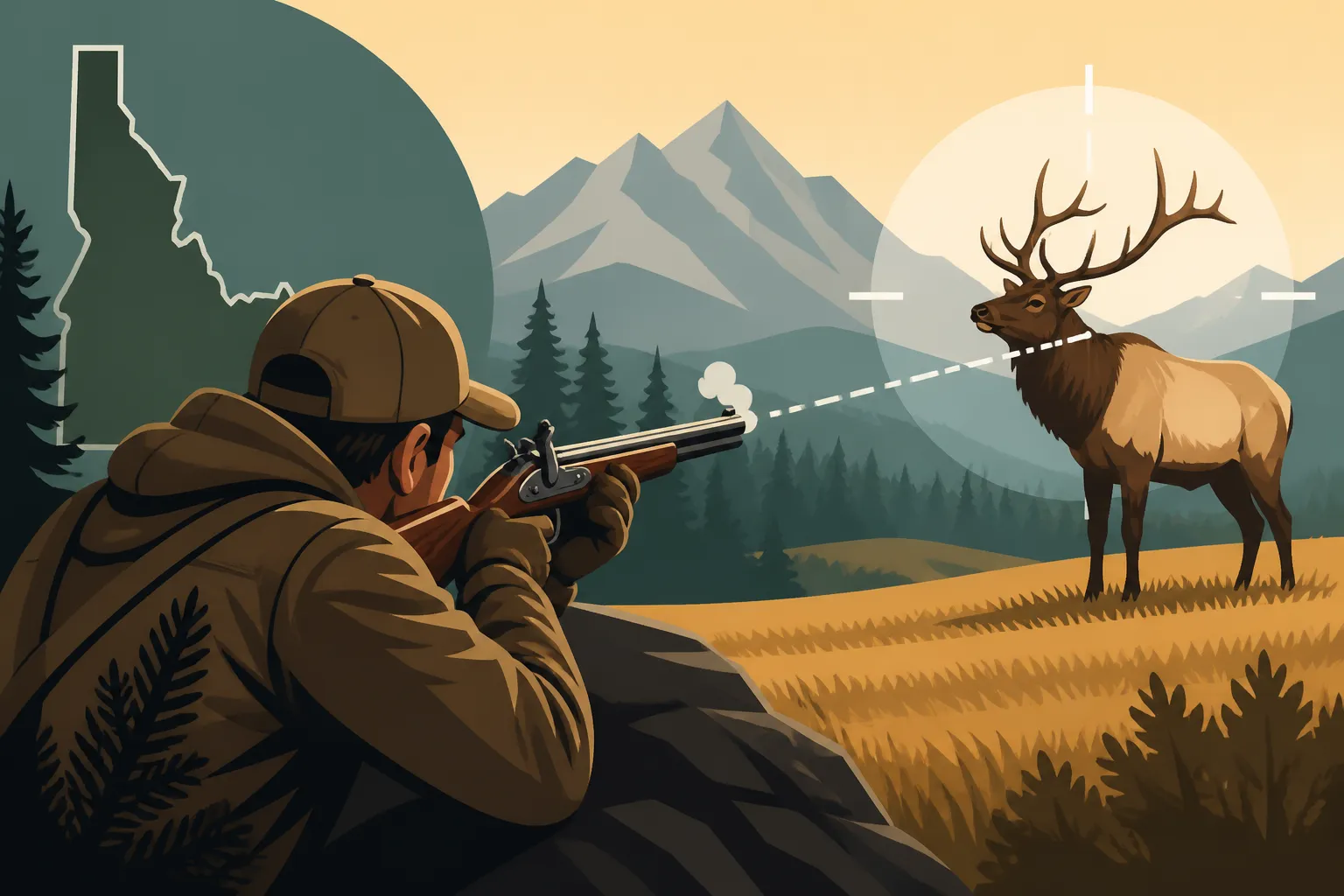
One of the biggest anxieties I hear from hunters diving into the world of muzzleloading, especially for a tough animal like an Idaho elk, is figuring out just how far they can really shoot effectively. It’s not like picking up a modern centerfire rifle where a 300-yard shot, with practice, is fairly common. Muzzleloaders, with their unique ballistics and traditional loading methods, demand a different kind of respect and a more honest assessment of your personal limitations. This guide is all about helping you understand the true effective range of your muzzleloader for elk, how to determine your personal ethical limits, and tactics to ensure you’re always within that responsible distance when a big bull steps out.
Understanding Muzzleloader Limitations for Elk
Let’s be real for a moment. Muzzleloaders, while incredibly effective tools when used correctly, are not precision long-range instruments by modern rifle standards. Their inherent design means lower velocities, heavier projectiles that lose energy faster, and often less consistent ignition. When you’re hunting something as robust and tough as an elk in Idaho's rugged terrain, understanding these limitations isn't just about making a good shot; it's about making an ethical kill. You owe it to the animal to put it down quickly and humanely, and that starts with knowing what your chosen tool is truly capable of.
Muzzle Velocity and Energy for Elk
The key difference between a muzzleloader and a modern rifle often boils down to muzzle velocity. Black powder or its substitutes produce significantly lower velocities than smokeless powder. This means your projectile starts slower and sheds energy at a much quicker rate. For an elk, you need substantial kinetic energy to penetrate thick hide, muscle, and bone, and to create a wound channel that causes rapid blood loss and organ damage. A .50 caliber muzzleloader, the minimum for elk in Idaho, might launch a 300-grain bullet around 1,800-2,000 feet per second (fps) at the muzzle. Compare that to a .30-06 launching a 180-grain bullet at 2,700-2,800 fps. That difference in initial speed translates directly to a massive difference in retained energy downrange.
At 100 yards, a muzzleloader bullet might retain enough energy for a clean kill, often still exceeding 1,500-2,000 foot-pounds (ft-lbs), which is generally considered sufficient for elk. However, stretch that to 200 yards, and that energy could easily drop below that critical threshold, especially with less aerodynamic projectiles. The bullet slows considerably, making it less effective at pushing through tissue and bone, and reducing the hydrostatic shock needed for a quick incapacitation. This rapid energy decay is why discussions about muzzleloader range often focus on shorter distances than you might expect with a centerfire rifle. You can dive deeper into the specific requirements in Idaho by checking out resources like "Idaho Muzzleloader Caliber Minimums: .45 for Deer, .50 for Elk."
Bullet Selection and Performance
Not all muzzleloader bullets are created equal, especially when it comes to elk. This isn't the time for a light, fast projectile designed for deer. For elk, you need heavy, controlled-expansion bullets that are designed to penetrate deeply and retain a high percentage of their weight. Think about bullets in the 250-400 grain range, ideally with a solid base or bonded construction. Pure lead balls or lighter, rapidly expanding sabots might be devastating on deer at close range, but they can break up or fail to penetrate vital organs consistently on an elk, especially if they hit bone.
Modern muzzleloader bullets from companies like Hornady (SST, ELD-X), Barnes (Spit-Fire T-EZ, MZ Expander), and Traditions (Smackdown XR) offer improved ballistic coefficients and better terminal performance than traditional round balls or soft lead conical bullets. They are designed to expand reliably but not explosively, creating a wide wound channel while driving deep. When you’re considering your effective range, the bullet you choose plays a massive role. A premium bullet designed for large, tough game will extend your ethical range more than a cheap, soft lead option, simply because it will perform better upon impact and deliver more of its energy where it counts.
Factors Influencing Effective Range
Determining the "effective range" of a muzzleloader for elk isn't a single number that applies to everyone. It's a dynamic equation influenced by several critical variables. Ignoring any of these factors can quickly turn an ethical shot into a wounded animal. A hunter's responsibility extends beyond just pulling the trigger; it includes a thorough understanding of their equipment's capabilities and their own skill level under real-world hunting conditions.
Ammunition Type and Powder Charges
The specific combination of powder, projectile, and primer you use significantly impacts your muzzleloader's performance. Different brands and types of black powder substitutes (like Triple Seven, Pyrodex, or Blackhorn 209) have varying burn rates and energy outputs. Blackhorn 209, for example, is known for cleaner burning and higher velocities compared to traditional black powder or Pyrodex, which can give you a bit more reach. However, consistency is king. Using the same batch of powder, measuring charges precisely, and ensuring proper bullet seating are all crucial for accuracy.
The amount of powder also matters. While many hunters gravitate towards "max loads" for increased velocity, sometimes a slightly reduced, more consistent load can lead to better accuracy, which is always more important than raw speed. It's a delicate balance to find the sweet spot where your chosen bullet flies consistently and retains enough energy for elk. Experimentation on the range with different powder charges and bullet combinations is absolutely essential. Your muzzleloader's performance with a 90-grain load of Triple Seven and a 300-grain conical will be vastly different than with a 110-grain load of Blackhorn 209 and a 250-grain sabot. These choices directly dictate your maximum effective distance.
Hunter Skill and Practice
This is arguably the most significant factor. Your muzzleloader is only as accurate as you are. A 3-inch group at 100 yards from a bench rest means nothing if you can't replicate that accuracy from a kneeling position, with your heart pounding, in cold, windy conditions. Consistent practice, shooting from various field positions (off a bipod, shooting sticks, backpack, or freehand), and under different pressures, is non-negotiable. Many hunters overestimate their ability to make a precise shot under duress.
An ethical elk hunter using a muzzleloader needs to be able to place a shot reliably within a 6-8 inch vitals zone at their maximum intended range. This often means consistently shooting 3-4 inch groups at that distance or better, giving you a margin for error. If you're consistently putting all your shots into a 6-inch circle at 100 yards, then 100 yards might be your maximum. If you can only keep them in a 10-inch circle, then you need to shorten that distance significantly or put in more range time. Don't forget that using open and peep sights only in muzzleloader-only hunts also adds to the challenge, making precise aiming harder than with modern optics. This makes consistent practice even more vital.
Environmental Conditions
Hunting in Idaho often means dealing with unpredictable weather and challenging terrain. Wind, rain, snow, and even temperature can affect a muzzleloader's performance and a hunter's ability to shoot accurately. Wind drift becomes much more pronounced with slower-moving muzzleloader projectiles. A 10-20 mph crosswind can push a bullet several inches off target at 100-150 yards, turning a kill shot into a painful miss or worse. Knowing "Reading Wind in Steep Timbered Country" is crucial.
Rain or snow can affect powder ignition, especially in traditional setups, and can obscure sights. Extreme cold can sometimes slightly reduce muzzle velocities. Beyond the direct ballistic effects, environmental conditions impact you. Cold hands, shivering, poor visibility, or unstable footing on a steep hillside all make accurate shooting more difficult. Your effective range on a calm, sunny day at the range will almost certainly be longer than your effective range on a blustery, snowy day in the timber. Always factor in these real-world challenges when you’re assessing a shot opportunity in the field.
Setting Your Personal Ethical Range
Forget what a manufacturer's box or a forum post claims about a muzzleloader's maximum range. Your personal ethical range is yours alone to determine. It's the maximum distance at which you can consistently and confidently make a humane kill shot on an elk, taking into account all the variables we just discussed. This isn't about bragging rights; it's about responsibility and respect for the animal. Pushing beyond your true capabilities, even by a few yards, can have devastating consequences.
Consistent Accuracy on the Range
The firing range is where the rubber meets the road. Before you even think about elk, you need to establish a baseline of consistent accuracy with your muzzleloader. Start close, at 50 yards, to ensure your rifle is sighted in and you're comfortable with its operation. Once you're consistently punching tight groups there, move back to 100 yards, then 125, 150, and maybe 200 yards. The goal isn't just to hit the target, but to consistently place your shots into a target area representing an elk's vitals (roughly an 8-inch circle).
I always suggest practicing from field positions, not just a bench. Kneeling, sitting, standing, even shooting off your backpack—simulate actual hunting scenarios. Pay attention to how many shots it takes to achieve that consistent grouping, and consider the time it takes to reload and fire subsequent shots, as this is a crucial factor with a muzzleloader. This is also a good time to track your bullet drop. Knowing your holdovers at various distances is paramount. Many hunters use ballistic apps or tables generated after thorough range testing to help with this. Programs like GoHunt's mapping tools can help you visualize distances and terrain where you might encounter an elk, allowing you to practice for specific scenarios.
Shot Placement on Elk
Understanding elk anatomy is critical. Their vital zone isn't huge, and it shifts depending on their angle to you. A broadside shot presents the largest target for the lungs and heart. An angling shot requires a precise understanding of where the bullet needs to enter to reach those same organs. A common mistake is aiming too high, especially when an elk is broadside, leading to hits above the spine or through the shoulder blade, which can be devastating but often not immediately fatal.
For an ethical kill, you're aiming for the heart and lungs. The heart sits low in the chest, just behind the front leg. The lungs fill most of the chest cavity above and behind the heart. This vital area, when an elk is broadside, is roughly an 8-inch circle. If you can consistently put your shots into that 8-inch circle on the range at a certain distance, that's a strong indicator of your maximum ethical range. If your groups open up beyond that, you need to shorten your effective distance. Remember, a wounded elk is a tragedy no hunter wants to create, and with a muzzleloader's single-shot limitation, that first shot must count.
The "Hunting Scenario" Test
This is where you bridge the gap between range practice and real hunting. Imagine an elk appearing at 120 yards. You're cold, maybe slightly winded from a stalk, and your heart is thumping. Could you make that shot? The "Hunting Scenario" test involves simulating these conditions. Try shooting after a brisk walk, or when you're slightly elevated. Use the same gear you'd have in the field, including your backpack, shooting sticks, or other aids.
A great exercise is to set up a life-sized elk target or a large piece of cardboard with the vitals outlined. Practice getting into shooting position quickly, ranging the target, and making the shot as if it were a real animal. Pay attention to how long it takes you to settle in and achieve a stable shooting platform. This will help you understand if you can perform under pressure. If you can consistently make clean, ethical shots under these simulated conditions at 120 yards, that might be your limit. If you struggle, consider reducing that distance to 100 yards or even less. It's always better to limit your shots to what you know you can accomplish, rather than what you hope you can.
| Range (Yards) | Typical Muzzle Velocity (fps) | Retained Energy (ft-lbs) | Trajectory Drop (inches) | Wind Drift (10mph) (inches) | Recommendation for Elk |
|---|---|---|---|---|---|
| 50 | 1850 | 2200 | 0.5 | 1 | Excellent |
| 75 | 1750 | 1950 | 1.5 | 2.5 | Very Good |
| 100 | 1650 | 1700 | 4 | 4.5 | Good, with practice |
| 125 | 1550 | 1450 | 7.5 | 7 | Cautious, high skill |
| 150 | 1450 | 1250 | 12 | 10 | Extreme caution, elite skill |
| 200 | 1250 | 950 | 22 | 18 | Not recommended for most |
Note: Velocities, energy, and trajectory are approximate for a .50 caliber, 300-grain sabot/conical with 100 grains of Blackhorn 209, sighted in at 100 yards. Actual results vary based on specific components, rifle, and conditions.
Tactics for Closing the Distance with a Muzzleloader
Since your effective range with a muzzleloader for elk is likely to be considerably shorter than with a high-powered rifle, your hunting tactics need to adapt. This isn't a long-range glassing and ambush game. This is about getting close, just like a bowhunter, using the terrain, your knowledge, and your skills to reduce the distance between you and the elk. Embracing this challenge is part of the allure of muzzleloader hunting.
Scouting and Terrain Knowledge
Successful muzzleloader hunting for elk often begins long before the season opens. Thorough scouting, both in person and with digital tools, is crucial. You need to identify key areas where elk will be during your hunt, considering their feeding, bedding, and watering patterns. Look for choke points, saddles, benches, and thick timbered areas where elk frequently travel. Understanding the terrain allows you to plan effective stalks and determine likely ambush points that keep shots within your ethical range.
Tools like GoHunt's online mapping platform, alongside traditional topographical maps, can be invaluable for e-scouting. They help you pinpoint potential elk habitat, identify natural funnels, and assess public land access. Knowing the lay of the land, including "Reading an Elk Zone Boundary on a Map," will help you predict elk movement and position yourself for a close-range encounter. Focus on areas with varied terrain, good cover, and plenty of feed and water, as these are the places elk are most likely to linger, giving you a chance to close the distance.
Calling and Decoying Strategies
One of the most exciting and effective ways to bring elk into muzzleloader range is through calling. Whether it's the bugle of a bull in the rut or the soft cow calls meant to entice, good calling can draw an elk right to you. This is especially potent during the peak of the rut when bulls are more aggressive and cows are more responsive. Understanding "Bugle and Cow Call Timing Through September" is key to maximizing your success.
Often, a two-person calling setup works best: one caller stays back, drawing the elk's attention, while the shooter positions themselves 50-75 yards ahead, ready for the shot. Decoys, particularly cow decoys, can also be very effective, giving an approaching bull something to focus on other than you. However, remember to always have a clear shooting lane and be ready. Elk can cover ground incredibly fast, and what starts as a distant bugle can turn into a 60-yard shot opportunity in minutes.
Patience and Persistence
Muzzleloader hunting for elk is a game of patience. You simply cannot force a long shot, so you often have to wait for the animal to present a closer, ethical opportunity. This might mean spending hours still-hunting through thick timber, slowly moving from cover to cover, or waiting patiently on a game trail that you've scouted. It means being willing to pass on a marginal shot at 150 yards in hopes of getting a 70-yard chip shot.
Persistence is also vital. You might blow a stalk, spook an elk, or simply not find them where you expected. The muzzleloader hunter needs to be tenacious, constantly adapting, and willing to put in the effort required to get those close encounters. This often involves more walking, more sneaking, and more time in the field. When you're "Packing an Elk Out of Steep Country Alone," you'll appreciate the effort you put in to ensure a quick, clean kill in the first place. This dedication, coupled with a deep understanding of your muzzleloader's capabilities, is what leads to consistent success in the challenging world of Idaho muzzleloader elk hunting.
Conclusion
Hunting Idaho elk with a muzzleloader is a unique and rewarding challenge. It forces you to become a better, more patient, and more skilled hunter, emphasizing tracking, stalking, and calling over raw ballistic power. The key to ethical and successful muzzleloader hunting lies in a deep understanding of your equipment's limitations and, more importantly, your own. Take the time on the range to truly know your effective range, practice under simulated hunting conditions, and always prioritize a humane shot over any desire for a long one. Respect the animal, respect the weapon, and you'll find immense satisfaction in bringing home an Idaho elk with your smoke pole.
Disclaimer
The information provided in this guide is for general informational purposes only and does not constitute legal advice. Hunting regulations and laws can change frequently. It is the responsibility of the hunter to always consult the most current Idaho Fish and Game regulations and any applicable federal laws before engaging in any hunting activity. Failure to do so could result in penalties. Always prioritize safety and ethical hunting practices.