Playing Wind Direction on a Timbered Stalk
There are few things more frustrating for an Idaho hunter than getting within striking distance of a magnificent bull or a cunning mule deer buck, only for an unpredictable gust of wind to betray your presence, sending your quarry crashing through the timber. That sudden shift, the swirling eddy in a draw, or the unexpected downdraft can turn a perfectly executed stalk into a heartbreaking bust in mere seconds. This guide is all about confronting that relentless challenge head-on, helping you understand, predict, and ultimately use the wind to your advantage when stalking through Idaho's dense timber and rugged terrain.
The Unpredictable Nature of Wind in Timbered Terrain
When you're out in the wide-open sagebrush flats, judging the wind can feel relatively straightforward. You see the grass ripple, a dust devil might spin, and your trusty wind checker shows a consistent direction. But step into a stand of Idaho's thick timber, especially in steep country, and all bets are off. The wind becomes a swirling, chaotic beast, influenced by everything from topography to temperature.
How Thermals Impact Air Movement
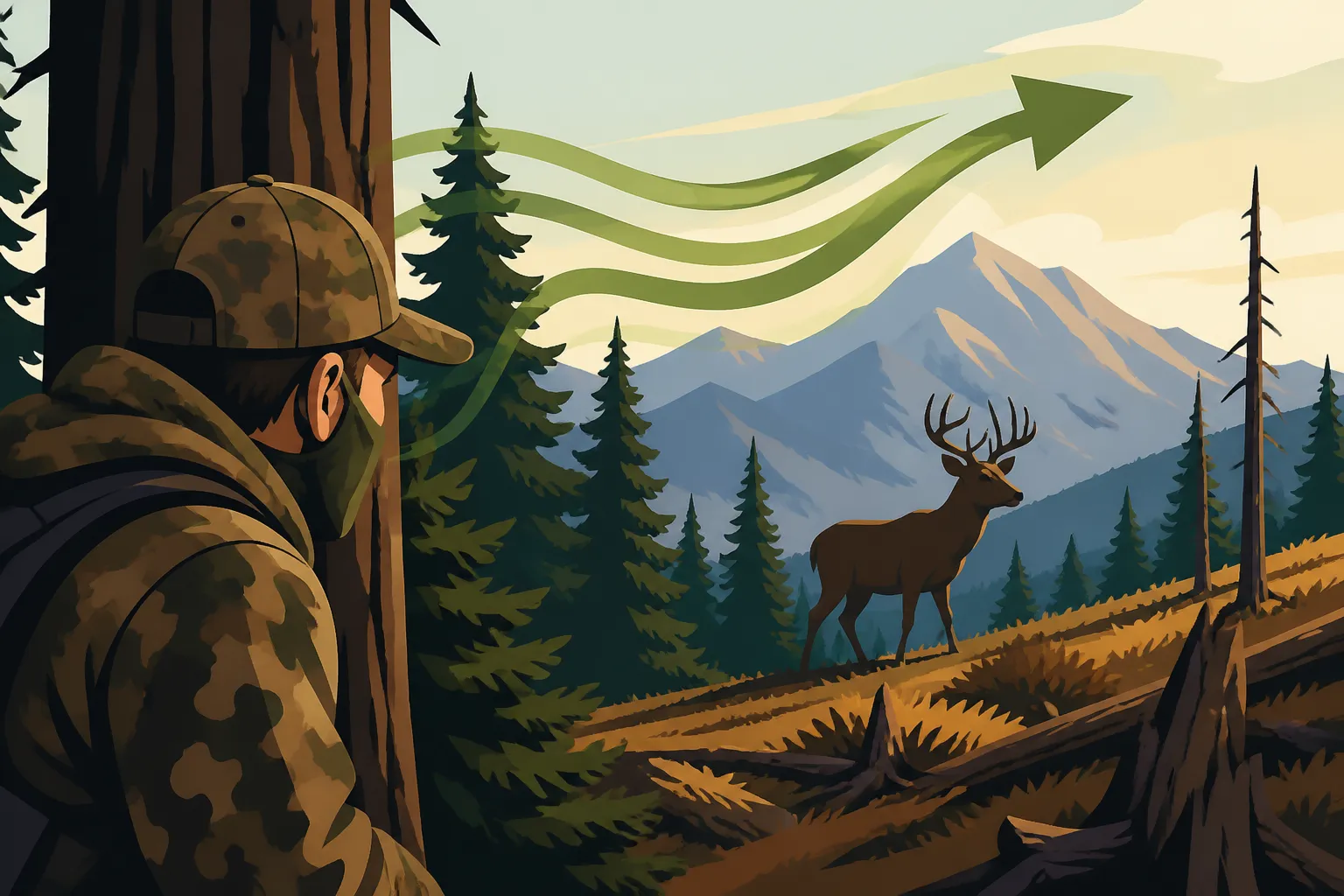
Thermals are one of the most significant factors influencing wind direction, particularly in mountainous or hilly timbered country. Imagine the sun hitting a south-facing slope in the morning. As the ground warms up, that warmer air begins to rise, creating an updraft. This rising warm air creates a vacuum, pulling cooler, denser air from lower elevations and shaded areas upwards. This is your morning thermal, often pushing scent up the mountain. As the sun begins to set and the ground cools, the process reverses. The cooler air, being denser, starts to sink, creating a downdraft that pulls scent down the mountain into the valleys and draws.
Understanding this daily cycle is crucial. If you're planning an evening stalk on a bedding area high on a ridge, you might assume the wind will carry your scent upwards, but as the day progresses and the thermals switch, your scent could suddenly plummet right into their lap. Many experienced hunters will adjust their approach drastically depending on the time of day, sometimes waiting hours for the thermals to stabilize or switch entirely. This isn't just theory; it's the invisible hand guiding game movement and your best chance at success.
The Swirling Chaos of Canyons and Draws
Deep canyons, draws, and steep drainages act like funnels and mixing bowls for air currents. What might appear as a steady breeze on the ridgetop can become a bewildering, multi-directional swirl once you drop into a timbered drainage. The sun might hit one side of a canyon while the other remains in deep shadow, creating localized thermal activity that pulls air in unexpected directions. Add a stream or creek to the mix, and you introduce another element of colder, denser air that can sink and run along the watercourse, creating its own micro-wind highway.
This is where the term "canyon swirl" comes from, and it's a frustration many hunters know all too well. You can be glassing a beautiful basin without missing bucks, see a deer bedded, and meticulously plan your approach, only to have a rogue gust betray you. It's not uncommon to see your wind checker puff in three different directions within a single minute in these spots. This complexity often means that a direct approach downwind might be impossible or too risky. Instead, you might need to use a much longer, circuitous route, often sticking to ridge lines or benches that offer more predictable airflow. For a deeper dive into these environmental nuances, you might find "Reading Wind in Steep Timbered Country" particularly insightful.
Microcurrents and Localized Eddies
Beyond the grander effects of thermals and canyon swirls, timbered terrain is also rife with microcurrents and localized eddies. Imagine standing in a thick patch of conifers. The wind might hit the treeline, then instead of pushing straight through, it could get deflected, swirling around the dense trunks, creating small pockets where the air actually moves in the opposite direction. A single large boulder, a fallen log, or even a dense clump of brush can create a localized eddy that pulls or pushes air in unexpected ways over just a few feet.
These small-scale phenomena are almost impossible to predict perfectly. They are the subtle, sneaky culprits that can bust a careful stalk even when the general wind direction seems favorable. This is why constant vigilance is key. It's not enough to check the wind once; you need to be doing it almost every step of the way, especially as you close the distance on an animal. Your wind checker should be your most used tool after your binoculars in these situations.
Mastering Your Wind Strategy on the Stalk
Understanding how wind behaves is one thing; effectively incorporating that knowledge into your stalking strategy is another. It requires a blend of constant observation, meticulous planning, and the patience to adapt.
Using Visual and Scent Indicators
Before you even take your first step on a stalk, you should be a detective, constantly reading the environment for wind clues. Visually, look for subtle movements: the rustle of leaves, the sway of tall grass blades, or the direction smoke from a distant fire might be drifting (though that's often less reliable in microclimates). Even spider webs shimmering in the light can offer hints. If you're near water, look at ripples or how debris floats.
However, the most direct and crucial indicator for a hunter is a good wind checker. These can range from simple squeeze bottles of unscented powder to small, battery-operated devices that puff out a continuous stream of vapor. Use it constantly. Every few steps, give it a puff. Before you peer around a tree, puff it. Before you crest a rise, puff it. Don't just check at eye level; sometimes, low-lying brush will show a different direction than the air 10 feet up. This constant feedback loop helps you stay ahead of those insidious microcurrents. Alongside this, strong scent control measures are paramount. While a perfect downwind approach is the goal, residual scent on clothing or gear can still be carried by even the slightest unfavorable breeze.
The Art of the Slow and Deliberate Approach
Stalking in timber, especially when trying to manage variable wind, is a test of patience. The phrase "still hunting" takes on new meaning here. You're not just moving slowly; you're moving with intent, reading the terrain, listening, and constantly checking the wind. A good rule of thumb is to take one step, pause for 30-60 seconds, check the wind, scan, listen, then take another step. This allows time for the wind to reveal itself, for you to identify any hidden obstacles, and for the woods to settle back down after your movement.
When planning your movement, prioritize an approach that keeps the wind in your favor as long as possible. If the thermals are moving uphill in the morning, plan to approach from below or parallel to the animal. If it's evening and they're moving downhill, come in from above. Sometimes this means taking a much longer, less direct route around a ridge or through a different drainage to maintain a favorable wind. This deliberate pace also gives you time to identify potential escape routes for the animal and ensures you're ready to freeze if they suddenly look your way. For bowhunters, this slow approach is critical to get within ethical range, often closer than you think, as detailed in "How Close a Bowhunter Needs to Get on Elk."
Planning Your Route Based on Anticipated Wind Shifts
Effective wind management isn't just reactive; it's proactive. Before you even commit to a stalk, spend time analyzing the terrain and considering how the wind might behave throughout the day. Using mapping tools like GoHunt, or even detailed topographic maps, you can identify saddles, draws, benches, and ridge lines that might channel or disrupt airflow. You might even consider scouting a unit from satellite imagery before your hunt to pre-plan these approaches.
Think about the sun's path and how it will warm or cool different slopes, influencing thermal activity. If you're stalking a bedded animal in a draw, consider an approach that allows you to stay on a side where the wind is most likely to blow your scent away from the animal, even if it's not perfectly in your face. Sometimes this means sacrificing a bit of cover for a better wind advantage. Have a primary route and at least one backup, especially if you anticipate a thermal switch or unpredictable gusts. Remember, the goal is to consistently keep your scent cone away from the animal's nose, even if the wind is swirling or shifting slightly. This foresight can make all the difference between a successful harvest and going home empty-handed.
When the Wind Turns Against You
Let's be realistic: even the most meticulous planning and constant vigilance won't guarantee perfect wind. Idaho's mountains have a mind of their own, and sometimes, despite your best efforts, the wind will simply turn on you. Knowing what to do in these scenarios is just as important as knowing how to stalk with good wind.
Recognizing a Bad Wind Scenario
The moment your wind checker shows your scent blowing directly towards where you believe the animal to be, you're in a bad wind scenario. It’s not just about a full-on swirl; even a slight quartering wind towards the animal's probable location is a red flag. Pay attention to how the animal is behaving, if you can see it. Is it suddenly alert? Head up? Ears twitching? While this could be due to many factors, a sudden change in wind direction is often the primary culprit.
Another sign of trouble is if you find yourself constantly adjusting your approach, trying to compensate for wildly shifting winds. If you're puffing your wind checker every few steps and getting inconsistent results, especially in varied terrain like a canyon bottom or a thick patch of timber where you're "Still Hunting Timber for Bedded Mule Deer," it's a sign that the wind is simply too unpredictable for a high-percentage stalk. Pushing through in these conditions is often an exercise in futility and frustration.
Adapting Your Stalk or Changing Tactics
When the wind turns sour, you have a few choices, and none of them involve blindly pushing forward. The first option is to freeze and wait. Sometimes, a gust is just that—a gust—and the prevailing wind might return. Give it a few minutes, re-evaluate. If the bad wind persists, your next move might be to reposition. Can you back out quietly and find a new approach from a different direction? Can you gain elevation or drop into a different drainage where the wind might be more stable? This often means taking a much longer detour, but it's better than getting busted.
If repositioning isn't feasible, or the wind is just too erratic, it might be time to change tactics entirely. If you're a bowhunter, perhaps you shift from a stalk to setting up an ambush point if you know the animal's likely travel corridor. If you're rifle hunting, maybe you need to back out and circle to gain a shooting advantage from a different, downwind ridge. In some cases, the best tactic is simply to back off, live to hunt another day, and return when conditions are more favorable. It’s a tough decision, especially when you’ve put in so much effort, but sometimes patience truly is the ultimate virtue. Understanding the "Effective Range of a Muzzleloader on Elk" or any other weapon is critical here, as extending your range might be an option if the wind dictates a longer shot.
The Importance of a Retreat Plan
Just as important as a primary and secondary approach is having a solid retreat plan. What happens if you get busted, or the wind suddenly swirls, and the animal bolts but hasn't pinpointed you? Can you quickly move to a vantage point to see where it goes? Can you melt back into the timber without making more noise, setting up for a potential follow-up later?
A retreat plan also considers what you'll do if the conditions simply become impossible. If the wind goes completely haywire, or a sudden storm rolls in, you need to know how to safely and quietly exit the area without disturbing more game or putting yourself in a bad spot. This involves knowing the terrain, having your map and GPS handy, and being aware of the fastest and quietest routes back to a less pressured area or your camp. Think of it as your "bailout" strategy – it's always good to have, even if you hope you never need to use it. When you're "Packing an Elk Out of Steep Country Alone," you'll appreciate not having to do it from a needlessly difficult position because you pressed too hard against bad wind.
Gear and Modern Tools for Wind Management
While basic woodsmanship and keen observation are your primary tools, modern hunting gear and technology can significantly aid in wind management. These aren't substitutes for skill, but powerful enhancements.
Scent Control and Elimination Systems
Let's be clear: nothing makes you 100% scent-free. But effective scent control can drastically reduce the amount of odor you give off, giving you a wider margin of error when the wind isn't perfect or when a microcurrent decides to betray you. This starts long before the hunt. Wash your hunting clothes in scent-free detergent, store them in airtight bags or containers, and shower with scent-free soap. Layering with garments that incorporate activated carbon or silver technologies, like those from brands such as ScentLok or Sitka Gear, can absorb or neutralize human odor.
While these systems won't fool an animal that has your direct scent blowing up its nose, they can make a huge difference in crosswind situations or when the wind is swirling slightly. If a sudden gust carries a faint whiff of your scent, a well-implemented scent control regimen might just buy you an extra moment before the animal definitively spooks, giving you time to react or take a shot. Remember, every little bit helps in the invisible war against a deer's or elk's nose.
Digital Tools and Predictive Wind Apps
In this modern age, technology offers incredible advantages. While they can't predict every single microcurrent in a timbered canyon, weather apps and specialized hunting platforms can give you a much better general idea of wind direction, speed, and anticipated shifts throughout the day. Apps like Weather Underground or AccuWeather often provide hyper-local forecasts, while dedicated hunting apps such as GoHunt's mapping platform or OnX Hunt go a step further.
These platforms often include wind layers that show predicted wind direction and speed at different times, sometimes even accounting for thermal shifts in generalized mountainous terrain. While these are broad predictions and won't replace your physical wind checker on a stalk, they are invaluable for pre-hunt planning and for selecting your initial approach. Knowing that the wind is expected to shift from a westerly to a northerly direction around midday can inform your entire morning hunt plan, helping you position yourself optimally for a stalk or an ambush. For more in-depth mapping capabilities, exploring "Using onX Layers for Idaho Public Land" can unlock powerful scouting advantages.
Physical Wind Indicators and Their Limitations
Beyond the classic squeeze bottle, there are other physical indicators you can use. Many hunters still prefer a small bag of finely crushed dry leaves or milkweed seeds, which are incredibly light and show even the slightest air movement. Some even carry a small piece of dental floss or a very light feather on a string attached to their bow or backpack, offering a constant, passive indicator of wind direction without needing to apply powder.
While these tools are excellent for showing immediate, localized wind, it's crucial to understand their limitations. They show you the wind right where you are, but not necessarily 50 yards ahead, or in the deep draw just below you. They also don't predict shifts. This is why a multi-faceted approach is best: combine the broad predictions from your digital tools with constant, real-time checks using your physical indicator. This allows you to plan strategically while remaining adaptable to the real-world conditions that Idaho's timber will inevitably throw at you.
| Wind Indicator Type | Pros | Cons | Best Use |
|---|---|---|---|
| Powder Bottle | Quick, easy, good visual | Limited supply, can get messy, not continuous | Spot checks, confirming direction before movement |
| Milkweed/Fluff | Very sensitive, natural | Limited supply, hard to collect, easily lost | Highly sensitive spot checks, close-range stalking |
| String/Feather | Continuous, passive, hands-free | Less precise on subtle shifts, can get tangled | Constant awareness of general wind direction |
| Digital App | Predictive, long-range forecast, mapping | Not real-time micro-currents, general predictions only | Pre-hunt planning, selecting approach, macro shifts |
| Natural Env. | Free, always available | Requires keen observation, can be ambiguous | General awareness, confirming other indicators |
Disclaimer
Always consult the current Idaho Fish and Game regulations before embarking on any hunting activity. Hunting laws and regulations can change, and it is the hunter's responsibility to stay informed and compliant. This guide is for informational purposes only and does not supersede official Idaho hunting regulations.