Idaho Muzzleloader Caliber Minimums: .45 for Deer, .50 for Elk
It's incredibly frustrating when you're trying to do everything by the book for your Idaho hunt, only to find the regulations a maze of specifics that feel designed to confuse. One of the trickiest areas for many hunters, especially those new to black powder, is understanding the exact muzzleloader caliber minimums. It’s not just about having a powerful enough gun; it’s about meeting the legal requirements to ensure an ethical hunt and avoid a heartbreaking citation. This guide will meticulously break down Idaho's muzzleloader caliber requirements for deer and elk, helping you step into the field with confidence and the right equipment.
Why Specific Caliber Minimums Even Exist for Muzzleloaders
Let's face it, hunting regulations can sometimes feel overly complicated, but when it comes to caliber minimums for muzzleloaders, there’s a solid, ethical foundation behind the rules. These aren't arbitrary numbers pulled from thin air; they're in place to protect the animals and ensure hunters have the best chance at a clean, humane harvest. It's a fundamental part of responsible hunting that the tools we use are adequate for the task.
Ethical Harvest and Bullet Energy
The primary reason Idaho, and many other states, sets caliber minimums for hunting big game is to ensure an ethical harvest. What does "ethical harvest" really mean here? It means using a projectile that delivers sufficient kinetic energy and penetration to quickly and humanely dispatch an animal. Nobody wants to wound an animal and have it suffer or be lost. Muzzleloaders, by their very nature, operate at lower velocities compared to modern centerfire rifles, which means projectile weight and diameter play an even more critical role in energy transfer.
When you launch a smaller caliber projectile, say a .36 or even a .40, the amount of energy it carries might be perfectly sufficient for smaller game like coyotes or even some varmints. However, when you're talking about the robust anatomy of a deer or, even more so, an elk, that smaller projectile might not have enough mass or diameter to create a wound channel that causes rapid incapacitation. It’s not just about getting a bullet into the animal; it’s about ensuring that bullet does its job effectively. The regulations are trying to prevent situations where a hunter might make a good shot, but the projectile simply lacks the punch needed to be truly effective on a larger animal. It’s all about minimizing suffering and maximizing the chances of recovering your hard-earned game.
The Idaho Fish and Game's Role in Regulation
The Idaho Department of Fish and Game (IDFG) doesn't just wake up one morning and decide to change a rule on a whim. These regulations, including muzzleloader caliber minimums, are the result of extensive research, biological understanding, and a commitment to wildlife conservation and ethical hunting practices. They are constantly evaluating data on animal populations, harvest success rates, and the impact of various hunting methods.
The IDFG aims to establish parameters that provide hunters with reasonable opportunities while safeguarding the health of the wildlife populations. By setting minimum calibers, they are essentially providing a guideline for what is generally accepted as powerful enough to achieve a humane kill on different species. They want to minimize wounding loss, which refers to animals that are shot but not recovered, often due to inadequate equipment or shot placement. These regulations contribute to maintaining the public's confidence in hunting as a responsible management tool. It's a way for the state to enforce a baseline of ethical responsibility, ensuring that every hunter goes into the field equipped to make the most humane shot possible.
Understanding Idaho's .45 Caliber Minimum for Deer
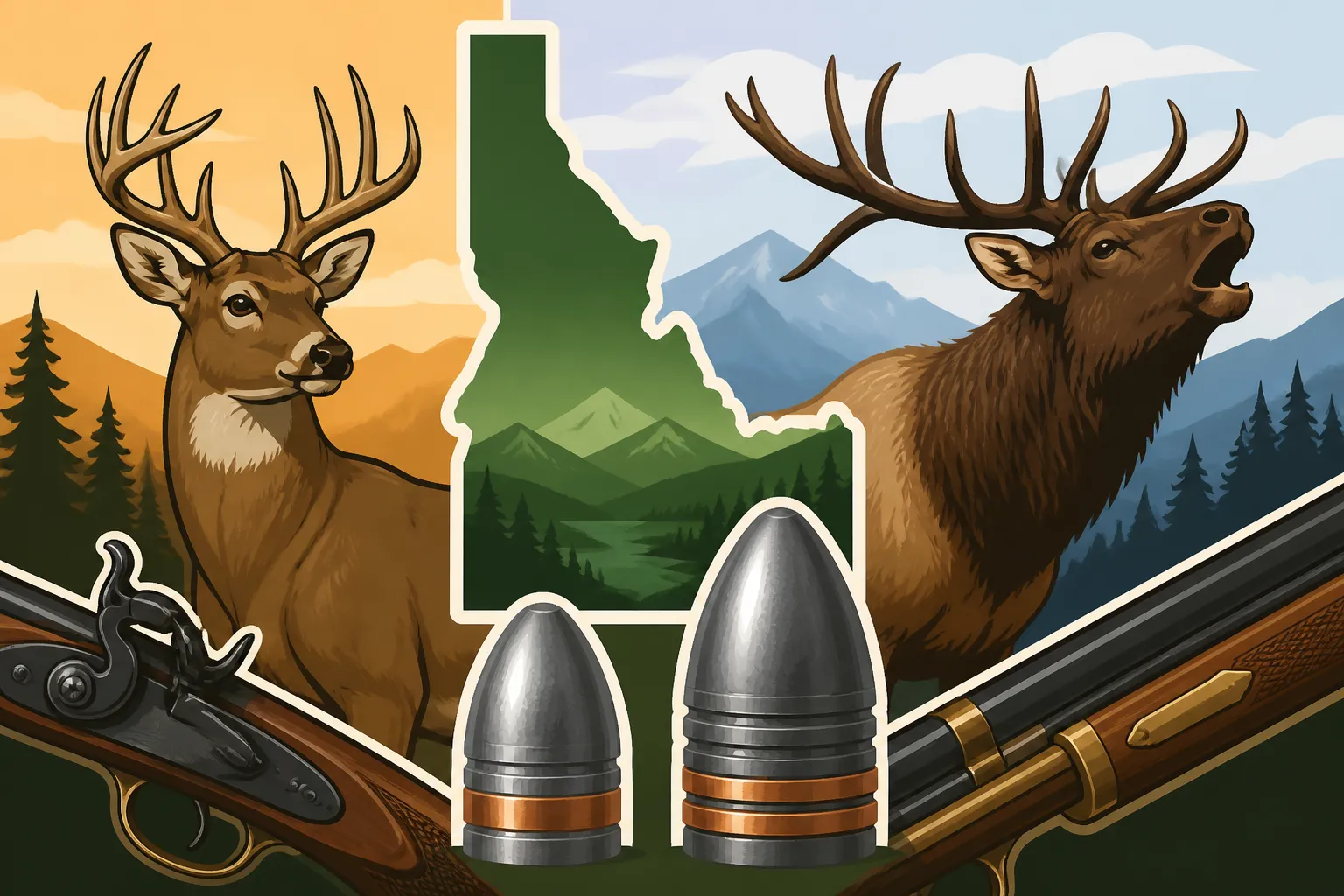
For many muzzleloader enthusiasts, the thought of a deer hunt in Idaho conjures images of crisp autumn mornings in the timber or glassing sagebrush hills. When preparing for this experience, one of the first things you absolutely need to confirm is your equipment meets the legal requirements. For deer, Idaho has set a clear standard: a minimum of .45 caliber.
What "Deer" Encompasses in Idaho
In Idaho, when the regulations state "deer," they're talking about both of our beloved resident species: the majestic Mule Deer and the elusive Whitetail Deer. These two species offer distinct hunting experiences, from the open breaks and high desert for muleys to the dense, dark timber of the panhandle for whitetails. While they differ in habitat and behavior, the biological reality is that both are medium-sized big game animals.
A mature Mule Deer buck can easily weigh 200-250 pounds, sometimes more, while a Whitetail buck in the northern forests can approach similar weights, often being denser through the chest. They possess significant bone structure and muscle mass, especially in the shoulder and rib cage area that you'd be aiming for. A .45 caliber muzzleloader, when loaded correctly with an appropriate projectile, delivers enough energy and creates a sufficiently large wound channel to quickly incapacitate these animals. It’s a good balance of power for a clean kill without being excessively oversized. You'll find that whether you're stalking a big whitetail in Unit 1 or glassing for a muley in the Owyhee country, your .45 caliber muzzleloader is the minimum legal and ethical tool for the job.
Acceptable Projectiles for .45 Caliber Muzzleloaders
Once you've confirmed your muzzleloader is .45 caliber or larger, the next crucial step is selecting the right projectile. The type of bullet you load can dramatically impact its performance in the field, even within the legal caliber. You've got a few main categories to consider, and each has its own loyal following and performance characteristics.
First, there are patched round balls. These are often the most traditional choice, essentially a lead sphere wrapped in a lubricated cloth patch. They generally travel at lower velocities and shed energy quickly, but can be incredibly accurate at shorter distances. For deer, a .45 caliber round ball can be effective if your shot placement is precise and the range is kept tight, typically under 75-100 yards. The large diameter on impact can cause significant tissue damage.
Then we have conical bullets. These are heavier, elongated lead projectiles that resemble modern bullets. They carry more mass and retain energy better than round balls, offering improved penetration and effective range. A .45 caliber conical bullet, weighing 200-300 grains, will typically offer superior terminal performance on deer. Brands like Hornady and Lee produce excellent conical molds or ready-to-load options.
Finally, there are saboted bullets. These consist of a smaller caliber bullet (like a .40 or .429) encased in a plastic sabot that allows it to be fired through a larger bore (like your .45 caliber). The sabot seals the bore, imparting spin, and then falls away after leaving the muzzle, leaving the smaller, often more aerodynamic and higher-performing bullet to continue its flight. Many saboted bullets are designed with advanced construction (like bonded cores or copper alloys) that expand reliably and penetrate deeply. While some traditionalists might shy away from them, saboted bullets often offer increased velocity, flatter trajectories, and better expansion, making them an excellent choice for a .45 caliber deer hunt, especially if you anticipate slightly longer shots. The important thing here is that the muzzleloader bore itself is the minimum .45 caliber.
Regardless of your choice, it’s absolutely paramount to practice with your chosen load. Different powders, powder charges, and projectiles will all behave differently in your specific rifle. Don’t wait until opening morning to figure out your most accurate combination. You need to know exactly how your rifle shoots with the load you plan to carry into the field.
The Heavier .50 Caliber Minimum for Idaho Elk
When it comes to pursuing elk in Idaho with a muzzleloader, the ante is raised, and so are the caliber requirements. While a .45 is perfectly legal and capable for deer, elk demand more. Idaho mandates a minimum of .50 caliber for elk, and for very good reasons rooted in the sheer biology of these magnificent animals.
The Sheer Size and Resiliency of Elk
If you've ever stood next to a mature bull elk, you understand immediately why a .50 caliber is the minimum. Elk are massive animals, often weighing between 600 and 1,000 pounds, with some of the biggest bulls pushing even heavier. Their bone structure is incredibly dense and thick, especially through the shoulders, ribs, and humerus, which are often the areas you're trying to penetrate to reach the vitals. They also possess an incredible will to survive and can cover vast distances even after a seemingly good shot if the bullet doesn't do its job effectively.
Compared to a deer, an elk presents a much larger, more robust target, and the vital organs are deeper within the chest cavity, often protected by that dense bone and heavy muscle. A .45 caliber projectile, even a well-constructed one, might struggle to consistently achieve the necessary penetration and energy transfer to quickly incapacitate a bull or cow elk. The larger diameter and heavier weight of a .50 caliber projectile are designed to address this challenge head-on, delivering a more significant punch, creating a wider wound channel, and having the momentum to push through tougher resistance. As any seasoned elk hunter will tell you, finding and recovering a wounded elk in Idaho’s steep, timbered, and often rugged terrain is an incredibly difficult and disheartening task. Using adequate equipment, starting with the right caliber, is your first line of defense against such a scenario.
Projectile Options for .50 Caliber Elk Hunting
With your .50 caliber muzzleloader in hand, selecting the right projectile for elk becomes even more critical. You're looking for heavy-for-caliber bullets designed specifically for deep penetration and reliable expansion on thick-skinned, heavy-boned animals. This isn't the time to skimp or go with a marginal option.
For .50 caliber, you'll primarily be looking at two main categories: heavy conical bullets and saboted bullets.
Heavy Conical Bullets: These are solid lead or lead alloy projectiles, often weighing from 350 to 500 grains. Their significant mass, coupled with a large frontal area, allows for substantial energy transfer and deep penetration. Examples include traditional "Maxi-Balls" or "REAL" bullets. When choosing conicals, look for those with a flat meplat or a hollow point designed for consistent expansion. The heavy weight helps them retain momentum even at muzzleloader velocities, driving them through bone and muscle. Keep in mind that heavy conicals might have a rainbow-like trajectory, so knowing your ballistic drops out to your effective range is absolutely crucial.
Saboted Projectiles: Similar to their .45 caliber counterparts, .50 caliber muzzleloaders can fire smaller, highly-engineered bullets in a sabot. This might mean a .45 caliber or even a .44 caliber jacketed bullet designed for pistol hunting, but optimized for muzzleloader velocities. Look for bullets explicitly marketed for big game, often featuring bonded cores, all-copper construction, or robust jackets. Popular options include Barnes Expander MZ, Hornady SST, or traditions-branded bullets, usually in the 250-300 grain range. These bullets are often more aerodynamic than traditional conicals, offering flatter trajectories and better accuracy at longer ranges. Their advanced construction ensures they hold together and expand reliably without fragmenting, which is vital for deep penetration on an elk.
When you're chasing elk, you're looking for a bullet that will punch through shoulder bone if necessary, drive deep into the vitals, and create a significant wound channel. It's often recommended to select a bullet that reliably performs at the lower end of your muzzleloader's velocity spectrum, ensuring it still expands even after losing some speed. Don't be afraid to try a few different premium options to see which one groups best from your rifle and gives you the confidence you need for an ethical elk hunt. Remember, proper load development is key; your muzzleloader, even with the right caliber, is only as good as the projectile and powder combination you send downrange.
Caliber Requirements for Other Big Game Species
While deer and elk are undoubtedly the stars of Idaho’s big game hunting scene, our state is home to a variety of other incredible animals that can be pursued with a muzzleloader. It's important to understand that the caliber requirements don't always stop at .50. Each species presents its own unique challenges, and Idaho's regulations reflect these differences to ensure humane hunting practices across the board. The good news is that if you're set up for elk, you're usually good for most other species.
Moose and Bighorn Sheep Requirements
When you start talking about species like Shiras Moose and Bighorn Sheep in Idaho, you're entering another league of robust, tough animals. For these incredible creatures, Idaho often maintains the same minimum caliber as elk, which is a .50 caliber muzzleloader or larger.
Let’s talk about moose for a moment. A mature Shiras moose bull is an absolute behemoth, easily dwarfing an elk. They are incredibly dense, heavily boned, and possess a thick hide and a substantial muscle structure. They are also known for being incredibly tough animals that can absorb a hit and keep moving. A .50 caliber, loaded with a heavy, well-constructed bullet, is truly the minimum for pursuing a moose ethically. Trying to take a moose with anything less would be a serious gamble on a humane kill and a frustrating proposition. The sheer size dictates the power needed to reach vital organs and create an effective wound channel. For more on this, you might find our article on Why Moose and Sheep Need a Larger Bore particularly insightful.
Bighorn Sheep, both Rocky Mountain and California subspecies, are also incredibly tough and agile animals. While not as massive as a moose or elk, their incredible musculature and ability to absorb impact, coupled with the often extreme terrain they inhabit, mean that a bullet needs to do its job quickly and effectively. They live in remote, unforgiving country, and recovering a wounded animal in a steep canyon or on a jagged mountain face is an almost impossible task. The .50 caliber minimum ensures that hunters have the necessary ballistic capability to make a clean kill when the opportunity arises, minimizing any chance of a non-lethal hit that could lead to loss.
Bear, Lion, and Pronghorn Muzzleloader Rules
Beyond the big ungulates, Idaho also offers opportunities to hunt black bear, mountain lion, and pronghorn with a muzzleloader. The rules for these species tend to align with the deer requirements or have specific provisions.
For Black Bear, Idaho typically requires a .45 caliber muzzleloader or larger. Black bears can vary significantly in size, from smaller, younger animals to large, mature boars that can rival the size of a deer. They have thick fur and a good layer of fat, which can also absorb some bullet energy. A .45 caliber with a heavy conical or a well-designed saboted bullet is generally considered adequate for ethical bear hunting. The challenge with bears often lies in their dense musculature and the fact that a precise shot to the vitals is paramount to avoid a long, difficult track.
Mountain Lion hunting with a muzzleloader is less common but certainly possible. Idaho’s regulations typically also mandate a .45 caliber muzzleloader or larger for mountain lions. Lions are incredibly athletic and tough, but they are also not as heavily built as elk or moose. Their lean, muscular bodies and relatively smaller vitals mean that accuracy is absolutely key. A well-placed .45 caliber shot will certainly do the job. Given the nature of lion hunting, often over hounds, shots are typically at closer ranges, which further enhances the effectiveness of a legal muzzleloader.
Pronghorn are an interesting case. While they are lighter-bodied than deer, their incredible speed and open country habitat mean that shots can sometimes be longer. Idaho requires a .45 caliber muzzleloader or larger for pronghorn. Although they are not as physically robust as a deer, their vital organs are compact, and a bullet still needs to perform. The lighter body weight means a good .45 caliber projectile will offer more than enough penetration. The real challenge with pronghorn, especially with a muzzleloader, is getting within an effective range, which, for most traditional black powder setups, means well inside 150 yards. This often requires superior stalking skills or exploiting terrain features in their wide-open habitat.
It's always critical to consult the most current Idaho hunting regulations booklet each year, as rules can occasionally be updated. While the general caliber minimums tend to be consistent, there might be specific weapon types or seasons where nuances apply.
Navigating Muzzleloader-Specific Season Restrictions
Hunting with a muzzleloader in Idaho isn't just about caliber; it's also about understanding the specific season you're hunting in. Idaho has distinct rules that apply differently to "muzzleloader-only" seasons versus using a muzzleloader during a "general" or "any-weapon" season. This distinction is absolutely crucial and can be a common point of confusion for hunters. Getting this wrong could lead to a violation, even if your caliber is legal.
Muzzleloader-Only vs. General Seasons
The core difference lies in the spirit of the hunt. Muzzleloader-only seasons are designed to be more traditional and challenging, offering a different experience than modern rifle hunting. Because of this, Idaho Fish and Game imposes stricter equipment requirements during these designated seasons.
During muzzleloader-only seasons, you generally face several key restrictions:
- No Scopes: You are typically limited to open sights or peep sights. This means that fancy magnified optics are out. This forces hunters to get closer to their quarry, truly embracing the challenge of traditional hunting. For more information on this, you might want to read Open and Peep Sights Only in Muzzleloader-Only Hunts and Why Idaho Muzzleloader-Only Hunts Ban Scopes and Inline Ignition.
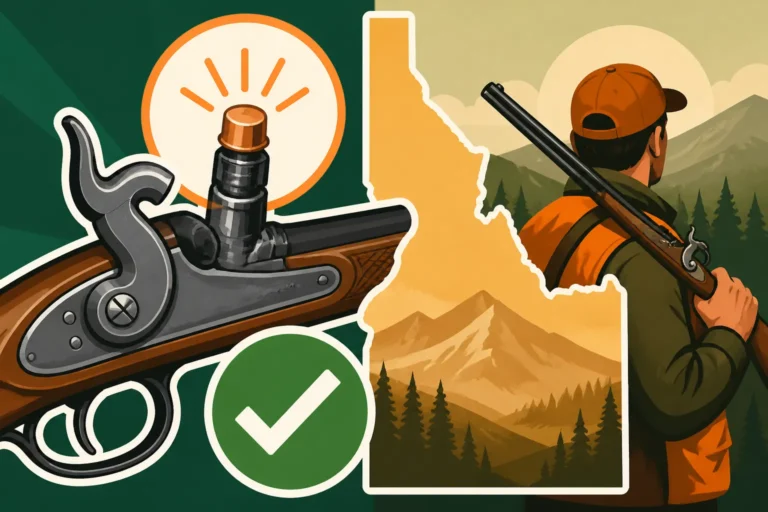
- Exposed Ignition: Your muzzleloader must usually have an exposed cap or primer. This rules out modern "inline" ignition systems where the primer is fully enclosed within the breech plug. The idea is to stick closer to historically authentic designs. Our article on The Exposed-Cap Ignition Rule Idaho Enforces dives deeper into this.
- No Sabots (Sometimes): While not universally applied to all muzzleloader-only hunts, some specific seasons or units might restrict the use of saboted bullets, limiting you to patched round balls or conical bullets. This is less common but always worth double-checking.
- Propellant Restrictions: Only black powder or approved black powder substitutes (like Pyrodex or Triple Seven) are allowed. Smokeless powder, even in rifles designed for it, is typically prohibited.
These restrictions are designed to level the playing field, making the hunt more about skill, woodsmanship, and getting within close range. They give hunters who enjoy that traditional challenge an opportunity to hunt with less pressure from high-tech gear.
In contrast, if you choose to hunt with a muzzleloader during a general weapon season (often called "any-weapon" season), you are typically exempt from most of these specific muzzleloader restrictions. In a general season:
- You can usually use a scope on your muzzleloader.
- You can typically use an inline ignition system.
- You can almost always use saboted bullets.
- You can still only use black powder or approved substitutes, but the other equipment rules loosen up.
Essentially, in a general season, your muzzleloader is treated much like any other legal firearm, as long as it meets the caliber minimums. This offers flexibility for hunters who prefer the muzzleloader but don't want the added challenge of traditional sights or exposed caps. Make sure you understand When No Muzzleloader Validation Is Needed which might apply if you are hunting with a muzzleloader outside of muzzleloader-only seasons.
The Importance of the Idaho Regulations Booklet
I cannot stress this enough: you must consult the current year’s Idaho Big Game Hunting Regulations booklet. Every. Single. Year. This isn't just a suggestion; it's a non-negotiable part of responsible hunting. Regulations can change, season dates shift, and specific unit rules might be updated. What was legal last year might not be this year, or a particular zone might have unique restrictions.
The official Idaho Fish and Game website (idfg.idaho.gov) is your primary resource for these regulations, usually available as a downloadable PDF. Read it cover to cover, paying particular attention to the "General Rules" section, the "Muzzleloader Equipment" section, and the specific unit and season you plan to hunt.
While excellent hunting planning tools like GoHunt can provide invaluable unit data, drawing odds, and harvest statistics, they are supplementary resources. They can help you sift through vast amounts of information and cross-reference details, making your planning process much more efficient. However, the official Idaho Fish and Game regulations are the ultimate legal authority. Use GoHunt to narrow down your options and gather insights, but always, always, double-check the precise rules in the official IDFG booklet for the current year before you ever step foot into the field. This diligent cross-referencing is your best defense against inadvertently breaking a rule and facing a costly fine or, worse, losing your hunting privileges.
Practical Advice for Muzzleloader Hunters in Idaho
Hunting Idaho’s rugged terrain with a muzzleloader is a truly rewarding experience, but it’s not for the faint of heart or the unprepared. Beyond just knowing the regulations, there's a practical side to becoming proficient with these unique firearms. It takes dedication, attention to detail, and a lot of practice to ensure you're effective and ethical in the field.
Choosing the Right Muzzleloader and Load
Selecting your muzzleloader is a very personal decision. Modern inline muzzleloaders, like those from CVA, Traditions, or Thompson/Center, often offer rifle-like accuracy and ease of use, making them a popular choice for hunters seeking reliability. Traditional percussion or flintlock rifles, while more challenging, offer an unparalleled connection to hunting heritage. Consider the weight of the rifle, especially if you plan on covering a lot of ground in the backcountry. An overly heavy rifle can quickly become a burden on a long stalk or a steep climb. Ergonomics, how the rifle feels and points for you, is also crucial.
Once you have your rifle, the real work begins: load development. This is where you’ll spend time at the range, trying different combinations of powder, projectile, and primer/cap.
- Powder: Whether you choose traditional black powder (like Goex or Swiss) or modern substitutes (Pyrodex, Triple Seven, Hodgdon 777), consistency is key. Always measure by volume, not weight, if the powder is sold by volume.
- Projectiles: As we discussed, for deer you're looking at .45 caliber patched round balls, conical bullets, or saboted options. For elk, moose, and sheep, step up to a .50 caliber with heavy conicals or robust saboted bullets. Pay attention to grain weight and bullet construction.
- Primers/Caps: Use the correct size and type for your ignition system.
Your goal is to find the most accurate and consistent load for your rifle, usually aiming for groups of 2-3 inches at 100 yards, which is generally considered sufficient for big game at typical muzzleloader ranges. Remember, the effective range of a muzzleloader on elk is typically considered to be within 150-200 yards for most setups and certainly less for traditional round balls. For further insights, checking out articles like The Effective Range of a Muzzleloader on Elk can be quite helpful. Don't fall into the trap of thinking a modern inline muzzleloader makes it a 300-yard gun; wind, trajectory, and bullet energy drop off quickly.
Essential Muzzleloader Accessories and Maintenance
Muzzleloader hunting requires a few specialized accessories that are just as important as the rifle itself:
- Loading Supplies: You'll need a powder measure, a bullet starter, and a sturdy ramrod (often an aftermarket, stronger ramrod than what comes with the rifle). Pre-measured powder charges in speed loaders or plastic tubes are invaluable in the field for quick, reliable reloading.
- Cleaning Kit: Black powder and its substitutes are notoriously corrosive. A dedicated cleaning kit with a bore brush, patches, solvent, and rust preventative is essential. You’ll need to clean your rifle thoroughly after every shooting session and certainly after every hunt, especially if it's been exposed to moisture.
- Primers/Caps: Always carry extra, and keep them in a waterproof container. Nothing is worse than a misfire due to damp ignition.
- Nipple Wrench/Breech Plug Wrench: For percussion and inline systems respectively, these are vital for removing and cleaning these critical components.
Diligent maintenance is non-negotiable. Fouling from black powder can build up quickly, affecting accuracy and making subsequent loading difficult. A clean bore ensures consistent performance. This extra effort is part of the charm and challenge of muzzleloader hunting, but neglecting it will surely lead to frustration in the field. Embrace the routine; it's part of the journey.
Practice, Practice, Practice
This might sound like common sense for any hunter, but it holds even more weight for muzzleloader users. The single-shot nature, slower lock times, and often heavier recoil of muzzleloaders mean that every shot counts even more. You won't get a rapid follow-up shot like you might with a centerfire rifle.
- Practice from field positions: Don't just shoot from a bench. Practice kneeling, sitting, standing unsupported, and using shooting sticks or tree rests, which are far more representative of real hunting scenarios. Simulate cold hands, elevated heart rates, and awkward angles.
- Practice loading quickly and smoothly: Under pressure, fumbling with powder and bullets can be disastrous. Practice loading your rifle as if a trophy animal is standing just out of sight.
- Know your range: Dial in your maximum ethical range and stick to it. If you can only consistently hit a 6-inch plate at 100 yards offhand, then 100 yards is your maximum range for big game, regardless of what the ballistics chart says. Remember, a wounded animal in steep country is a terrible outcome.
- Simulate conditions: If you hunt in cold weather, practice with gloves on. If you expect rain, practice shooting with your rain gear.
The commitment to practice will not only build your confidence but also ensure you're truly prepared to make a clean, ethical shot when the moment of truth arrives. Resources like GoHunt can help you scout units and identify potential practice areas on public land, ensuring you're not just practicing, but practicing in conditions that might resemble your hunting grounds. While the article Realistic Archery Practice Distance for Big Game focuses on bowhunting, the principle of consistent, field-realistic practice applies universally to all hunting disciplines, especially muzzleloading.
Common Pitfalls and How to Avoid Them
Even experienced hunters can fall prey to simple mistakes, and with muzzleloaders, the margin for error can feel even thinner. Avoiding common pitfalls is just as important as knowing the rules and practicing your craft. A little foresight can save you a lot of headache, heartache, and potential legal trouble.
Misinterpreting Regulations
One of the most frequent and easily avoidable mistakes is simply misinterpreting or not thoroughly reading the Idaho hunting regulations. It’s easy to skim or rely on hearsay, but that can be a costly error.
Here's a hypothetical scenario: A hunter, excited about an Idaho elk tag, knows that .50 caliber is the minimum for elk. He has a fantastic .45 caliber muzzleloader that shoots like a dream and delivers impressive energy. He assumes, because it's "powerful," it'll be fine. He heads out for a muzzleloader-only elk season, confident in his setup. However, the official regulations clearly state a .50 caliber minimum for elk. He is not only hunting with an illegal firearm for the species but also potentially violating the spirit of the hunt. This oversight, while perhaps unintentional, could lead to a citation, confiscation of game, or even loss of hunting privileges.
Another common misunderstanding revolves around the "muzzleloader-only" seasons. Hunters might read that their muzzleloader is legal in Idaho, and then use it with a scope or inline ignition during a muzzleloader-only hunt, unknowingly breaking the specific season rules. Remember, "legal caliber" doesn't always mean "legal for this specific season."
How to avoid it:
- Read the official regulations, cover to cover, every single year. Don't just look up your unit; read the general provisions and weapon-specific rules.
- Highlight key sections related to your weapon and species.
- Call Idaho Fish and Game directly if you have any doubt whatsoever. Their enforcement officers and regional offices are there to help clarify rules, not just enforce them. It's much better to ask a question beforehand than to explain a violation afterward.
- Cross-reference with reputable sources: While the official regs are paramount, trusted platforms like GoHunt can help you digest complex regulations and provide clarity, but always perform that final check with the IDFG document itself.
Inadequate Bullet Performance
Another significant pitfall, even when using a legally compliant caliber, is choosing an inadequate bullet for the intended game. Just because a bullet is .50 caliber doesn't mean it's automatically suitable for elk.
Consider this: A hunter is using a .50 caliber muzzleloader for elk. He chooses a very lightweight, pure lead round ball, perhaps one designed for target shooting or much smaller game. While it meets the caliber minimum, that lightweight round ball will have limited penetration and energy retention on a massive elk. Even with a perfect shot, it might not penetrate deeply enough to reach the vitals or create enough damage for a quick, humane kill. The elk might be wounded and lost, a heartbreaking outcome for any hunter.
How to avoid it:
- Choose premium bullets for big game. Especially for elk, moose, or large bears, invest in bullets specifically designed for these animals. Look for attributes like bonded cores, all-copper construction, or robust jackets that ensure deep penetration and controlled expansion. Brands like Barnes, Hornady, and Nosler make excellent muzzleloader projectiles designed for terminal performance on large animals.
- Match bullet weight to game size. For .45 caliber deer, a 200-300 grain conical or sabot is a good starting point. For .50 caliber elk, moose, or bear, look for 275-500 grain conicals or heavy sabots in the 250-300 grain range. Heavier bullets generally penetrate better.
- Understand bullet design. Hollow points designed for rapid expansion on deer might be too fragile for elk shoulders. Conversely, a monolithic solid might not expand enough to create a wide wound channel. Research how your chosen bullet is designed to perform at muzzleloader velocities.
- Test your chosen load extensively. Pay attention to how the bullet impacts targets. While you can't test on live animals, you can evaluate penetration into ballistic gel or wet newspaper to get an idea of its capabilities.
By being meticulous about both legal compliance and the practical performance of your equipment, you significantly increase your chances of a successful and ethical muzzleloader hunt in Idaho.
Idaho Muzzleloader Caliber Minimums by Species
To help summarize, here's a quick reference table for Idaho's muzzleloader caliber minimums for various big game species. Remember, these are minimums, and choosing a larger caliber or a more robust projectile within the legal minimums is often a wise choice for ethical hunting.
| Species | Minimum Muzzleloader Caliber | Notes |
|---|---|---|
| Deer | .45 Caliber | Applies to both Mule Deer and Whitetail Deer. |
| Elk | .50 Caliber | Larger diameter and heavier bullets recommended due to elk's size and toughness. |
| Moose | .50 Caliber | Highly recommend robust, heavy bullets for deep penetration on these massive animals. |
| Bighorn Sheep | .50 Caliber | Tough animals in rugged terrain, requiring effective terminal performance. |
| Black Bear | .45 Caliber | Choose well-constructed bullets that will penetrate thick hide and bone. |
| Mountain Lion | .45 Caliber | Accuracy is key; often taken at closer ranges. |
| Pronghorn | .45 Caliber | Lighter-bodied, but shots can be longer. Focus on accurate loads and getting within ethical range. |
| Other Small Game | No specific minimum for some | Always check regulations for smaller game like upland birds or small game, though muzzleloaders are less common. |
Disclaimer:
The information provided in this guide is for general informational purposes only and is not intended as legal advice. Hunting regulations, including specific caliber requirements and season rules, can change annually and may vary by unit or specific hunt. It is the sole responsibility of the hunter to consult and comply with the most current and official Idaho Department of Fish and Game hunting regulations before engaging in any hunting activities. Always refer to the official IDFG website or printed regulations booklet for the most accurate and up-to-date information.