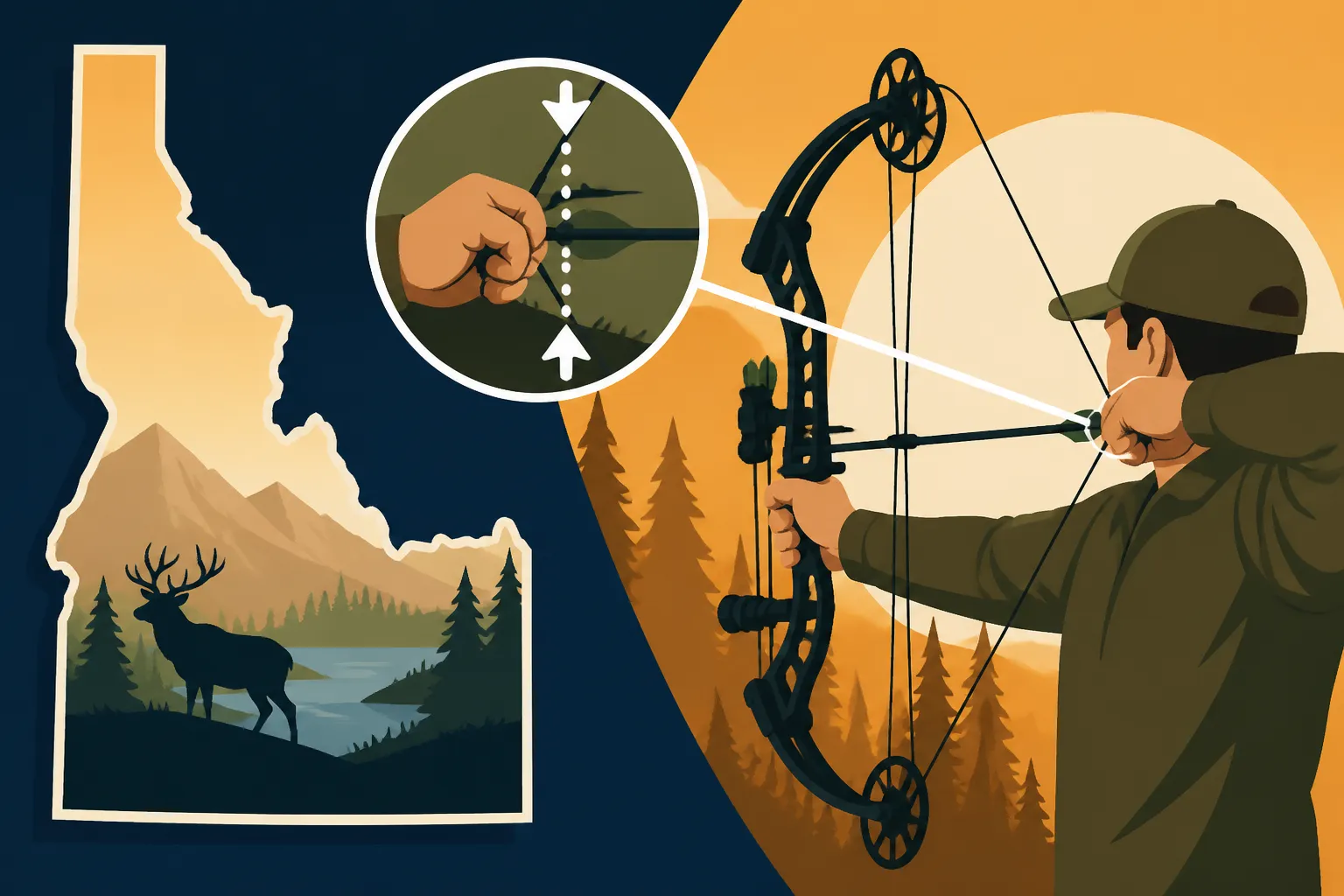
How Idaho Measures Draw Weight at 28 Inches
One of the trickiest parts of gearing up for an Idaho archery hunt, especially if you're new to the state or coming from somewhere with different regulations, is understanding the technicalities of bow requirements. It's not just about pulling back a string; Idaho Fish and Game has specific rules about minimum draw weight, and how that weight is actually measured can cause a lot of confusion. This guide is here to unravel the mystery of how Idaho measures draw weight at 28 inches, ensuring you're compliant and ready for your hunt.
Why Draw Weight is So Important for Ethical Hunting
It’s easy to get caught up in the latest gear — the fastest bows, the coolest accessories. But at its core, draw weight isn't just a number; it's a critical factor for ensuring an ethical and effective harvest. You wouldn't take a squirrel gun out for elk, right? The same principle applies to archery equipment. The state of Idaho wants to ensure that any animal you shoot with a bow has the best possible chance of a quick, humane death. This comes down to arrow penetration, and penetration is directly linked to the kinetic energy delivered by your bow, which in turn depends heavily on draw weight and arrow mass.
Ensuring Humane Take Down
The primary reason behind draw weight minimums is ensuring sufficient kinetic energy and momentum to push an arrow, complete with a broadhead, through the vitals of big game animals like deer and elk. Without enough power, your arrow might not penetrate deeply enough, leading to a wounded animal that suffers and potentially escapes, never to be recovered. No hunter wants that outcome. It's about respecting the animal and making a clean kill, even if it means you have to put in extra work at the gym to pull a heavier bow. This is why Idaho has a specific requirement for Idaho Requires a 40-Pound Bow at a 28-Inch Draw for big game.
Avoiding Equipment Limitations
Beyond the ethical considerations, having adequate draw weight means your equipment isn't the limiting factor in your success. Imagine getting a perfect shot opportunity on a trophy bull elk, only for your arrow to glance off a rib or stick just under the hide because your bow simply didn't have the juice. It's a heartbreaking scenario that can be avoided by making sure your setup meets (or, ideally, exceeds) the minimum requirements. Plus, a properly powered bow allows for a wider range of arrow and broadhead choices, giving you more flexibility in optimizing your setup for penetration and flight characteristics.
Understanding the 28-Inch Draw Length Standard
The phrase "at 28 inches" is key when discussing draw weight in Idaho, and it often trips up archers, especially those with shorter or longer draw lengths. It’s not just an arbitrary number; it’s a standardized measurement used across the archery industry to compare bows fairly and ensure a baseline for performance. Think of it like comparing horsepower in cars; you need a consistent test environment.
The Archery Industry Standard
The 28-inch draw length is a universally accepted benchmark in the archery world. When a bow manufacturer advertises a bow as having, say, a 70-pound draw weight, that rating is almost always measured at a 28-inch draw length. This standardization allows hunters and pro shops to compare different bows on an even playing field, regardless of the individual archer's physical dimensions. It’s a practical way to ensure that when Idaho Fish and Game sets a minimum, they're referring to a value that can be consistently measured and understood across all types of bows and manufacturers. Without this standard, every bow would have a different effective draw weight depending on the archer, making regulation nearly impossible to enforce fairly.
Why Your Personal Draw Length Matters
While the 28-inch standard is for regulation and comparison, your personal draw length is what truly matters for your shooting comfort and the actual energy your bow generates for you. If your personal draw length is shorter than 28 inches, your bow will likely generate less kinetic energy than its advertised peak weight at 28 inches. Conversely, if your draw length is longer, you'll generally generate more.
For example, if you have a 26-inch draw, a bow set to 60 pounds at 28 inches might only be delivering 55 pounds of force at your personal draw length. This is crucial for hunters with shorter draw lengths who need to ensure their bow still meets the state's minimum even if they can't physically draw it to 28 inches. It means you might need to set your bow's peak weight higher than the stated minimum to ensure you're compliant at your actual draw. This is where understanding your bow's specific characteristics and perhaps consulting with a pro shop becomes invaluable.
How Draw Weight is Actually Measured
Measuring draw weight isn't as simple as hooking a scale to the string and pulling. There's a specific technique and equipment involved to get an accurate, compliant reading. Idaho requires the peak draw weight to be measured, which is the maximum force required to pull the string back.
The Peak Weight Measurement
Idaho's regulations specify measuring the "peak" draw weight. For compound bows, this is typically the highest point in the draw cycle, before the let-off kicks in. For traditional bows like recurves and longbows, the draw weight increases progressively throughout the draw, so the peak weight is simply the weight at your full draw, or in the case of the regulation, at 28 inches.
To measure this accurately, a specialized archery scale is used. These scales are designed to capture and hold the peak weight reading. Your local pro shop will have one of these, and it's always a good idea to have them check your setup. They'll draw the bow slowly and smoothly until the string reaches 28 inches, or your full draw length if it's shorter and you're verifying it meets the minimum. This ensures that the measurement isn't rushed or affected by jerky movements. It's a precise process because even a pound or two can make a difference in meeting the legal threshold.
Compound Bow Let-Off and Its Impact
This is where compound bows get a bit more nuanced. Compound bows are designed with cams that create a "let-off" when you reach full draw. This means that while you might pull 60 pounds to get the string back, once you're at full draw, you might only be holding 15-20 pounds. This let-off makes it much easier to hold the bow steady for longer periods, which is a huge advantage when waiting for that perfect shot.
However, Idaho's regulation is concerned with the peak draw weight, not the holding weight. So, even if your bow has an 80% let-off, the measurement that counts for compliance is the maximum force required to get the bow to full draw, or to 28 inches. It's important to differentiate between these two numbers. If your bow is set to 60 pounds peak weight at 28 inches, it's legal, even if you only hold 12 pounds at full draw. Confusing the two could lead to misinterpreting the regulations and potentially an illegal setup. You can read more about Compound Bow Let-Off and Measured Draw Weight to better understand this concept.
Legal Minimums for Idaho Big Game
Idaho isn't messing around when it comes to bow hunting big game. There are clear minimum draw weights set in place to protect both the animals and the integrity of the hunt. These minimums apply across the board, whether you're chasing mule deer in the breaks or stalking a bull elk in the timber.
Deer and Elk Minimums
For deer, elk, and most other big game species in Idaho, the legal minimum peak draw weight is 40 pounds, measured at a 28-inch draw. This means that regardless of your personal draw length, your bow must generate at least 40 pounds of force at that 28-inch measurement point in its draw cycle. If your personal draw length is shorter than 28 inches, you might need to adjust your bow's settings to ensure it still meets this 40-pound benchmark at the 28-inch mark.
It's a common misconception that if you only draw to 26 inches, you just need 40 pounds at your draw. That's not how the rule works. The rule is explicitly about the bow's capability at 28 inches. So, if you draw less, you'll need to set your bow higher so that if it could be drawn to 28 inches, it would pull at least 40 pounds. This can require a slightly heavier bow setting than some shorter-draw archers might prefer, but it's non-negotiable for legal hunting. For a deeper dive into these requirements, check out Idaho Minimum Peak Draw Weight for Any Bow.
Special Considerations for Traditional Bows
Traditional bowhunters, those wielding recurves or longbows, also fall under the same 40-pound minimum. However, the way it's achieved and felt is quite different. Unlike compounds, traditional bows don't have let-off. The draw weight increases continuously as you pull the string back. So, a 40-pound recurve or longbow means it literally takes 40 pounds of force to draw it back to 28 inches.
This means traditional bowhunters must be capable of physically pulling and holding that full weight at their anchor point for a steady shot. There's no mechanical advantage easing the hold. This often necessitates significant practice and strength training. If you're considering a traditional bow, ensure its stated draw weight (often marked on the limb) at 28 inches meets or exceeds the 40-pound minimum. For those interested in the nuances, we have an article comparing Recurve Poundage That Will Kill an Elk and another on Longbow Against Recurve on a Western Hunt.
Verifying Your Bow's Compliance
So, you've got your bow, you know the rules, but how do you actually verify that your setup is good to go for an Idaho hunt? This step is crucial, and it’s one where you really don’t want to guess. A quick check now can save you a lot of headache, or even a citation, later in the field.
Visiting a Reputable Archery Pro Shop
Honestly, the absolute best way to verify your bow's compliance is to take it to a reputable archery pro shop. These folks are experts; they deal with these regulations all the time and have the proper equipment to measure your bow accurately. They can put your bow on their scale, measure the peak draw weight at 28 inches, and ensure everything is set correctly. They can also help you fine-tune your draw length, adjust your draw weight, and even recommend appropriate Arrow Weight That Gets Through an Elk and Fixed Blade Against Mechanical Broadheads on Elk to maximize your ethical hunting potential.
Don't be shy about asking questions. Tell them you're hunting in Idaho and need to confirm compliance with the 40-pound minimum at 28 inches. They'll guide you through the process and make any necessary adjustments. This is also a great opportunity to get a professional eye on your form and make sure your gear is performing optimally. Remember, investing a little in a pro shop visit can pay dividends in the field.
Adjusting Draw Weight and Draw Length
If your bow isn't meeting the minimum, or if your personal draw length is significantly different from 28 inches, a pro shop can help you adjust your setup. Most modern compound bows allow for adjustments to both draw weight and draw length. Draw weight is usually adjusted by turning limb bolts, increasing or decreasing tension. Draw length can often be changed by adjusting modules on the cams, though some bows require different cams or a different bow altogether.
It's typically not recommended to make significant adjustments yourself, especially if you're unfamiliar with the process. Over-loosening limb bolts can be dangerous, and incorrect draw length adjustments can throw off your cam timing and overall bow performance. Let the experts handle it. They can ensure your bow is not only compliant but also tuned correctly for your shooting style and the demands of an Idaho hunt. They can also provide tips for Bow Tuning Worth Doing Before a Mountain Hunt that will make a huge difference in accuracy and confidence.
Beyond Draw Weight: Other Archery Regulations
While draw weight is a significant part of Idaho's archery regulations, it's certainly not the only one. The state has a comprehensive set of rules designed to maintain fair chase, ensure ethical harvesting, and protect the experience for all hunters. It's vital to be familiar with all of them before heading into the field.
Broadhead Requirements
Idaho has specific rules about broadheads used for big game. Mechanical broadheads are generally permitted, but they must meet certain cutting diameter requirements, typically needing to open to a specific width. Fixed-blade broadheads also have minimum cutting widths. These rules are in place to ensure that the broadhead creates a sufficiently large wound channel for a quick, humane harvest. Always double-check the current regulations for specific measurements, as they can sometimes change. A good pro shop can also guide you on selecting the right broadheads for your target species and draw weight.
Lighted Nocks and Release Aids
Many modern archers use accessories like lighted nocks, which make it easier to track your arrow after the shot, especially in low light. Idaho generally permits the use of lighted nocks. Similarly, mechanical release aids, which help achieve a more consistent and precise arrow release, are also legal for archery hunting in Idaho. These accessories can be a great benefit to accuracy and shot recovery, but as always, ensure they function correctly and don't interfere with your shooting form or bow performance. You can learn more about Whether Lighted Nocks Are Legal for Bowhunters and Are Release Aids Allowed for Archery Hunting? in Idaho.
Practice and Shot Distance
While not a formal regulation, Idaho emphasizes ethical hunting, and that means being proficient with your equipment. This translates to knowing your effective range. For most bowhunters, this is far shorter than they might initially think. For elk, a realistic maximum range for most hunters is often considered to be 40-60 yards, and for deer, it might be similar or slightly less depending on the terrain and conditions. Pushing beyond your comfort and accuracy limits drastically increases the chance of wounding an animal. Consistent practice at varying distances, in different weather conditions, and from various shooting positions is essential. Consider dedicating serious time to Realistic Archery Practice Distance for Big Game to truly understand your limitations. This preparation is key to knowing How Close a Bowhunter Needs to Get on Elk for a high-percentage shot.
Useful Resources for Idaho Hunters
Navigating hunting regulations can feel like a maze, but thankfully, there are excellent resources available to help you stay informed and prepared for your Idaho adventure. Utilizing these tools is a hallmark of a responsible and successful hunter.
Idaho Fish and Game Website
The official Idaho Fish and Game (IDFG) website is your absolute go-to for all current regulations. They publish yearly big game regulations pamphlets that detail everything from draw weight minimums and broadhead rules to season dates, unit boundaries, and licensing requirements. It's available online as a PDF, so you can download it and keep it handy on your phone or tablet.
Beyond the regulations, the IDFG website offers a wealth of information, including harvest statistics, controlled hunt draw odds, and educational resources. They also have a handy online "Hunt Planner" tool that can help you scout units and understand terrain, public land access, and more. Make it a habit to check their site before every hunting season, as rules can sometimes change from year to year.
Online Hunting Forums and Communities
Online hunting forums and social media groups dedicated to Idaho hunting can be fantastic resources for gleaning practical advice and insights. You can connect with experienced local hunters who are often happy to share tips, discuss regulations, and even recommend good pro shops or areas to scout. Just be sure to cross-reference any information with official IDFG sources, as anecdotal advice isn't always 100% accurate.
Platforms like GoHunt also offer a ton of resources for western hunters, including detailed state profiles, draw odds analysis, and unit breakdowns. While these sites don't replace the official IDFG regulations, they can be incredibly helpful for research and planning, providing a consolidated view of information and tools to make informed decisions. Forums and communities offer a place to ask specific questions about gear, tactics, or even unique challenges you might face in Idaho's diverse terrain.
Draw Weight Compliance Table
To help consolidate the key information about draw weight in Idaho, here's a quick reference table. Remember, these are the minimum requirements, and exceeding them (within your comfortable and accurate shooting ability) is often beneficial for ethical hunting.
| Factor | Requirement | Notes |
|---|---|---|
| Minimum Peak Draw Weight | 40 pounds | Measured at 28-inch draw length. |
| Measurement Standard | At 28 Inches | Applies to all bows (compound, recurve, longbow). |
| Compound Bow Let-Off | Only Peak Weight Matters (not holding weight) | Ensure 40+ lbs is achieved before let-off. |
| Traditional Bows | Must reach 40+ lbs at 28" draw | No let-off, so physical strength is key to hold full weight. |
| Verification Method | Archery Pro Shop Recommended | Use a calibrated scale to get an accurate, professional measurement. |
| Consequence of Non-Compliance | Potential citation, loss of hunting privileges | Seriously, don't risk it. Check your bow. |
It's really important to get this right. Don't let a technicality ruin your hunt or, worse, lead to a wounded animal. Get your bow checked, understand the numbers, and practice, practice, practice!
Disclaimer
The information provided in this guide is for general informational purposes only and does not constitute legal advice. Hunting regulations can change, and interpretations may vary. Always consult the official Idaho Fish and Game regulations or contact them directly for the most current and accurate information before participating in any hunting activity.