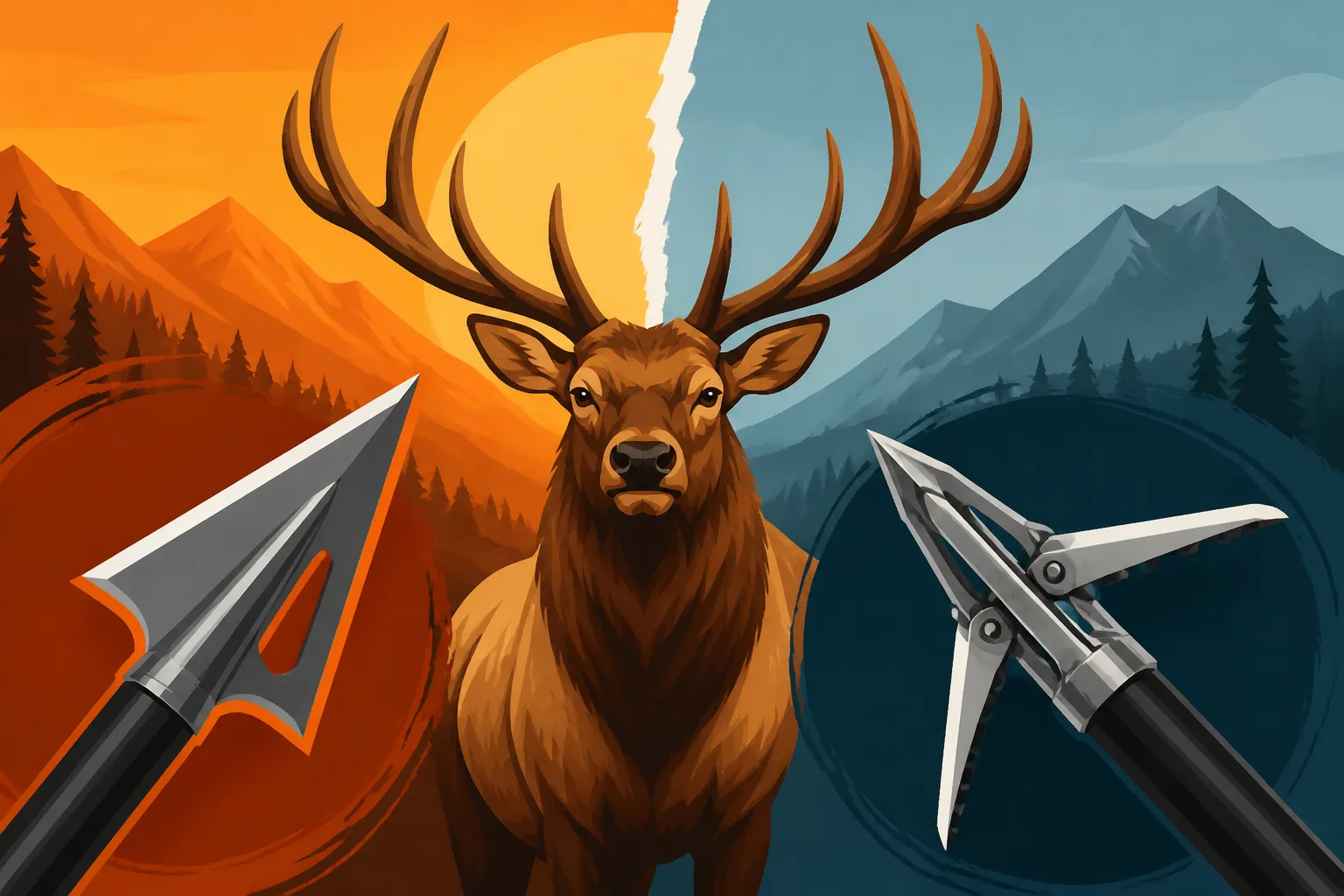
Fixed Blade Against Mechanical Broadheads on Elk
There's a unique knot of anxiety that tightens in a bowhunter's stomach when it comes to choosing the perfect broadhead for elk, especially here in Idaho's rugged, unforgiving terrain. We all want to make the most ethical, humane kill possible, and a significant part of that equation rests squarely on how well our arrow performs on impact. This guide is dedicated to dissecting the age-old debate between fixed blade and mechanical broadheads, giving you the detailed, real-world insights you need to make an informed decision for your next Idaho elk adventure.
Understanding the Stakes: Why Broadhead Choice Matters for Idaho Elk
Hunting elk with a bow isn't just a physical challenge; it's a mental one, too. You train, you scout, you invest countless hours, all for a fleeting moment of truth. When that moment arrives, every single component of your setup needs to perform flawlessly. Elk are incredibly tough animals, built for survival in some of the most challenging environments, and that dense musculature and thick bone structure demand a broadhead that can deliver maximum penetration and devastating hemorrhaging. The sheer size and resilience of an elk mean there's little room for error, and a sub-optimal broadhead choice can turn a clean hit into a long, agonizing track, or worse, a lost animal.
The Anatomy of an Elk and Vital Zones
To truly appreciate the importance of your broadhead, you need a solid understanding of elk anatomy. Their vitals – primarily the lungs and heart – are well-protected within a robust rib cage. While a lung shot is generally considered effective, a double lung shot is paramount for a quick recovery. The heart is smaller and sits lower in the chest, making it a more challenging target. Beyond these, you might also aim for the liver as a secondary, although slower, kill zone.
What makes elk so formidable is the dense bone structure, particularly the scapula (shoulder blade), and the heavy muscle mass that surrounds these areas. An arrow needs to penetrate through hide, layers of muscle, potentially bone, and then continue deep into the vitals. This isn't like shooting a deer; an elk's hide is thicker, its ribs are stouter, and the sheer volume of tissue to pass through is significantly greater. Your broadhead must maintain its integrity, cut efficiently, and penetrate deeply, minimizing energy loss on impact.
Idaho's Diverse Hunting Environments and Shot Scenarios
Idaho offers an incredible variety of elk habitats, from the dense timbered mountains of the Panhandle to the sprawling sagebrush breaks and steep canyons of the central and southern regions. This diversity directly impacts the types of shots you might encounter. In thick timber, shots are often close, fast, and frequently present challenging angles, requiring an arrow that can punch through brush if necessary and hold a true line. Conversely, in open country, shots might be at longer distances, but still demand precise accuracy, with wind becoming a major factor.
Imagine still-hunting through a steep, timbered draw, only to have a bull explode from its bed at 30 yards, offering a quartering-to shot as it turns to flee. Or picture patiently glassing an open hillside, finally getting a bull to commit, and having to make a precise shot across a canyon. These scenarios demand different things from your broadhead. A broadhead that flies true like a field point is an advantage at longer distances, while one known for unparalleled penetration might be preferred for those close, tough-angle shots through muscle. Understanding the unit you plan to hunt, perhaps using resources like GoHunt to scout terrain, can help you anticipate these scenarios and make a more tailored broadhead decision.
Fixed Blade Broadheads: The Tried and True Workhorse for Elk
Fixed blade broadheads have been around since the dawn of archery hunting, and for good reason: they are simple, robust, and incredibly effective when properly tuned. Comprising a single, solid piece of metal with sharp edges, these broadheads maintain their cutting diameter from the moment they leave the bow until they exit the animal (or run out of steam). Their reliability is legendary, offering unparalleled penetration potential due to their inherent structural integrity and lack of moving parts. Many veteran elk hunters swear by them, valuing their consistent performance above all else.
Anatomy and Performance Characteristics
Fixed blade broadheads come in various designs, from two-blade designs to three or four blades, and even some hybrid designs that incorporate bleeders. What truly defines them is the absence of moving parts. This means there's no risk of blades failing to deploy or becoming damaged before impact. The ferrule—the body of the broadhead that connects to the arrow shaft—is often quite robust, designed to withstand heavy impacts with bone without bending or breaking.
When a fixed blade broadhead hits an elk, it begins cutting immediately. The blades slice through hide and muscle, and if it encounters bone, a well-designed fixed blade will often cut through or split it, rather than deflecting or breaking. This efficiency in cutting and superior structural integrity translates directly into deeper penetration, which is absolutely critical for reaching those deep-seated vitals on a large animal like an elk. While many hunters obsess over "cutting diameter," the actual cutting surface area and the sharpness of the blades are arguably more important for penetration. Quality fixed blades, like those offered by proven brands, will feature surgical-sharp edges and durable materials that can withstand the rigors of an elk hunt.
Tuning Your Bow for Fixed Blade Accuracy
One of the most common critiques of fixed blade broadheads is their reputation for being less forgiving than mechanicals when it comes to arrow flight. This isn't a flaw of the broadhead itself, but rather a reflection of your bow's tuning. Because fixed blades present a larger surface area to the air during flight compared to a field point, any inconsistencies in arrow flight due to improper bow tuning will be exacerbated. This can lead to erratic flight, planing, and ultimately, poor accuracy.
Therefore, meticulous bow tuning is non-negotiable when shooting fixed blades. This involves ensuring your arrow rest is perfectly aligned, your nocking point is correct, and your cams are synchronized (for compound bows). Methods like paper tuning, walk-back tuning, and bare shaft tuning are essential steps to achieve perfect arrow flight. Once your bow is truly tuned to send a broadhead and a field point to the same spot, fixed blades will fly with remarkable precision. This commitment to tuning not only builds confidence in your equipment but also makes you a more proficient archer. Remember, for a successful Idaho hunt, knowing Bow Tuning Worth Doing Before a Mountain Hunt can make all the difference.
Mechanical Broadheads: Expanding Your Cutting Diameter
Mechanical broadheads are a relatively newer innovation, designed to offer the field-point accuracy that many hunters desire, combined with a much larger cutting diameter on impact. The fundamental principle is that the blades are tucked away during flight, presenting a smaller profile that mimics a field point. Upon impact, a trigger or pressure mechanism causes the blades to deploy, expanding to create a wider wound channel. This design aims to offer the best of both worlds: superior accuracy in flight and devastating cutting power where it counts.
Design Variations and Deployment Mechanisms
Mechanical broadheads come in a fascinating array of designs, each with its own deployment mechanism. Some are "front-deploying," where the blades open forward upon initial contact. Others are "rear-deploying," where the blades pivot backward, often from a solid base. Blade retention systems vary widely, from small O-rings and collars that hold the blades in place to intricate spring-loaded designs. Each design has its proponents and detractors, with discussions often centered on reliability and the energy required for deployment.
The promise of a larger cutting diameter, often ranging from 1.5 inches to over 2 inches, is a major draw for mechanicals. This expanded cutting surface, theoretically, creates a more significant wound channel, leading to faster blood loss and a quicker recovery. For hunters who value accuracy at longer distances or struggle with tuning fixed blades, mechanicals can be a game-changer, provided they perform as advertised. It's always wise to research various designs thoroughly, perhaps using detailed reviews and discussions found on hunting platforms like GoHunt, to understand the real-world performance characteristics. You might also want to check if Whether Lighted Nocks Are Legal for Bowhunters as part of your overall arrow setup.
Penetration Concerns and Ethical Considerations
While mechanical broadheads offer advantages, they also introduce some trade-offs, particularly concerning penetration. The act of deploying the blades requires kinetic energy, meaning some of the arrow's momentum is absorbed in opening the broadhead rather than driving it forward. Additionally, the wider cutting diameter, while creating a larger wound, also increases friction as the arrow passes through the animal, further reducing penetration depth.
This becomes a critical factor when hunting an animal as robust as an elk. If a mechanical broadhead encounters heavy bone, like a shoulder blade or a rib at an awkward angle, there's a greater risk of it failing to penetrate adequately, deflecting, or even breaking. A partial pass-through or a non-lethal wound can lead to immense suffering for the animal and heartbreak for the hunter. Therefore, when choosing a mechanical broadhead for elk, it's paramount to select one known for robust construction, reliable deployment, and sufficient blade angle to minimize penetration loss. For many, this also means ensuring you have enough Arrow Weight That Gets Through an Elk to maintain kinetic energy. The ethical responsibility rests on the hunter to ensure their equipment is up to the task of a clean, humane kill, especially with a mechanical that demands even more precise shot placement.
Making Your Choice for Idaho Elk Country
Ultimately, the choice between fixed blade and mechanical broadheads for elk hunting in Idaho boils down to a combination of your specific hunting style, bow setup, and personal confidence. There isn't a single "best" broadhead that works for every hunter in every situation. Both types have proven their effectiveness on elk countless times when used correctly. The key is to understand their strengths and weaknesses and then align them with your own capabilities and the demands of the hunt.
Matching Broadhead to Bow Setup and Hunting Style
Your bow setup plays a significant role in broadhead performance. If you're shooting a higher draw weight bow with a heavy, high-FOC arrow, you're generating substantial kinetic energy and momentum. Such a setup often provides enough "horsepower" to drive a well-constructed mechanical broadhead through an elk, even with some energy lost on deployment. However, if you're shooting a lower draw weight, perhaps a traditional recurve, fixed blades become almost essential due to their superior penetration capabilities. Knowing Recurve Poundage That Will Kill an Elk can help you determine if your setup is adequate.
Consider your typical shot distance and hunting style. If you primarily hunt tight timber where shots are usually under 40 yards, and you prioritize maximum penetration through potential bone, a fixed blade might be your preferred choice. If you hunt more open country, where longer shots are more common, and you value field-point accuracy above all else, a robust mechanical might be a better fit, assuming your bow setup can handle it. When you're assessing your bow's capabilities, it's also good to know the Idaho Minimum Peak Draw Weight for Any Bow to ensure compliance with regulations. Many hunters consult online forums and data from platforms like GoHunt to see what other successful elk hunters are using with similar bow setups.
Practice, Confidence, and Ethical Responsibility
No matter which broadhead you choose, nothing replaces diligent practice and the confidence it instills. You should be able to consistently hit your target with your chosen broadhead out to your maximum ethical shooting distance. This means shooting your broadheads regularly, not just field points, to ensure they fly true with your arrows. If you're using a mechanical, practice with it to confirm reliable deployment and consistent accuracy.
Your ethical responsibility as a hunter is paramount. This means knowing your limitations and only taking shots that offer the highest probability of a clean, humane kill. This is especially true when it comes to elk, where a wounded animal can travel for miles. Spend time honing your skills, understanding shot placement, and ensuring your equipment is perfectly matched to the task. Use resources like the detailed unit breakdowns on GoHunt to get a better sense of the terrain and potential shot scenarios in your chosen area, which can further inform your broadhead decision. Remember that Realistic Archery Practice Distance for Big Game is a critical factor, and you should never push beyond what you can consistently hit. Ultimately, the best broadhead is the one you have the most confidence in and can consistently place precisely where it needs to go.
Here's a quick comparison to help you weigh your options:
| Feature | Fixed Blade Broadheads | Mechanical Broadheads |
|---|---|---|
| Pros | – Superior penetration | – Field point accuracy in flight |
| – Exceptional reliability (no moving parts) | – Larger cutting diameter (on deployment) | |
| – High structural integrity | – More forgiving of minor bow tuning issues | |
| Cons | – Can be less forgiving of bow tuning issues | – Potential for reduced penetration (energy loss on deployment) |
| – May require more extensive bow tuning | – Risk of failure to deploy or blade damage | |
| – Smaller cutting diameter (generally) | – Structural integrity concerns (some models) | |
| Best Use Case for Elk | – Lower draw weight bows | – Higher kinetic energy bow setups |
| – Heavy bone impact potential | – Hunters prioritizing flat-flying accuracy | |
| – Timber hunting with close, tough angles | – Situations requiring wider wound channels | |
| Idaho Specific Considerations | – Excellent for dense Idaho timber and brush | – Requires careful selection for heavy bone/muscle on large Idaho bulls |
Disclaimer
Please note that hunting regulations, seasons, and licensing requirements can change frequently. While we strive to provide accurate and up-to-date information, it is always the hunter's responsibility to consult the most current Idaho Fish and Game regulations directly before planning or engaging in any hunting activities. This article is for informational purposes only and should not be considered legal advice.