Realistic Archery Practice Distance for Big Game
The moment of truth arrives quickly in bowhunting, often catching us off guard despite months of preparation. You’ve put in the hours, slung countless arrows downrange, but when that majestic bull or buck steps out, many hunters freeze, second-guess, or worse, take a shot outside their comfortable range. This guide isn't about telling you what your maximum shot distance should be; it's about helping you honestly assess and build a realistic archery practice distance for hunting big game in Idaho, ensuring your ethical limits align with your actual field capabilities.
The Ethical Imperative of Realistic Archery Distances
Let's be brutally honest: no one wants to wound an animal. The whole point of hunting, beyond putting food on the table or experiencing the wild, is to execute a quick, humane harvest. This isn't just about personal integrity; it's about respect for the animal and the hunting tradition itself. Where the arrow lands dictates everything. A precise hit in the vital zone means a quick, clean kill. A marginal hit, even if recoverable, can mean immense suffering for the animal and a heartbreaking, often fruitless, pursuit for you.
The Ethical Responsibility of a Clean Harvest
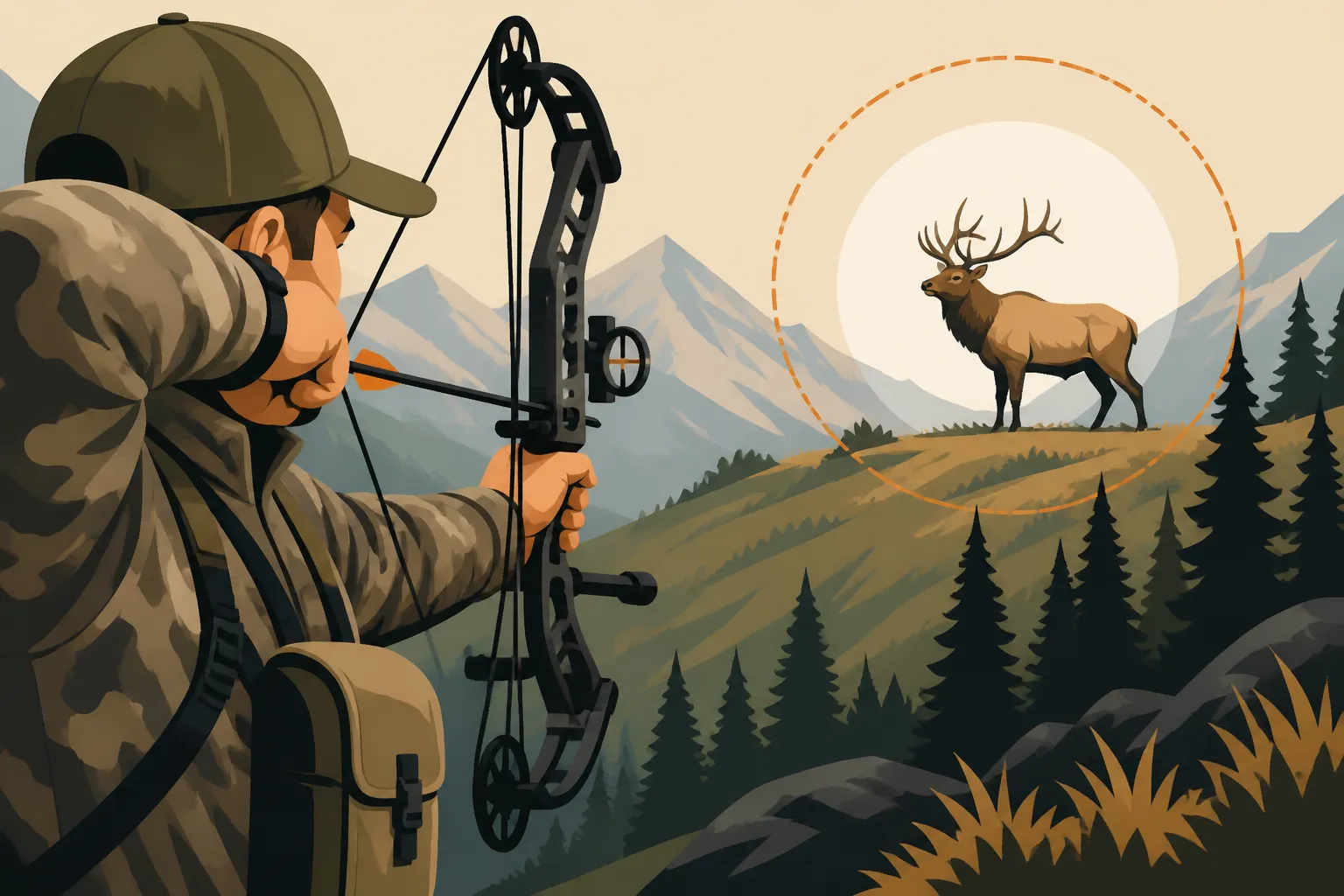
Every bowhunter carries a profound ethical responsibility the moment they nock an arrow in the field. Unlike a rifle, where energy transfer is immense and a larger margin for error often exists, archery relies entirely on precise shot placement to penetrate vital organs and cause rapid blood loss. This means we have to be absolutely certain of our capabilities. It's not about how far you can shoot on a flat range on a calm day, but how far you can consistently place an arrow into a 6-8 inch vital zone under pressure, at an unknown angle, with shifting winds, and possibly compromised footing. Push that limit, even by just five yards, and your chances of making a clean kill plummet dramatically. The goal isn't just to hit the target; it's to hit the right spot on the target, every single time.
Mitigating Target Panic and Buck Fever in the Field
Ah, target panic. The bane of many an archer's existence. That inexplicable urge to punch the trigger, lunge forward, or flinch right as the pin settles, often exacerbated by the adrenaline surge of seeing a magnificent animal. It’s a real and frustrating phenomenon. The pressure of a real hunting scenario, often dubbed "buck fever," can make even a familiar 20-yard shot feel like 60. This is where realistic practice truly shines. By consistently practicing at distances that challenge your form and focus without pushing you past your comfort zone, you build muscle memory and mental resilience. If you've confidently executed hundreds of perfect shots at 40 yards in practice, that 35-yard opportunity in the field becomes less intimidating. You learn to trust your process, allowing your body to execute the shot mechanically while your mind focuses on the ethical placement. Remember, the goal of practice is to make the shot routine, so when adrenaline hits, your body takes over with practiced precision, minimizing the grip of target panic.
Factors Defining Your Personal Effective Range
Your "effective range" isn't a fixed number; it's a dynamic assessment influenced by a multitude of variables. It's the maximum distance at which you, with your specific gear, can consistently and ethically put an arrow into an animal's vital zone under actual hunting conditions. Ignoring these variables is a recipe for heartbreak.
Assessing Your Gear and Physical Limits
Let’s start with the tools of the trade. Your bow setup plays a huge role. A slower bow, for example, might be less forgiving of minor form errors at longer distances because the arrow spends more time in the air, allowing external factors like wind to affect it more. Consider your arrow weight. An extremely light arrow might fly fast and flat, but it could struggle with penetration on larger game like elk, especially if it encounters bone. Many seasoned hunters will tell you about the importance of Arrow Weight That Gets Through an Elk. Similarly, your choice of broadhead matters immensely. Are you shooting fixed blade or mechanical? Each has its pros and cons, especially when it comes to accuracy at various distances and penetration. You might want to explore the differences between Fixed Blade Against Mechanical Broadheads on Elk before making a final decision.
Beyond your equipment, your physical condition is paramount. Can you draw your bow smoothly and hold it steady after a strenuous hike up a steep ridge? Are you shaking after a burst of adrenaline? Fatigue, cold, and even excitement can significantly impact your ability to hold steady. Your draw weight is also a key factor. While Idaho requires a minimum peak draw weight, knowing your comfortable and sustainable draw weight is more important. Your ability to consistently hold at full draw, especially with modern compound bows that have a high Compound Bow Let-Off and Measured Draw Weight, directly impacts your accuracy. Don't compromise form for poundage; accuracy trumps power every time.
Environmental Challenges in Idaho's Backcountry
Idaho offers some of the most stunning, yet challenging, hunting terrain in the Lower 48. These environmental factors significantly shrink your realistic effective range compared to a flat range.
- Wind: A gentle breeze on the range might barely nudge your arrow. In the mountains, that "gentle breeze" can funnel through canyons, gusting unpredictably. Even a 5-10 mph crosswind can push an arrow several inches off target at 40 yards, potentially turning a vital shot into a gut shot. You have to learn to read the wind, not just at your position, but also across the flight path of your arrow.
- Elevation and Shot Angles: Shooting downhill or uphill dramatically changes your point of impact due to gravity's effect on the arrow's flight path. A 30-yard shot at a steep downhill angle might require you to aim for what feels like 20 yards. Rangefinders with angle compensation are invaluable here, but you still need to practice these shots. What feels like a simple downhill shot can lead to an arrow sailing over the animal if you don't adjust correctly. This is particularly relevant in units like those found in the Clearwater country or the Frank Church wilderness.
- Obstacles and Cover: Trees, brush, tall grass – these are your constant companions in Idaho. A seemingly clear shot can have a hidden branch just inches from your arrow's path, deflecting it entirely. Practicing shooting through small gaps, or from compromised positions (kneeling, sitting, twisted), will prepare you for these realities.
- Light Conditions: Early morning or late evening often present the best hunting opportunities, but also the lowest light. Can you still clearly see your pins and your target's vitals? The ability to pick a spot, not just a patch of hide, diminishes with low light.
These variables underscore why "range distance" and "hunting distance" are often two very different numbers.
Building Your Skill Through Intentional Practice
Moving beyond simply flinging arrows, intentional practice is about simulating the challenges of the field and systematically refining your abilities. It's about building confidence through repetition, under conditions that mimic reality.
From Flat Ground to Field Simulation: Practical Drills
Start with the basics, always. Consistent, perfect form at known distances on a flat range is your foundation. But once you've achieved that, it's time to get creative and push yourself into real-world scenarios.
- Varying Distances: Don't just shoot 20, 30, 40, 50. Throw in odd distances like 27, 34, 48. This forces you to estimate or dial your sight rather than relying on muscle memory for fixed pins.
- Angled Shots: Find a hill or an elevated platform. Practice shooting uphill and downhill at various angles. Pay attention to how your body position changes and how it affects your anchor and release. Use an angle-compensating rangefinder, but also practice estimating distances on slopes, then verifying.
- Compromised Positions: Practice shooting from your knees, sitting, squatting, or even twisting your torso. That elk might not present a perfect broadside shot from a level stance. You might be tucked into a sparse patch of cover, needing to get low. These awkward positions challenge your form stability.
- Quick Draws and Holds: In hunting, animals rarely pose for an extended period. Practice drawing your bow quickly, settling your pin, and executing the shot within a limited timeframe (e.g., 10-15 seconds). This helps build speed and efficiency, crucial for those fleeting opportunities.
- Obstacle Course: Set up targets behind simulated brush (cardboard boxes, small branches). Practice identifying narrow shooting lanes and executing precise shots through them.
- Unannounced Distances: Have a friend set up targets at unknown distances, making you range them and shoot under mild pressure. This simulates the unknown nature of a hunting encounter.
Remember, the goal is not to impress anyone, but to build rock-solid confidence in your ability to consistently hit a specific spot under duress.
Mental Toughness and Pressure Drills
The mental game in bowhunting is arguably as important as the physical. Your mind can be your greatest asset or your worst enemy.
- Simulated Hunt Scenarios: Before a hunt, mentally walk through various scenarios. What if a bull appears at 60 yards? What if he's 25 yards but behind a tree? Visualize your shot process for each. Then, physically enact some of these during practice. For instance, walk a hundred yards, stop, immediately draw and shoot a target. Simulate being out of breath.
- "The Shot Clock": Set a timer for a short period (e.g., 15 seconds) once you draw back. This simulates the fleeting opportunity of a real animal. It forces you to focus and execute without overthinking.
- High-Stakes Shots: At the end of a practice session, declare one shot as the "hunt shot." If you miss your mark, you have to do 20 push-ups or clean all the targets. This introduces a low-level consequence, building mental resilience for real pressure.
- The "One Arrow" Rule: Sometimes, only one arrow counts. During a practice session, try a scenario where you only get one shot at a given target. Make it count. This trains you to value each shot and execute with precision from the very first draw.
Engaging with resources like GoHunt can further enhance your mental preparation. Their detailed maps and data for specific units can help you visualize the terrain and potential shot scenarios you might encounter, linking your practice directly to the ground you'll hunt.
The Role of Consistent Bow Tuning
All the practice in the world won't matter if your bow isn't tuned perfectly. A well-tuned bow is forgiving, meaning it will group arrows more consistently even with minor inconsistencies in your form. A poorly tuned bow will amplify those errors, sending arrows flying erratically. It’s a painstaking process, but absolutely essential for ethical hunting. From paper tuning to bare shaft tuning, and micro-adjusting your rest and cams, there are several steps involved. Many hunters find that Bow Tuning Worth Doing Before a Mountain Hunt is an annual ritual, if not more frequent, especially after changing strings or arrows. A bow that shoots broadheads and field points to the same spot is a confident bow, and a confident hunter.
Applying Practice to Idaho's Diverse Terrains
Idaho is a land of incredible contrasts, from the sprawling high desert to dense timber and rugged mountains. Each unique environment presents different challenges and dictates what your realistic shooting distance might be.
Western Mountains and Open Country
Picture yourself in the Idaho Breaks or the remote country of the Salmon-Challis National Forest. Here, the terrain is often steep, open, and wind-swept. Opportunities for longer shots might arise, but they come with significant caveats.
- Distance Deception: Distances in open, vast country can be incredibly deceiving. A 50-yard shot might look like 30, or vice-versa. Always, always range your target. And if the animal is moving, estimate the distance to where you anticipate the shot will occur.
- Wind Effects: As mentioned, wind is a major factor. The longer the shot, the more pronounced the effect. In these areas, practicing in gusty conditions is non-negotiable. Learn to hold for wind, aiming into it slightly, or wait for lulls.
- Steep Angles: Shooting up or down significant inclines is common. Practice these shots extensively. Remember, gravity pulls the arrow towards the earth, so when shooting downhill, your arrow will hit higher than your pin suggests, and vice versa for uphill shots. Rangefinders with angle compensation are your friend, but practice makes perfect. For these situations, some hunters find that a Single Pin or Multi Pin in Steep Country offers a clearer sight picture and less clutter.
- Physical Exertion: Hiking these mountains demands top-tier Physical Conditioning for Idaho Backcountry. Your ability to steady your bow after a tough climb will be severely tested. Integrate cardio and strength training that mimics mountain hunting into your routine.
Timbered River Bottoms and Dense Cover
Now, shift your mental image to the dense timber of northern Idaho’s Panhandle or the thick river bottoms of the Clearwater country. Here, the game is completely different.
- Close, Quick Shots: You're often dealing with much shorter distances, typically 10-30 yards. But these shots are often fast and furious. An animal might bust out of cover and give you only a second or two before disappearing again. This emphasizes the need for quick target acquisition and a smooth, unhurried draw and release.
- Obstacle Negotiation: Thick trees, tangled brush, and downed logs are everywhere. You rarely get a perfectly clear lane. Practice shooting through small windows, rotating your body, and finding creative angles. This is where knowing How Close a Bowhunter Needs to Get on Elk truly comes into play – often, it's about closing the distance for a clean shot through a tight window, not just getting within range.
- Low Light and Shadows: Timbered areas are naturally darker, even in midday. Animals can melt into the shadows. Your ability to pick out vitals and aim precisely is challenged.
- Animal Behavior: Game in timber tends to be jumpier and more reactive to sound and movement. Patience and stealth are key, as is the ability to make minimal movement during your draw cycle.
Scouting and Preparing Your Hunt Area
One of the most valuable tools for aligning your practice with reality is thorough scouting. Long before you even set foot in the field, you can leverage modern technology to get a lay of the land. Using platforms like GoHunt, you can engage in extensive E-Scouting an Idaho Unit Before the Season. This allows you to study topography, identify potential bedding areas, feeding zones, and water sources. Crucially, it helps you visualize the type of shot opportunities you might encounter.
By examining satellite imagery and topographical maps, you can understand the elevation changes, the density of timber, and the openness of different areas. This insight informs your practice: "If I'm hunting Unit X, I need to practice more steep downhill shots at 30-45 yards." Or, "If I'm in Unit Y, I need to focus on quick, close-range shots in dense cover." Understanding Reading an Elk Zone Boundary on a Map and how different units within that zone can vary in terrain is vital. When you're out there, actively Reading Terrain Before You Pick a Camp or stalk route will give you a major advantage. Knowing the typical shot distances for specific areas you plan to hunt means you can tailor your practice regimen to those very conditions, drastically increasing your confidence and ethical range when it matters most.
Here's a quick look at how practice scenarios can build different skills:
| Practice Distance (Yards) | Scenario Type | Key Skills Tested |
|---|---|---|
| 20-30 | Quick draw, close cover, awkward positions | Form under pressure, quick target acquisition, shooting through small lanes |
| 30-40 | Varied angles (uphill/downhill), mild wind | Range estimation, angle compensation, wind doping, steady hold |
| 40-50 | Open terrain, moderate wind, small targets | Precision aiming, mental focus, follow-through, controlling torque |
| 50+ (Advanced) | Long hold, extreme angles, subtle wind shifts | Pin float management, complete understanding of ballistics, ultimate discipline |
Ultimately, your realistic archery practice distance for big game in Idaho is a deeply personal number. It’s not what your buddy can shoot, or what the guy on YouTube claims. It’s what you can consistently and ethically execute under the most demanding field conditions. Be honest with yourself, push your practice, not your limits, and you’ll find immense satisfaction in every hunt, whether an arrow is released or not.
Disclaimer
Hunting carries inherent risks, including serious injury or death. This guide provides general information for educational purposes and should not be considered a substitute for official Idaho Fish and Game regulations, professional hunting instruction, or personal judgment. Always consult the most current Idaho hunting regulations and prioritize safety and ethical hunting practices above all else.