Best All-Around Caliber for Timber and Breaks
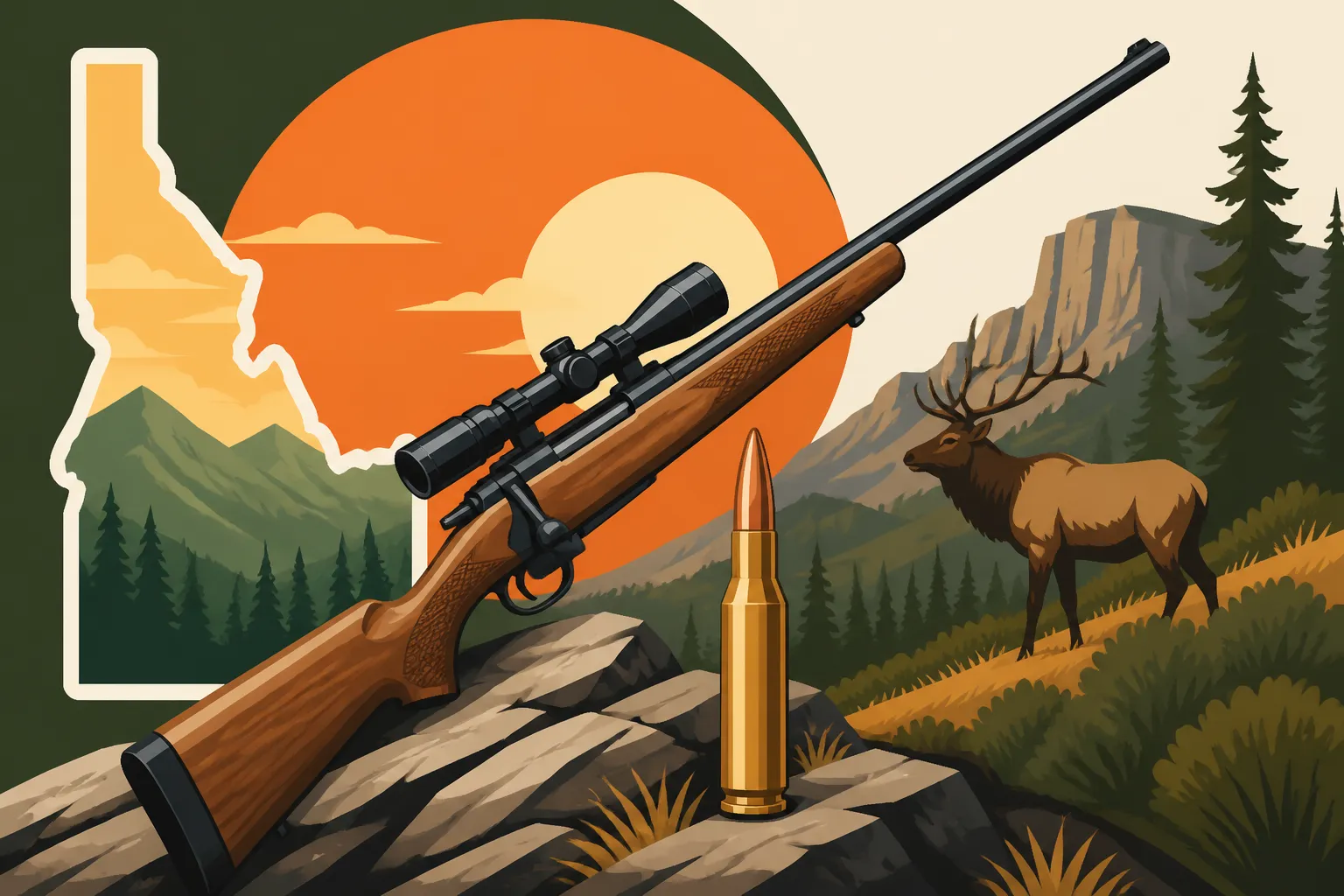
Choosing that one perfect rifle caliber for hunting in Idaho can feel like trying to pick a single tool for an entire workshop. You’re looking at dense, dark timber where shots are measured in yards, then eyeing vast, open mountain breaks where a shot could easily stretch past 300 or 400 yards. It’s a real head-scratcher, trying to find a cartridge that offers enough punch for elk in the thick stuff but still shoots flat enough for a distant mule deer across a canyon. This guide is all about cutting through that confusion, helping you understand what makes a caliber truly versatile for all of Idaho's varied terrain and game.
Understanding Idaho's Diverse Hunting Terrain
Idaho's landscape is a hunter's dream, but it's also incredibly demanding on your gear, especially your rifle. You're rarely in just one type of habitat for an entire hunt. One moment you might be still-hunting deep in an old-growth cedar grove, and the next you're cresting a ridge, looking out over miles of sage-covered hills or steep, rocky breaks. This geographical variety is precisely what makes the "best all-around caliber" such a hot topic of debate.
The Challenge of Dense Timber
Imagine yourself slipping through the thick, shadowed underbrush of northern Idaho's national forests. The air is damp, the ground is soft with duff, and visibility is often limited to 50 yards, sometimes even less. In these conditions, a shot at a whitetail deer or a bull elk might present itself quickly, and close. You need a bullet that can deliver a heavy punch at short range, often needing to penetrate brush or dense muscle and bone without fragmenting prematurely. Accuracy here isn't about pinpoint long-range precision as much as it is about quick target acquisition and reliable knockdown power. A powerful, moderate-velocity cartridge with a heavy, stout bullet truly shines in this environment, minimizing bullet deflection and maximizing energy transfer in a short amount of travel. This is where cartridges like the good old .30-06 Springfield have earned their reputation, launching substantial projectiles with authority.
The Expanse of Mountain Breaks
Now, mentally shift gears. You've hiked out of the timber and are glassing a sprawling canyon in the high desert or the rugged slopes of the Clearwater Mountains. Here, a trophy mule deer might be bedded 350 yards away, or an elk herd could be feeding on a distant bench. The challenge completely changes. Wind becomes a significant factor, requiring a bullet that resists drift. Trajectory, or how flat your bullet flies, becomes paramount because misjudging range by even a little can mean a clean miss or, worse, a wounded animal. For these scenarios, you're looking for a cartridge that pushes bullets at higher velocities with good ballistic coefficients, designed to maintain energy and accuracy over extended distances. You can learn more about specific techniques for covering vast distances by checking out our guide on Glassing Breaks and Benches for Mule Deer. This is where many hunters start looking at magnum cartridges, or at least those with a reputation for flat-shooting performance.
What "All-Around" Really Means for a Caliber
When we talk about an "all-around" caliber for Idaho, we're not just looking for a compromise; we're seeking versatility. It’s a cartridge that can ethically and effectively take common big game animals like deer, elk, and black bear across the full spectrum of Idaho's diverse hunting conditions. This means it needs to:
- Deliver sufficient energy: Enough kinetic energy at both close (timber) and extended (breaks) ranges to ensure a quick, clean kill on species up to elk.
- Exhibit reasonable trajectory: While not necessarily a laser beam, it should offer a manageable drop curve out to 300-400 yards, requiring minimal holdover adjustments.
- Handle varying bullet weights and types: The ability to load different bullet constructions (e.g., tough, bonded bullets for elk; lighter, faster bullets for deer) is a huge plus.
- Be manageable in terms of recoil: If you can't shoot it accurately due to excessive recoil, then all its ballistic advantages are moot. A consistent shot trumps raw power any day.
Ultimately, the best all-around caliber isn't about being the absolute best at one thing, but being consistently good at many things across the varied demands of an Idaho hunting season.
Key Characteristics of a Versatile Idaho Caliber
So, what should you really be looking for when you're sifting through all the options on the market? It's not just about what looks good on paper; it's about practical performance in real hunting situations.
Energy and Bullet Construction for Big Game
When you're chasing elk through dense timber or trying to anchor a mule deer on a windswept ridge, you need a bullet that performs. The most important factor here isn't just the caliber number, but the combination of bullet weight, velocity, and construction. For elk, a minimum of 1,500 foot-pounds of energy at impact is often recommended for ethical kills, with many hunters preferring significantly more, especially for quartering shots that require deep penetration. A bullet needs to hold together, expanding reliably without disintegrating.
Imagine you've drawn a coveted A Tag and are targeting an Idaho elk during archery season. Even if you're bowhunting, the principle of sufficient energy and proper bullet construction holds true for fixed blade or mechanical broadheads. For rifles, this means looking for bullets with heavy-for-caliber weights and robust construction, like bonded core bullets or monolithic copper designs. These bullets are engineered to penetrate deeply, retaining their mass and energy as they pass through hide, muscle, and bone, ensuring vital organ damage even on large, tough animals. Federal Premium's Trophy Bonded Tip or Hornady's CX are excellent examples of this type of modern bullet.
Recoil Management for Follow-Up Shots
Let's be honest, nobody enjoys getting hammered by their rifle. Excessive recoil can lead to flinching, poor shooting habits, and a general lack of confidence. And when you're hunting in Idaho, especially in the timber, quick follow-up shots are sometimes a necessity, not a luxury. If that first shot doesn't drop the animal, or if you're presented with a second opportunity at another animal, you need to be able to get back on target quickly and accurately.
A caliber that allows you to comfortably practice and shoot effectively is always better than one that you dread pulling the trigger on. For example, a .308 Winchester generally has milder recoil than a .300 Winchester Magnum, making it easier for many hunters to shoot precisely, especially in awkward field positions or when needing a quick second shot. This comfort level translates directly into better accuracy, which is always the most ethical path to a clean harvest. Even seasoned hunters can benefit from a rifle they can shoot all day without developing a flinch. When considering your setup, think about the total weight of your rifle; a heavier rifle will soak up more recoil than a lightweight mountain rifle chambered in the same cartridge.
Ballistics That Bridge the Gap
This is where the "all-around" aspect really comes into play. You need a bullet that isn't excessively dropping at 300 yards but also isn't over-penetrating light game at 50 yards with explosive expansion. A good balance means a relatively flat trajectory out to typical hunting ranges (say, 300-400 yards), coupled with enough energy retention for larger game at those distances.
Consider the classic .30-06 Springfield. It's not known for being the "flattest" shooter compared to some magnums, but it's incredibly versatile. With a 180-grain bullet zeroed at 200 yards, it might drop around 8-10 inches at 300 yards and 20-24 inches at 400 yards, depending on the load. These are highly manageable holdovers for most hunters with a little practice, especially if they use a ballistic calculator from resources like GoHunt or practice with their specific load. Compare that to a super-fast, lightweight bullet that might fly flatter but could potentially struggle with penetration on a large bull elk through the shoulder at 50 yards. The key is finding that sweet spot where a bullet has enough velocity and mass to perform reliably across the range of scenarios Idaho throws at you. You might also want to explore our thoughts on Rifle Zero Distance for Canyon Country Shooting to help dial in your setup.
Top Contenders for Idaho's All-Around Caliber
When you start digging into discussions about versatile hunting calibers, a few standouts consistently rise to the top. These cartridges have proven their worth over decades in diverse terrains, including Idaho's challenging landscapes.
The .30-06 Springfield: A Classic Workhorse
Ah, the venerable .30-06. If there’s one cartridge that almost perfectly embodies the spirit of "all-around," it's this one. Developed over a century ago for military service, it quickly proved its mettle in the hunting fields and has remained a staple ever since. Its popularity isn't just nostalgia; it's pure, unadulterated performance.
The .30-06 throws a wide range of .30-caliber bullets, typically from 150 grains up to 200 grains, with 165-grain and 180-grain bullets being incredibly popular for big game. At these weights, it launches bullets with more than enough energy for any non-dangerous game animal in Idaho, from deer and pronghorn to elk and black bear. For timber hunting, a 180-grain bullet will bust through brush and bone with authority, carrying significant momentum to anchor an animal quickly. When you step out into the breaks, that same 180-grain bullet, zeroed correctly, offers a very manageable trajectory out to 350-400 yards. While it won't be as flat as some magnums, the holdovers are consistent and predictable, especially if you know your rifle and load. The recoil is noticeable but generally manageable for most hunters, allowing for good control and quick follow-up shots. Ammunition is widely available and typically less expensive than magnum options, making practice more accessible.
The .308 Winchester: Compact and Capable
The .308 Winchester is another perennial favorite, particularly among hunters who appreciate a compact, lightweight rifle. This cartridge offers nearly identical ballistic performance to the .30-06 out to about 300 yards, all in a shorter action. This translates to lighter, handier rifles, which can be a real blessing when you're packing miles into the backcountry.
Just like its older brother, the .308 uses .30-caliber bullets, commonly ranging from 150 to 180 grains. For deer and black bear, a 150-grain or 165-grain bullet is fantastic, offering excellent velocity and energy. For elk, bumping up to a 180-grain bullet with a premium construction is a solid choice. In the dense timber, its performance is excellent, providing ample knockdown power without excessive recoil. Out in the open breaks, while its velocity will start to drop off a bit more significantly than a .30-06 past 300 yards, it remains very effective out to 400 yards with modern bullet designs. Its inherently accurate nature means that many rifles chambered in .308 Winchester are tack-drivers, boosting confidence when that long shot presents itself. The lighter recoil also makes it a great choice for hunters who are recoil-sensitive or those who simply want to shoot more comfortably.
The 7mm Remington Magnum: Power with Flatter Trajectory
If you lean towards needing a bit more reach and flatter trajectory for those longer shots across the breaks and canyons, the 7mm Remington Magnum often enters the conversation. This cartridge is a true magnum, designed for higher velocities and more energy at extended ranges.
The 7mm Rem Mag shoots a smaller diameter (.284-inch) bullet than the .30-calibers, but it pushes these bullets (typically 140 to 175 grains) at blistering speeds. This results in a significantly flatter trajectory compared to the .30-06 or .308, making those 300-500 yard shots much more forgiving in terms of trajectory drop. For large mule deer or elk across an Idaho canyon, this can be a real advantage, especially if you're not perfectly dialed into your rangefinder. The energy delivered by a 7mm Rem Mag, particularly with heavier, premium bullets, is more than sufficient for elk-sized game, even at longer distances. However, this increased performance comes with a trade-off: recoil. The 7mm Rem Mag definitely kicks more than a .30-06 or .308, which can affect shooter comfort and accuracy if you're not used to it. Consistent practice is crucial to mastering this cartridge. You might also consider this as a good option when you're Choosing a Rifle for Idaho's Timber and Breaks for its versatility.
The .300 Winchester Magnum: When Power is Paramount
For those who prioritize maximum power, flat trajectory, and superior long-range performance, the .300 Winchester Magnum is often the go-to. It's a heavy hitter, capable of taking any big game in North America, and certainly any in Idaho, with authority.
The .300 Win Mag is essentially a souped-up .30-caliber, pushing the same range of bullet weights (150-200+ grains) at much higher velocities than the .30-06. This translates to a very flat trajectory and outstanding energy retention, even at ranges exceeding 500 yards. If you frequently find yourself hunting vast, open country where long shots are the norm, or if you simply want the peace of mind of maximum power, the .300 Win Mag delivers. For big bull elk in the breaks, a well-placed shot from a .300 Win Mag is incredibly effective. However, there's no escaping the recoil. The .300 Win Mag kicks substantially, often requiring a rifle with a good recoil pad, a muzzle brake, or a heavier rifle to make it manageable for extended shooting sessions or follow-up shots. It's a cartridge that demands respect and plenty of practice to shoot accurately. You can use platforms like GoHunt to analyze cartridge ballistics and see how the .300 Win Mag performs against other calibers at varying ranges, helping you determine if its power is worth the increased recoil for your personal shooting style.
Here's a quick comparison of these popular "all-around" calibers:
| Caliber | Common Bullet Weights (gr) | Recoil Level | Trajectory (Relative) | Energy (Relative) | Ideal Use Case |
|---|---|---|---|---|---|
| .30-06 Springfield | 150-200 | Moderate | Good | Excellent | Versatile, all North American big game, accessible |
| .308 Winchester | 150-180 | Mild-Moderate | Good | Very Good | Shorter action, lighter rifles, highly accurate |
| 7mm Remington Magnum | 140-175 | Moderate-Heavy | Flatter | Excellent | Longer range, flatter trajectory, good on elk |
| .300 Winchester Magnum | 150-200+ | Heavy | Very Flat | Superior | Extreme range, maximum power, tough game |
Making Your Final Caliber Decision
Ultimately, the "best" all-around caliber isn't just a number; it's a personal choice that blends ballistic capability with your individual shooting comfort and hunting style.
Matching Your Personal Shooting Style and Comfort
This is perhaps the most critical factor. It doesn't matter how powerful or flat-shooting a cartridge is if you can't shoot it accurately and consistently. If a magnum's recoil makes you flinch, you'll be far less effective than with a milder-recoiling cartridge that you can shoot with confidence. Spend time at the range with different rifles and calibers if possible. See what feels good, what allows you to hold a tight group, and what you can comfortably shoot from various positions—bench, prone, kneeling, and off-hand—just like you might in the field.
Think about the amount of practice you're willing to put in. A .30-06 or .308 allows for more comfortable, affordable practice, which builds skill and confidence. If you opt for a .300 Win Mag, be prepared to invest more time and potentially money in mastering its recoil and ballistics. A great way to prepare for your Idaho hunt, regardless of caliber, is to push your Realistic Archery Practice Distance for Big Game, or rifle equivalent, in varied conditions.
Bullet Selection: The Real Game Changer
While the caliber gets all the attention, the bullet you choose to put in that caliber is often a more significant factor in terminal performance. Modern bullet technology has advanced so much that many standard calibers can perform like magnums with the right projectile.
For timber hunting, you'll want a tough, controlled-expansion bullet that will penetrate deeply through heavy hide and bone without fragmenting. Examples include Nosler AccuBond, Barnes TTSX, Hornady InterBond, or Swift A-Frame. These bullets retain a high percentage of their weight, ensuring they reach the vitals of even a large bull elk. For open country and longer shots, a bullet with a high ballistic coefficient (BC) will help cut through the wind and retain velocity and energy better. Many of the same premium hunting bullets mentioned above also feature excellent BCs, making them truly versatile. Don't underestimate the impact of choosing the right bullet for your intended game and conditions; it can elevate the performance of any "all-around" caliber. It's worth researching specific bullet designs and how they perform on target. Sites like GoHunt provide valuable data and reviews that can help you compare options based on real-world hunter experiences.
Rifles and Optics: Optimizing Your Setup
Finally, the caliber is only one part of the equation. The rifle itself and the optic you mount on it complete the system. A lightweight rifle might be wonderful for packing up steep terrain, but it will increase felt recoil. A heavier rifle will absorb more recoil, making magnum calibers more manageable.
For hunting in dense timber, a compact rifle with a shorter barrel (e.g., 20-22 inches) can be easier to maneuver through thick brush, and a lower magnification scope (e.g., 2-10x or 3-9x) with a wide field of view is ideal for quick, close shots. For the wide-open breaks, a longer barrel (24-26 inches) can squeeze a bit more velocity out of a cartridge, and a higher magnification scope (e.g., 4-16x or 4.5-14x) with good light-gathering capabilities is beneficial for spotting and aiming at distant animals. Some hunters even opt for Quick Detach options on their optics, allowing them to swap between a low-power red dot or fixed sight for timber and a higher power scope for open country, though this is less common for an "all-around" setup. Regardless of your choice, ensure your rifle is properly sighted in, and you're confident in its accuracy and feel.
Remember, the goal is ethical hunting. Choosing a versatile caliber that you can shoot accurately, coupled with the right bullet for the job, will set you up for success across Idaho's amazing and diverse hunting opportunities.
Disclaimer
The information provided in this guide is for general educational purposes only and should not be considered legal advice. Hunting regulations, seasons, and licensing requirements in Idaho can change frequently. Always consult the most current official Idaho Department of Fish and Game regulations or contact the IDFG directly before planning any hunting activity.