Do Shooting Hours Shift Through the Season?
It’s a common moment of confusion for so many of us out in the field: as the seasons change, and the days get shorter or longer, we find ourselves squinting at our watches, wondering if legal shooting light has truly arrived or if we’re still waiting for that extra minute. The truth is, legal shooting hours for big game in Idaho do shift throughout the season, not because the rules themselves change, but because the sun has a mind of its own. This guide will clarify exactly how these hours work, what you need to know to stay legal, and how to track them accurately for a successful hunt.
Understanding Idaho's General Big Game Shooting Hours
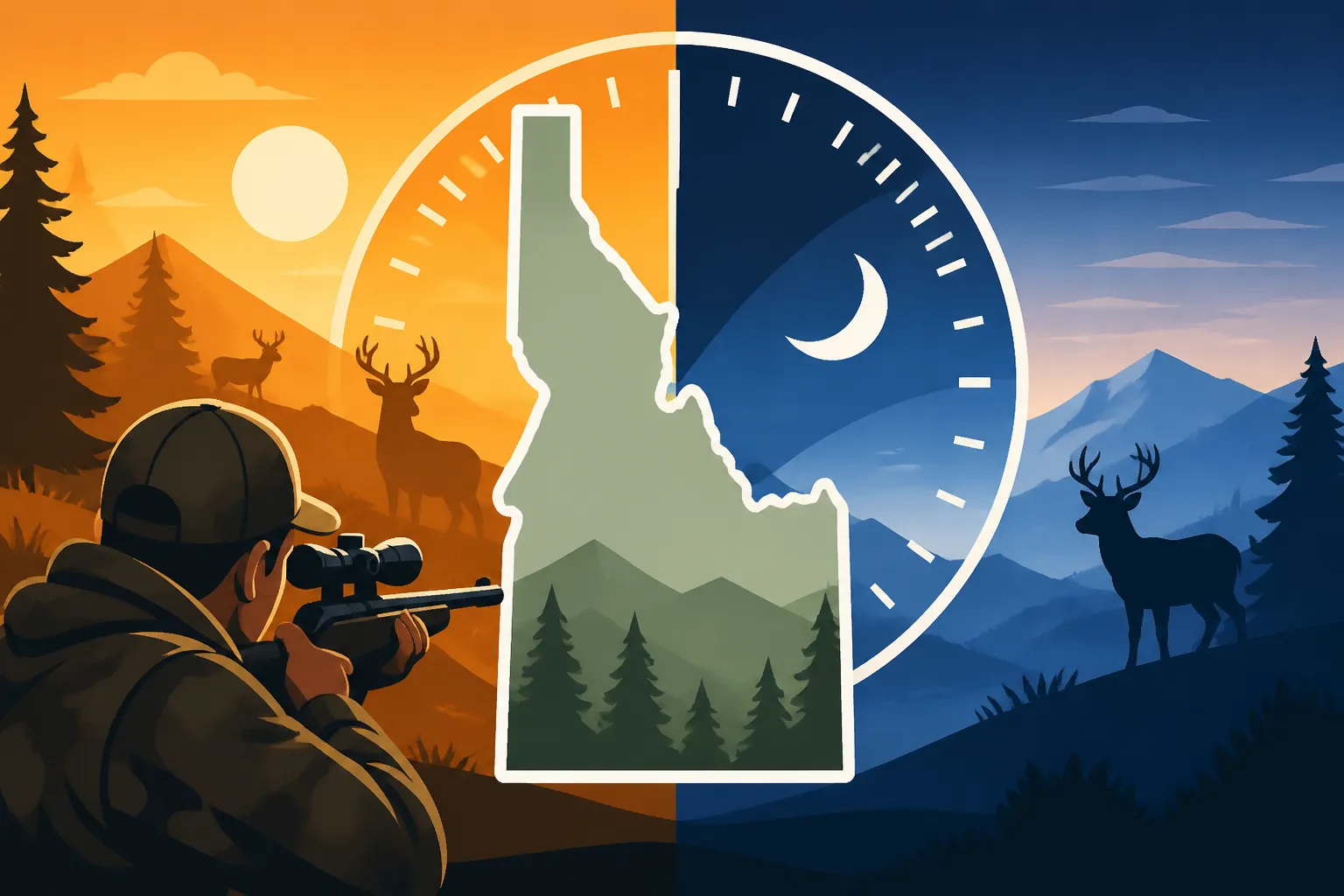
Let's cut right to the chase: for most big game hunting in Idaho, the rule of thumb is that you can hunt from half an hour before official sunrise to half an hour after official sunset. This isn't a suggestion; it's a hard and fast rule designed to ensure fair chase, promote ethical shot opportunities, and provide a clear boundary for all hunters.
The Standard Timeframe: Half-Hour Before to Half-Hour After
This consistent window of legal light is a cornerstone of Idaho hunting regulations. The idea is to give you enough ambient light to clearly identify your target, ensure a clean shot, and avoid any mistakes. Think about those misty mornings or late evenings when the light is fading fast – that half-hour before sunrise and after sunset provides a crucial buffer. It’s enough time to get into position or wait for a last-minute opportunity, but not so much that you're hunting in true darkness. This rule applies across the board for species like elk, deer, moose, and bear during their general and controlled seasons. It's one of the bedrock principles, similar to understanding that Idaho Requires a 40-Pound Bow at a 28-Inch Draw for archery or being aware of Idaho Muzzleloader Caliber Minimums: .45 for Deer, .50 for Elk for those specific hunts.
The rationale is rooted in both safety and ethics. Trying to identify game, especially antlered or horned animals, in poor light dramatically increases the risk of misidentification, a poor shot, or even accidentally targeting another hunter. By standardizing this timeframe, Idaho Fish and Game aims to create a level playing field and minimize unfortunate incidents.
How "Sunrise" and "Sunset" Are Defined
Now, this is where the "shifting" part comes in. When Idaho Fish and Game talks about "official sunrise" and "official sunset," they're not talking about when you think the sun clears the horizon or dips below it. They're referring to specific astronomical events, precisely calculated for your location. These times are published and widely available, and they are what game wardens use to enforce the rules.
These times are constantly changing, sometimes by only a minute or two a day, but those minutes add up quickly over a hunting season. For example, the sunrise time in early September is vastly different from what it is in late October, even though the "half-hour before" rule stays the same. This means you can't just memorize a single set of times for the entire season. You need to be aware of the daily adjustments. Many hunters, especially those who prefer early morning or late evening sits, meticulously track these times to maximize their legal hunting window. Without this knowledge, you might be heading out too early or staying too late, unknowingly putting yourself at risk of a violation.
Do Shooting Hours Shift? The Short Answer and The Nuance
Yes, absolutely, shooting hours do shift through the season. This isn't Idaho Fish and Game changing the regulations on a whim; it's simply a reflection of the earth's rotation and orbit around the sun. The core rule—half-hour before sunrise to half-hour after sunset—remains constant, but the actual clock times for sunrise and sunset change every single day.
The Dynamic Nature of Daylight
Think about it: in June, the days are long, and in December, they're short. Idaho's hunting seasons span months, from spring bear and early archery elk to late-season rifle deer hunts. Over that period, the amount of daylight fluctuates dramatically.
For instance, if you're hunting archery elk in the Panhandle in early September, you might be looking at a sunrise around 7:00 AM, making legal shooting light start at 6:30 AM. Fast forward to a late-season deer hunt in December, and sunrise might not be until 8:00 AM, pushing your start time to 7:30 AM. That's a full hour difference in the start of legal light! The same applies to sunset. A late September evening hunt might extend until 7:30 PM, but by late November, you could be packing up by 5:00 PM. These shifts are significant and require your attention. It’s vital to adjust your hunting schedule daily or weekly to stay within the legal framework, much like how you would adjust your tactics based on factors like Reading Wind in Steep Timbered Country or scouting new areas through E-Scouting an Idaho Unit Before the Season.
Why Official Times Are Crucial, Not Just a Guess
You might think, "Oh, it's close enough," but when it comes to hunting regulations, "close enough" often isn't good enough. Game wardens are highly trained and equipped with the tools to determine exact sunrise and sunset times for any given location and date. They are not interested in your approximation or your best guess. If you take a shot even a few minutes outside of the legal window, you could be facing a hefty fine, loss of hunting privileges, and confiscation of your harvest.
Imagine you're tucked into a blind, watching a beautiful mule deer buck as the light begins to fade. You glance at your phone, and it says 6:45 PM, with official sunset at 7:10 PM. That gives you 25 minutes of legal light left. But if your phone's time is off, or you're relying on a general idea, and sunset was actually 7:00 PM, then your legal shooting time ended at 7:30 PM. The game warden checking on your harvest might have a very different set of data, leading to a serious violation. It's a tough lesson to learn, which is why precise tracking is non-negotiable.
Tools and Resources for Tracking Idaho Shooting Hours
Thankfully, in this modern age, keeping track of daily shifting shooting hours isn't nearly as difficult as it once was. You don't have to carry a massive astronomical almanac in your pack anymore!
Your Smartphone and Hunting Apps
For many hunters, their smartphone has become an indispensable tool in the field. There are numerous hunting-specific apps available that provide real-time, location-based sunrise and sunset data, automatically calculating your legal shooting light window. Apps like GoHunt, onX Hunt, and others have this feature built right in, often showing you a countdown to the start or end of legal light.
These apps are fantastic because they use your device's GPS to provide precise times for your exact location, not just a general city. This is crucial when you're deep in the backcountry, far from a major town. Just remember to always keep your phone charged, or carry a power bank, because a dead phone won't do you any good when that bull steps out at last light. It's another example of how technology, combined with a good understanding of rules like Idaho's Motorized Hunting Rule Keeps You on the Road, can enhance your hunting experience.
Idaho Fish and Game Publications and Online Resources
While apps are convenient, always cross-reference with official sources. The Idaho Fish and Game (IDFG) publishes annual hunting regulations booklets that often include tables or information on where to find sunrise and sunset times. Their website, particularly the "Idaho Legal Shooting Hours for Big Game" section, is another excellent and authoritative resource.
It’s a good habit to check the IDFG website for your specific unit or region, or consult the printed regulations booklet for the most accurate and official information. This not only confirms what your apps are telling you but also ensures you're looking at the most current data, especially if there were any unexpected changes or clarifications. After all, the IDFG is the ultimate authority on all things Idaho hunting, from season dates to understanding How Idaho Measures Draw Weight at 28 Inches for bowhunters.
The Importance of a Reliable Watch or Device
Beyond your smartphone, a good, reliable watch is a hunting essential. Even if your phone battery dies, or you lose signal, a wrist-mounted device can keep you informed. Many modern outdoor watches (like those from Garmin or Suunto) can also provide sunrise/sunset data, sometimes even tracking moon phases, which can be useful for planning.
Before you head out, make sure your watch is set to the correct time and that it’s synchronized with official sources. It might seem like a small detail, but being off by five or ten minutes could be the difference between a legal harvest and a violation.
Here's a quick look at how sunrise and sunset times can shift throughout the year in Boise, Idaho, to illustrate the point:
| Month (2024) | Approximate Sunrise (Boise) | Approximate Sunset (Boise) | Legal Shooting Begins | Legal Shooting Ends |
|---|---|---|---|---|
| May 15 | 6:15 AM | 8:45 PM | 5:45 AM | 9:15 PM |
| July 15 | 6:10 AM | 9:10 PM | 5:40 AM | 9:40 PM |
| Sept 15 | 7:00 AM | 7:40 PM | 6:30 AM | 8:10 PM |
| Nov 15 | 7:30 AM | 5:20 PM | 7:00 AM | 5:50 PM |
| Dec 15 | 7:55 AM | 5:10 PM | 7:25 AM | 5:40 PM |
Note: These are approximate times for illustration. Always verify exact times for your specific location and date from official sources or a reliable hunting app.
Exceptions and Special Considerations
While the "half-hour before/after" rule is standard for big game, it's always worth being aware that some other hunting activities might have different rules.
Specific Seasons or Species with Different Rules
Generally speaking, for big game like deer, elk, moose, and bear, the "half-hour before official sunrise to half-hour after official sunset" rule holds steadfast. However, if you venture into other types of hunting, you'll find variations. For instance, predator hunting, especially for coyotes, can sometimes extend into night hours with the aid of artificial light in certain areas. Waterfowl hunting often has specific legal shooting times that align with federal regulations.
But for the big game hunter, especially when you're focused on an elk or deer tag, stick to the standard rule. Don't assume that just because you can hunt coyotes at night in one area, the same applies to your general elk season. Idaho Fish and Game is very clear about these distinctions in the regulations. This is similar to how rules for a muzzleloader-only hunt explicitly state Why Idaho Muzzleloader-Only Hunts Ban Scopes and Inline Ignition, differentiating them from general weapon seasons.
Daylight Saving Time
Ah, Daylight Saving Time – the annual clock change that seems to confuse everyone, especially hunters. When the clocks "spring forward" or "fall back," the numbers on your watch change, but the actual amount of daylight doesn't. This means that while sunrise might suddenly appear an hour later on your clock after the "fall back" change, the sun is still rising at the same absolute time in the sky.
The important thing to remember is that the "half-hour before official sunrise" rule is tied to the sun's position, not your clock. So, when Daylight Saving Time ends in the fall, and your clock "falls back" an hour, be extra careful. If sunrise was 7:30 AM before the change, it will now be 6:30 AM on your newly adjusted clock, meaning legal shooting light will also start an hour "earlier" by your clock. Always double-check your official sunrise/sunset times after the time change to avoid any miscalculations.
Practical Advice for Staying Legal and Ethical
Navigating the shifting shooting hours can feel like a chore, but it's a critical part of being a responsible and ethical hunter.
Planning Your Hunt Around Legal Light
Every good hunt plan should factor in legal shooting hours. For morning hunts, this means knowing precisely when you need to be in your stand or at your vantage point, ready to go, the moment legal light begins. It means budgeting enough time for a quiet approach in the dark, without spooking game. If you're planning a full day out, knowing when legal light ends dictates your evening strategy: do you need to start packing out earlier, or can you sit those extra 20 minutes for a last-minute opportunity?
Consider using the early and late moments of legal light to your advantage. Animals are often most active during these crepuscular hours. Knowing your exact window allows you to optimize your strategy. Whether you're Bugling Elk in Idaho's Timbered Zones or trying to catch a mule deer moving to feed, those first and last minutes of legal light can be prime time.
When in Doubt, Don't Pull the Trigger
This is the golden rule, the ethical imperative that every hunter should live by. If you are even slightly unsure if it's legal shooting light, or if you can't clearly identify your target, or if you don't feel you can make a clean, ethical shot, do not pull the trigger.
It's far better to let an animal walk away and return another day than to risk a violation or, worse, wound an animal in poor light and lose it. Low light conditions can make judging distance difficult, obscure vital areas, and make tracking a wounded animal incredibly challenging. Ethical hunting demands that you only take shots when you have absolute certainty. Always prioritize a humane harvest over filling your tag, especially when the light is borderline.
Disclaimer
Please remember that hunting regulations can change. While this guide provides a comprehensive overview of Idaho's big game shooting hours, it is your responsibility to always consult the current Idaho Fish and Game regulations for the most up-to-date and specific information before heading into the field.