Two-Hunter Calling Setups That Actually Work
It's a familiar scenario for many Idaho elk hunters: you hear a distant bugle, your heart starts pounding, and you decide to try calling him in. You let out your best bugle or cow call, mimicking the sounds you’ve practiced relentlessly, only to have the bull hang up just out of sight, circle wide to catch your wind, or simply go silent, leaving you wondering where you went wrong. The truth is, bringing a wary bull into shooting range, especially on pressured public land, is incredibly challenging when you're going it alone. This guide will walk you through effective two-hunter calling setups that actually work, transforming how you approach those stubborn Idaho bulls and significantly boosting your chances of success.
The Limitations of Solo Calling in Elk Hunting
While the romance of a solo hunt is undeniable, and the feeling of self-reliance it instills is profound, trying to call in elk by yourself presents a stacked deck against you, particularly when dealing with mature bulls that have already graduated from "elk hunting school" (meaning they've been hunted before). When you're the sole source of sound, you're tasked with the impossible dual role of being both the enticing elk and the ready shooter. This often leads to critical compromises that can cost you an opportunity.
A bull approaching a lone caller has one singular point of focus for the source of the sound. His inherent caution, honed by generations of survival, will almost always lead him to circle downwind, attempting to pinpoint the "elk" by scent. As a solo hunter, this puts you in an agonizing position: do you abandon your calling post and try to intercept him, risking being busted, or do you freeze, hoping he makes a mistake and walks into range before smelling you? Neither is an ideal option. The bull's incredible senses – his ears mapping your location, his nose seeking your danger – are constantly working in concert, making it nearly impossible to maintain a believable illusion while simultaneously being ready for a clean shot.
Beyond the tactical hurdles, there's the intense pressure of performance. Imagine a bull bugling closer, his hot breath visible in the crisp morning air, adrenaline coursing through your veins. You might be trying to quietly nock an arrow, adjust your rifle scope, or switch from a bugle tube to a cow call, all while fighting the urge to move and remaining absolutely motionless. This multi-tasking often results in fumbled gear, detected movement, or a hurried, unethical shot. These situations are tough enough when everything goes perfectly, let alone when you’re doing it all yourself in the rugged Idaho backcountry.
Understanding the Two-Hunter Calling Advantage
Introducing a second hunter into your elk calling strategy isn't just about doubling your manpower; it's about amplifying your tactical capabilities and exponentially increasing your odds. This strategic partnership allows for a clear division of labor, enabling you to mimic the complex social dynamics of an elk herd far more effectively. Critically, it directly addresses the primary weaknesses of solo calling: minimizing scent and visual detection, and crafting a truly convincing "herd" scenario. With two people, you can unlock dynamic and believable interactions that can fool even the most cagey Idaho bulls.
The Caller-Shooter Dynamic
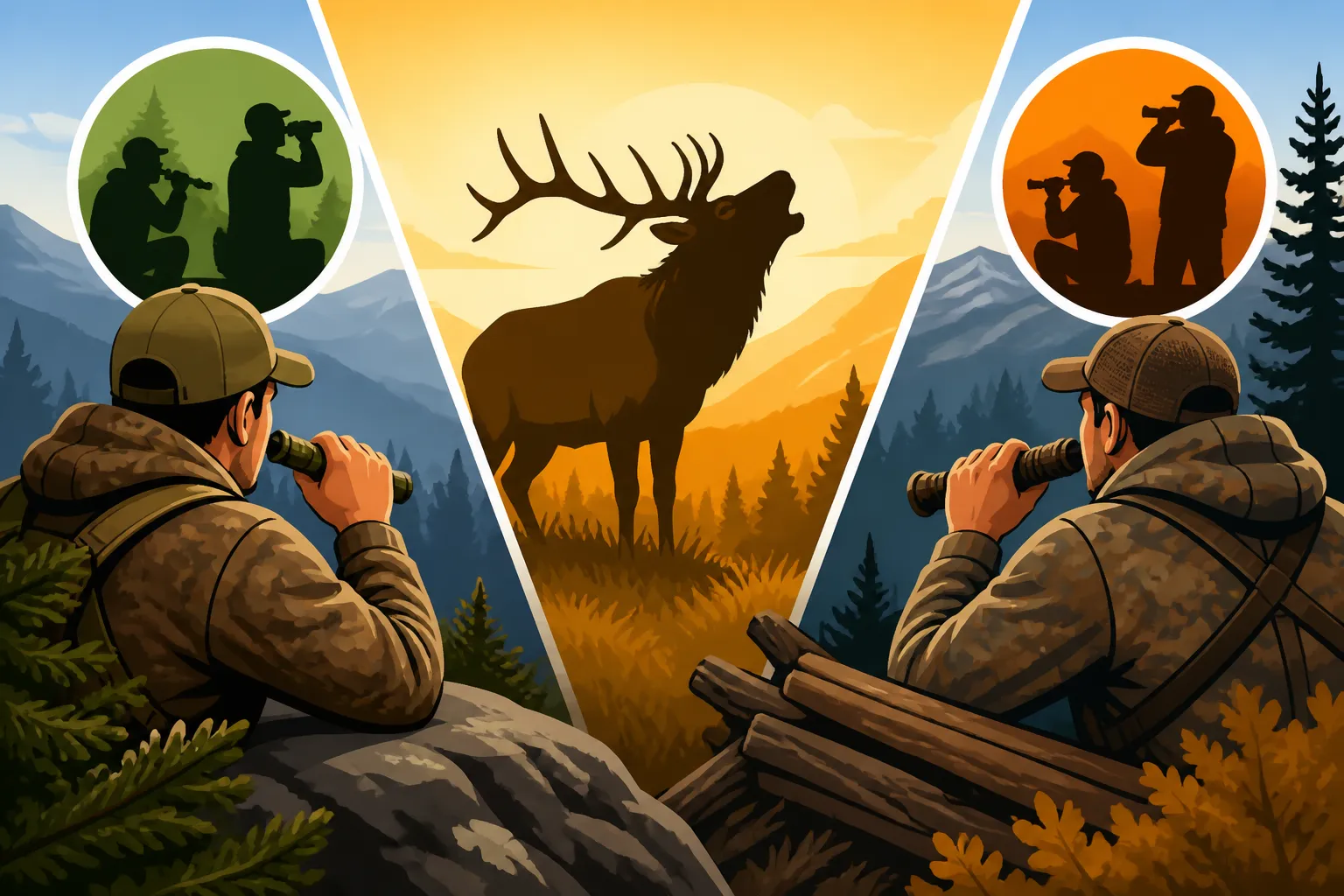
The most fundamental and powerful advantage of a two-hunter setup is the separation of roles into a dedicated caller and a dedicated shooter. This clear division allows each individual to immerse themselves fully in their primary task without distraction. The caller can focus entirely on producing a nuanced range of elk vocalizations – from soft cow mews to aggressive bugles – varying tone, volume, and rhythm to weave a compelling narrative. They can listen intently to the bull's responses, adjust their calls on the fly, and expertly keep the bull’s attention fixated on their position. This freedom means the caller can be as aggressive or subtle as the situation demands, free from the added stress of needing to be ready for a shot.
Meanwhile, the shooter can position themselves strategically, typically downwind and slightly ahead of the caller, with their weapon poised and ready. Their sole objective is to detect the approaching elk, evaluate the shot opportunity, and execute a clean kill. This eliminates the frantic, often noisy movements that a solo hunter would make to transition from calling to shooting. With the caller acting as the primary attractant, the bull's focus is almost entirely diverted, often allowing the shooter to get a clean, undisturbed shot at an elk that believes it's walking into a gathering of its own kind. This dynamic is incredibly effective in dense timber, thick brush, or Idaho’s rugged canyons, where visibility is often limited and reaction time is precious. It significantly boosts your chances, especially when considering How Close a Bowhunter Needs to Get on Elk.
Creating Realistic Scenarios
Elk are highly social creatures, and a lone bugle or cow call, particularly in heavily hunted areas, can often sound suspicious or easily isolated by a shrewd bull. With two hunters, whether both are calling or one is calling and the other is making subtle sounds, you can paint a much more vivid and believable picture. This could be a small, contented herd, a dominant bull challenging a satellite, or a lost cow desperately seeking company. This enhanced realism is the key to overcoming a mature bull's natural wariness and drawing him in.
For example, one hunter might unleash aggressive bugles and grunts from a concealed position, mimicking a dominant bull, while the second hunter, positioned elsewhere, offers soft, pleading cow calls. This multi-dimensional sound profile is far more convincing than a single sound source. The separation of sounds also makes it harder for the approaching bull to pinpoint an exact origin, often compelling him to move into a position favorable for the shooter to get a shot. By orchestrating a believable interaction, you can often coax a bull out of his comfort zone and directly into an open shooting lane. When you think about Bugling Against Cow Calling Through September, these setups allow for the most intricate and compelling applications of those sounds.
Proven Two-Hunter Calling Setups
Beyond the basic caller-shooter dynamic, several tactical variations can be employed, tailored to the specific terrain, wind conditions, and the behavior of the elk you're pursuing. Mastering these setups, through both theoretical understanding and practical field experience with your partner, will dramatically improve your ability to bring Idaho bulls into effective range.
The "Split" or "Ambush" Setup
This is arguably the most foundational and widely effective two-hunter setup, particularly popular for bowhunters due to the need for close-range shots. The strategy involves the caller positioning themselves 50-100 yards behind the shooter, often slightly off to one side to create an angle. The shooter is meticulously positioned in a prime shooting lane, with clear lines of sight, paying close attention to the prevailing wind direction and the most probable approach paths of the elk. The caller then initiates the calling sequence, mimicking a lone cow, a small group of cows, or even a challenging bull.
The core principle here is to draw the bull's attention past the shooter. The approaching elk, fixated on the sounds originating from the caller, will ideally walk past the shooter, presenting a broadside or slightly quartering-away shot. Crucially, because the bull's focus is entirely on the caller, he's often completely oblivious to the shooter's presence until it’s too late. The caller's role is to maintain the auditory illusion, keeping the bull engaged and, ideally, stopping him for a clear shot. This setup shines in timbered country or rolling hills where visibility is limited, effectively forcing the bull to commit to a direction to locate the sound. It's a classic ambush, brilliantly leveraging the elk’s natural curiosity and territorial instincts against them. This is often the best setup when you're Calling Elk on Pressured National Forest Ground.
The "Herd Master" Setup
The "Herd Master" setup aims to create the illusion of a full, thriving elk herd, complete with a dominant bull and several contented cows. This tactic is particularly effective when you're trying to lure in a satellite bull or challenge an existing herd bull. In this scenario, one hunter acts as the "dominant bull," strategically positioned and unleashing aggressive bugles, chuckles, and grunts. The second hunter, positioned slightly ahead and to the side, makes soft, contented cow mews and chirps, perhaps even some calf sounds, to paint a picture of a full harem.
An approaching bull, whether he's a curious satellite or a potential rival, hears the cacophony of the "dominant bull" and the enticing sounds of "cows." His natural drive will often lead him to approach the "cows" while simultaneously trying to size up or circle the "dominant bull." This behavior can skillfully guide him directly into the shooter's pre-selected lane. The caller might even incorporate subtle sounds like raking a tree with a stick to simulate a bull thrashing his antlers, adding another layer of realism. This setup demands impeccable coordination and a deep understanding of elk behavior, as both hunters are playing distinct, yet complementary, roles to create a truly believable scene. GoHunt can be invaluable in scouting areas suitable for this, highlighting open parks or broken timber where such a scenario would be most convincing.
The "Comeback Kid" or "Run-and-Gun" Variation
Not all elk encounters unfold perfectly. Sometimes, bulls are reluctant to commit, especially if they've been educated by previous hunting pressure. The "Comeback Kid" variation is designed to capitalize on a bull that’s either hanging up, circling cautiously, or even starting to move away. The strategy involves the caller simulating an elk (cow or satellite bull) that is actively moving away from the bugling bull, triggering a "fear of missing out" or territorial response.
In this scenario, after initial calling attempts, the caller might abruptly simulate a cow or satellite bull rapidly moving away. This often ignites a "comeback" response from the bull, who doesn't want to lose potential cows or yield his territory. The caller might quickly move forward 50-70 yards, make an urgent cow call, and then go completely silent. The shooter remains stationary, weapon ready, anticipating the bull to charge back in to investigate the "fleeing" elk. Alternatively, the caller could be positioned further back, making calls to pull the bull through the shooter's position, then quickly move to a new location to make a "fading" call, prompting the bull to push even harder to catch up. This aggressive tactic requires excellent physical conditioning and precise, non-verbal communication, but it can be incredibly effective when more traditional setups fail. It's an ideal follow-up when Locator Bugles for Finding Bulls at Dawn have revealed a bull, but he’s proving hesitant to commit.
Key Considerations for Success in Two-Hunter Calling
Successfully executing these two-hunter setups involves much more than simply knowing where to stand. It demands meticulous planning, continuous and discreet communication, and a profound understanding of both the environment and the animals you're pursuing. Without these critical elements, even the most well-intentioned strategies can unravel at the most crucial moments.
Communication is King
In any two-hunter setup, explicit pre-hunt discussions and subtle, real-time communication are absolutely paramount. Before you even set foot in the woods, discuss roles, expected distances between caller and shooter, and establish a clear set of silent hand signals. What does a clenched fist mean? How will the caller indicate the bull is circling wide or closing rapidly? These critical details must be ironed out well in advance. During the hunt itself, use only silent hand signals or extremely subtle whispers, especially as the elk draws closer. Never underestimate an elk’s superior hearing; even a hushed word can alert a wary bull.
A single misstep in communication can jeopardize the entire setup. For instance, if the caller ceases calling prematurely, the bull might lose interest or, worse, shift its attention to the shooter. Conversely, if the shooter is unaware of the bull's precise approach vector, they might be caught off guard, leading to a missed opportunity. Utilizing advanced mapping features, such as those offered by GoHunt, can assist in pre-planning positions, identifying potential approach corridors, and even mapping out escape routes, ensuring both hunters are always on the same page. You might find it helpful to review The Grid Glassing Method, Step by Step to improve your ability to visualize and communicate approach routes.
Practice Makes Perfect
Just as you wouldn't expect to consistently hit a target without dedicated practice, the same principle applies to executing complex calling setups. Regularly practice your calling sequences and partner positions. Physically walk through the motions of positioning, calling, and preparing for a shot in varied terrain. Use rangefinders to accurately gauge the 50-100 yard distances often required in a split setup. Simulate different bull reactions—such as a bull hanging up or circling—and discuss how you would adapt as a team. This "dry run" not only refines your tactical execution but also builds critical trust and synchronicity between you and your hunting partner. The more seamlessly you operate as a unit, the less prone you are to making costly mistakes when a bull is closing in.
Pay close attention to the nuances of calling, experimenting with varying tones, volumes, and cadences. A cow call that sounds perfect in your living room might be too aggressive or too soft in a dense forest or expansive meadow. Practice reading subtle elk sign and integrating it into your strategy, like understanding Reading Fresh Elk Sign in Dark Timber to anticipate their movements. Knowing how to adjust your calls dynamically based on the bull's real-time response is an art form that only truly develops with consistent practice and experience.
Adapting to Terrain and Wind
Idaho's incredibly diverse hunting landscapes, ranging from dense, dark timber to expansive, open sagebrush breaks, demand significant flexibility and adaptability in your calling strategies. A "split" setup that might be incredibly effective in thick timber, funneling a bull into a narrow lane, could be entirely useless in an open basin where a bull can easily spot both hunters from hundreds of yards away. Similarly, wind is the hunter's perpetual double-edged sword: it can be your greatest ally or your most formidable enemy. Always, and without exception, approach and set up with the wind in your favor, ideally ensuring the elk will approach upwind of the shooter, effectively placing the shooter downwind of the caller. This critical requirement necessitates a profound understanding of Playing Wind Direction on a Timbered Stalk and how thermals shift throughout the day, especially in mountainous regions.
| Setup Type | Caller Position (Relative to Shooter) | Primary Goal | Ideal Terrain | Key Challenge |
|---|---|---|---|---|
| Split/Ambush | 50-100 yards behind/to side | Lure bull past shooter | Dense timber, rolling hills, creek bottoms | Bull hangs up, circles wide, caller gets busted |
| Herd Master | 20-50 yards ahead/to side | Simulate full herd, attract satellite/rival | Open parks, broken timber, saddle crossings | Bull circling downwind, caller gets winded |
| Comeback Kid | Moves away, then calls | Trigger bull to follow "fleeing" elk | Varied, good for pressured or reluctant bulls | Rapid movement, bull losing interest quickly, noise |
Remember that the strategies for navigating and hunting Terrain That Hides a Stalk Above Timberline will be vastly different from those employed in the dense, lower-elevation timber. You and your partner must thoroughly scout your chosen hunting area, utilizing resources like GoHunt to analyze topography, identify natural travel corridors, and pinpoint optimal ambush points. Never commit to a setup without first meticulously assessing how the terrain will likely funnel the elk and how the wind will carry your scent and calls. The ability to adapt quickly and effectively on the fly, especially when a bull defies expectations, is a hallmark of truly experienced and successful hunting duos. This is where diligent pre-scouting, coupled with knowledge gleaned from resources like E-Scouting an Idaho Unit Before the Season, can make all the difference.
Choosing the Right Gear
The effectiveness of these strategies is also significantly enhanced by having the appropriate gear. Both hunters should carry high-quality calls that produce realistic sounds and are robust enough to withstand the rigors of backcountry use. A good rangefinder is indispensable for precisely measuring distances in a split setup. For the shooter, a reliable weapon, whether a compound bow with crisp sights or a rifle like those recommended for Choosing a Rifle for Idaho's Timber and Breaks, is absolutely essential. Both partners should also be equipped with suitable camouflage, effective scent control, and reliable navigation tools. The ability to quickly, quietly, and efficiently set up, adjust positions, and move when necessary is paramount to successfully executing these intricate calling strategies.
In summary, transitioning from solo calling to a well-coordinated two-hunter setup can dramatically elevate your success rate in the elk woods. By strategically dividing roles, crafting more convincing and realistic calling scenarios, and meticulously planning your approach, you and your hunting partner can consistently outsmart even the wariest of Idaho bulls.
Disclaimer
Always consult the latest Idaho Fish and Game regulations before planning any hunting trip. Regulations regarding seasons, weapon types, and tag requirements are subject to change annually and vary by game management unit and species. Ensure you have the appropriate licenses and tags for your hunt. This guide is for informational purposes only and does not supersede official state regulations.