Telling a Whitetail From a Mule Deer
It’s a moment every hunter in Idaho faces: you’re out in the timber or glassing a distant hillside, and you spot a deer. Your heart gives that little thump. But then the questions start. Is it a whitetail or a mule deer? This isn't just about curiosity; knowing the difference is crucial for legal harvest, especially with differing tag requirements and management units across the state. This guide is going to walk you through the tell-tale signs, helping you confidently distinguish between these two magnificent species in Idaho's diverse landscapes.
The Ears: The Most Obvious Clue
When you first lay eyes on a deer in Idaho, often the very first thing that stands out, even at a distance, is the size and shape of its ears. This is rarely a subtle difference, and it’s why the mule deer got its name in the first place. If you can only get a quick glimpse, focus on those ears. They'll tell you a lot right away.
Mule Deer's Defining Lobes
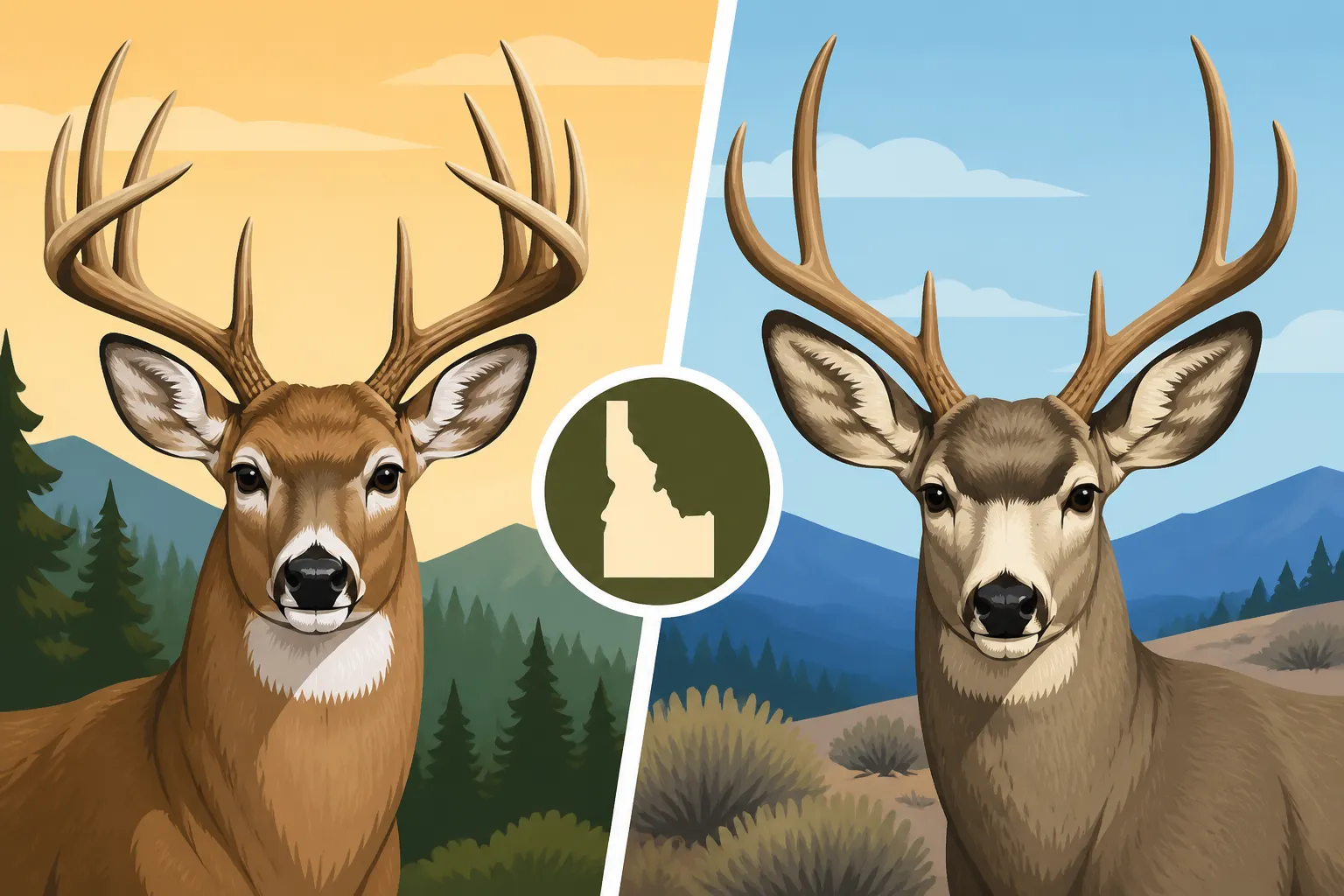
Imagine the ears of a donkey – large, prominent, and almost comical in their size compared to the deer's head. That's essentially what you're looking for with a mule deer. Their ears are incredibly long, typically measuring 8 to 10 inches from base to tip, and they stand out from the sides of the head. When they're alert, those ears swivel independently like radar dishes, constantly scanning for sounds. Even when relaxed, they still appear disproportionately large. From a distance, this can make a mule deer's head appear larger and heavier, adding to its overall robust appearance. It’s an evolutionary adaptation that helps them hear predators and other deer across vast, open landscapes where their primary defense is detection at range. This characteristic is so reliable, it's often the first thing experienced hunters key in on, especially when trying to identify deer on a distant ridge or in thick sagebrush.
Whitetail's Proportionate Pinnae
In stark contrast, a whitetail deer's ears are much more "normal" sized, if you will. They're proportionate to its head, generally measuring about 6 to 7 inches long. While they're still expressive and can move independently, they don't have that exaggerated, oversized look of a mule deer's ears. When a whitetail is alert, its ears might stand up straight, giving it an inquisitive look, but they won't dominate the silhouette of its head the way a mule deer's do. Think of them as more rounded at the tips, too, a subtle difference from the mule deer's slightly more pointed tips. In the dense timber of northern Idaho where whitetails thrive, these smaller ears are less likely to snag on branches and are perfectly adequate for hearing movement in their brushy habitat. Often, if you can’t quite make out the tail or antlers, those ears are going to be your best bet for a positive ID.
Antler Configuration and Structure
Beyond the ears, the antlers of a mature buck offer another clear distinction. While antler growth can vary widely based on age, nutrition, and genetics, the fundamental structure of how they branch is typically consistent between the two species. This is often where new hunters get stumped, especially if they’re used to seeing one species more than the other.
Mule Deer's Bifurcated Beauty
Mule deer antlers are famous for their "bifurcated" branching pattern. What does that mean? Basically, instead of growing off a main beam with tines sprouting individually, a mule deer's main beam typically forks, and then each of those forks often forks again. So, a typical mule deer buck will have two main points coming off the skull, which then fork into two, and those two points might fork again, resulting in a characteristic "double fork" appearance on each side. A common description is that each side looks like a "Y" that splits into another "Y." So, a 4×4 mule deer will usually have four points on each side, where each point is a result of this splitting. There might be small "kickers" or brow tines, but the primary growth pattern is this distinct bifurcation. This gives their rack a wide, basket-like appearance. When you're glassing for Mule Deer Across Idaho's High Desert and Breaks, looking for this unique antler growth can save you a lot of time and potential misidentification.
Whitetail's Forward-Sweeping Racks
Whitetail deer, on the other hand, have a much different antler structure. Their antlers typically grow with a single, main beam that sweeps forward and outward from the head, then curves back. From this main beam, individual tines, or points, sprout upwards. These points usually grow vertically or slightly angled back from the main beam, without the branching or forking seen in mule deer antlers. So, a typical 4×4 whitetail will have a strong main beam with four distinct points growing off it. This gives their rack a more compact, upright appearance compared to the wide, branching mule deer rack. Sometimes, a main beam might have a small fork at the very end, but the overall structure remains a main beam with points. If you're hunting Whitetail Range Through Idaho's Panhandle, becoming familiar with this antler style is absolutely essential, especially during the peak of the rut when bucks are most active.
The Tale of the Tail: Color, Shape, and Action
Perhaps the most iconic distinguishing feature, especially when a deer is startled or running away, is its tail. The color, shape, and how it’s carried provide an almost unmistakable identifier. This is often the split-second cue that confirms your initial assessment.
Mule Deer's Rope-Like Tail and Rump Patch
The mule deer’s tail is quite distinctive: it's relatively short, narrow, and often described as "rope-like." It's usually cream-colored at the base, with a prominent black tip, like a little paint brush or a tuft of black horsehair. Crucially, the tail is not entirely white on the underside. When a mule deer is alarmed and fleeing, it often holds this tail down or slightly elevated, but it doesn't "flag" it high in the air the way a whitetail does. Instead, it might twitch it nervously or hold it still. The rump of a mule deer is also very noticeable; it's a large, stark white or cream-colored patch that covers a significant portion of its hindquarters. This large rump patch, combined with the small, black-tipped tail, creates a very specific visual signature. When you’re trying to determine if you’ve found the deer you’re hunting in a general season, distinguishing the tail is critical, as Whitetail and Mule Deer Tags Are Not Interchangeable in Idaho.
Whitetail's Flashing White Flag
The whitetail deer’s tail is legendary for a reason. It's much broader and longer than a mule deer’s tail, and its underside is pure, brilliant white. When a whitetail is alarmed, it doesn't just twitch its tail; it literally raises it high, waving it back and forth like a bright white flag as it bounds away. This "flagging" action is a clear signal to other deer of perceived danger, and it’s an unmistakable visual. The upper side of the tail is brown, matching the deer's coat, but it’s that bright white underside that really gives it away. When it's not alarmed, the tail usually hangs down, covering the rump. The rump itself doesn't have that expansive white patch like the mule deer; it’s generally the same brown color as the rest of the body, making the "flag" even more striking when it’s raised. If you're still-hunting in the dense cover of northern Idaho, that flash of white as a deer bolts is your immediate confirmation that you've spooked a whitetail.
Body Shape and General Stature
While ears, antlers, and tails are key indicators, the overall body shape and general build of these deer also tell a story. There are subtle differences in their proportions and how they carry themselves that, once you learn to see them, become quite apparent.
Mule Deer's Robust, Deep-Chested Build
Mule deer generally appear more robust, heavier-bodied, and stockier than whitetails. They have a deeper chest and a more muscular build, especially around the shoulders and hindquarters. Their legs tend to look shorter in proportion to their body, giving them a compact, powerful appearance. This is a deer built for navigating varied terrain, from steep canyon breaks to rocky slopes, often at higher elevations. Think of a mule deer as a rugged, mountain athlete – strong and durable. Their body coloring also often leans towards a more grayish-brown, with lighter patches on the throat and belly, and that distinctive large white rump patch, often extending slightly up the back. When you're looking at a deer that seems to have a substantial, almost blocky build, especially in the more open, high-desert regions of Idaho, you're likely observing a mule deer. Tools like GoHunt can help you scout units known for strong Mule Deer Population Trends Across the West, allowing you to practice identifying these traits virtually before heading into the field.
Whitetail's Sleeker, More Agile Frame
Whitetail deer, in contrast, tend to have a sleeker, more graceful, and agile build. They often appear to have longer, more slender legs relative to their body size, giving them a more "leggy" appearance. Their body is generally less bulky, with a narrower chest and a more refined silhouette. This streamlined physique is perfectly suited for their preferred habitat of dense forests, thickets, and river bottoms, where quick, evasive maneuvers are key to survival. Their coat color is typically a reddish-brown during summer, fading to a grayer brown in winter, and they have clear white patches on their throat, belly, and inside their legs. The large white rump patch of a mule deer is absent; instead, the rump matches the body color, highlighting the stark contrast when their white tail is raised. If you're observing deer in an agricultural area adjacent to thick cover or in the heavily forested panhandle, that more elegant, nimble build is a strong indicator of a whitetail. Getting familiar with Hunting Whitetails in Northern Timber Country will certainly highlight these physical adaptations.
Gait and Movement Patterns
One of the most defining characteristics, especially if you catch a deer in motion, is its distinctive way of moving. This is often an instantaneous identification, as the two species employ entirely different methods of evasion.
The Mule Deer's Distinctive Stotting Bound
When a mule deer feels threatened and decides to flee, it doesn't just run; it performs a remarkable bounding leap known as "stotting" or "pronking." This involves all four legs pushing off the ground at the same time and landing simultaneously. The deer springs high into the air, often clearing obstacles with ease, and then lands on all four feet before immediately springing up again. This gives them a characteristic bouncy, almost pogo-stick-like movement. They can cover surprisingly long distances this way, making them difficult to track in broken terrain. It's an energy-intensive but effective way to navigate uneven ground and get a clear view over brush while maintaining speed. Watching a mule deer stotting across an open sage flat or bounding up a rocky slope is an unforgettable sight and an instant identifier. If you're trying to Field Judging a Mule Deer Buck Quickly, observing its gait can confirm your initial visual assessment.
Whitetail's Fluid Run and Explosive Leaps
Whitetail deer, when alarmed, will typically run in a fluid, more traditional gallop, using alternating leg movements. They are incredibly fast and agile, capable of darting through dense cover with impressive speed and precision. While they don't stot, they are masters of explosive leaps, often jumping high over fences, downed logs, or thick brush with incredible grace and power. Their ability to quickly change direction and weave through obstacles is a key survival strategy in their dense habitats. When they run, especially when startled, that large white tail will be flagged high, adding to the visual spectacle. If you witness a deer tearing through a thick patch of alder or timber, dodging and weaving with incredible agility, and flashing a bright white flag, you're almost certainly watching a whitetail. This fluid, explosive movement is a perfect complement to their sleeker build and their preferred habitat.
Habitat Preferences and Geographical Overlap in Idaho
While physical characteristics are the primary identification tools, understanding where each species typically lives in Idaho can provide valuable context and help narrow down your initial assessment. Idaho is unique in that both species can be found here, and in some areas, their ranges even overlap.
Mule Deer Across Idaho's High Desert and Breaks
Mule deer are creatures of open, rugged country. In Idaho, you’ll find them predominantly in the central, southern, and eastern parts of the state. They thrive in the high desert, sagebrush flats, juniper and pinyon woodlands, mountainous timbered areas, and the steep, rocky breaks along river canyons. Think of units with significant elevation changes, sparse timber, and plenty of visibility – that's mule deer heaven. They are well-adapted to drier conditions and often prefer higher elevations in the summer, descending to lower, snow-free Mule Deer Winter Range Across the High Desert during the colder months. Their diet consists largely of browse such as sagebrush, bitterbrush, and serviceberry. When you're scouting areas with expansive views, rocky outcrops, and sparse vegetation, especially using mapping tools like GoHunt, you're primarily looking for mule deer habitat. Knowing this can help you anticipate what species you’re likely to encounter even before you spot anything.
Whitetail Hold Idaho's Northern Panhandle
Whitetail deer are a different story entirely. While you can find pockets of them throughout the state, their stronghold in Idaho is undoubtedly the northern Panhandle and the Clearwater regions. These areas are characterized by dense conifer forests, thick river bottoms, brushy draws, and agricultural lands interspersed with heavy cover. Whitetails prefer security cover – places where they can melt into the shadows and escape detection. They are masters of using topography and vegetation to their advantage, often remaining unseen even when very close. Their diet is more varied, including forbs, agricultural crops, and various browse species found in their forested environments. If you're exploring the thick timber of the Selkirk Mountains or the dense riparian zones along the Clearwater River, your chances of encountering a whitetail are much higher. Understanding Whitetail Deer Hold Idaho's Northern Panhandle is key to successful hunting in these areas, as their behavior and preferred habitat dictate different hunting strategies. It's important to be aware of the exact unit you're in, as this directly affects your tag. When E-Scouting an Idaho Unit Before the Season with resources like GoHunt, you can overlay habitat maps with game management unit boundaries to better understand which species is prevalent where you plan to hunt.
Quick Reference Table: Mule Deer vs. Whitetail
Here’s a handy table to help you quickly recall the key differences between mule deer and whitetail deer:
| Feature | Mule Deer | Whitetail Deer |
|---|---|---|
| Ears | Very large, long (8-10 inches), "mule-like" | Proportionate, shorter (6-7 inches), rounded tips |
| Antlers | Bifurcated (forking), "Y" splits into "Y" | Main beam with tines sprouting upwards |
| Tail | Short, narrow, black tip, rope-like | Broad, long, pure white underside, brown top |
| Tail Action | Held down or slightly elevated, twitches | "Flags" high and waves when alarmed |
| Rump | Large, distinct white/cream patch | Matches body color, no large white patch |
| Body | Robust, deep-chested, stocky, grayish-brown | Sleeker, agile, more "leggy", reddish-brown |
| Gait | Distinctive four-legged "stotting" bound | Fluid run, powerful leaps, alternating legs |
| Habitat | Open sagebrush, high desert, steep breaks, higher elevations | Dense forests, thickets, river bottoms, lower elevations |
Remember, while these characteristics are generally reliable, individual deer can vary. Sometimes, a hybrid might even show up, making identification tricky. But by focusing on a combination of these features – ears, antlers, tail, body, and movement – you'll significantly improve your ability to correctly identify the deer you encounter in Idaho's vast and beautiful wildlands. Knowing these distinctions is not just for bragging rights; it's a vital part of responsible and ethical hunting. You wouldn't want to accidentally use an elk tag on a moose, and the same applies to deer. Also, knowing when The Idaho Hunting Passport Lets You Try Before You Certify can be a great way to gain field experience and practice these identification skills with a mentor before heading out on your own. It takes practice and keen observation, but soon, telling a whitetail from a mule deer will become second nature.
Disclaimer
Please be aware that hunting regulations, seasons, and requirements can change. Always consult the most current Idaho Fish and Game regulations before planning any hunting trip. This guide is for informational purposes only and should not be considered a substitute for official state publications.