Motorized Rules on Idaho Wildlife Management Areas
Few things are more frustrating for an Idaho hunter than planning an epic trip to a promising spot, only to arrive and realize you've completely misunderstood the rules about where you can drive your vehicle. It’s a common scenario, especially when those promising spots fall within Idaho's vast network of Wildlife Management Areas (WMAs). These areas are critical for our cherished game, but their unique access regulations can quickly turn an exciting hunt into a head-scratching, or even costly, experience. This guide is here to meticulously break down the motorized rules specific to Idaho’s WMAs, helping you navigate these vital hunting grounds legally, ethically, and effectively, so you can focus on the hunt, not the rulebook.
Understanding Idaho's Wildlife Management Areas (WMAs)
When we talk about public land hunting in Idaho, our minds often jump straight to National Forests and BLM land. And rightly so, as these vast tracts offer incredible opportunities. However, Idaho also manages a fantastic system of Wildlife Management Areas (WMAs) that are specifically designed for the benefit of wildlife and public recreation, including hunting. Understanding what these areas are and why they exist is the first step in appreciating their unique access rules.
What WMAs Are and Why They Exist
Idaho’s Wildlife Management Areas are crucial pieces of the conservation puzzle. Unlike the broader mandates of National Forests or BLM lands, WMAs are typically lands purchased or managed directly by the Idaho Department of Fish and Game (IDFG) with a primary focus on wildlife habitat. Think of them as dedicated havens for critters. They’re strategically located to protect vital winter ranges, enhance crucial migration corridors, or provide high-quality breeding grounds for deer, elk, upland birds, and waterfowl. The goal isn't just to have animals, but to ensure robust, healthy populations that can sustain themselves and provide hunting opportunities.
These areas are incredibly diverse. Some WMAs are sprawling, rugged backcountry tracts that feel just like the National Forest, while others might be smaller parcels of farmland specifically managed for pheasant or quail. The key takeaway is their dedicated purpose: wildlife first. This singular focus often means that the rules within WMAs are tailored to minimize disturbance to animals, especially during sensitive times of the year, which directly impacts how we, as hunters, can access and use them. Idaho has 31 Wildlife Management Areas spread across the state, ranging significantly in size and habitat types. Knowing How Large Idaho's WMAs Actually Are can give you a better appreciation for the scale of these conservation efforts.
General Hunting Rules on Idaho Wildlife Management Areas
While WMAs are public lands open to hunting, it’s absolutely critical to understand that they often come with a distinct set of rules that go above and beyond the general statewide regulations. This isn't just about motorized access; it can include specific weapon restrictions, unique season dates, or even limitations on how and where you can scout. The IDFG puts a lot of effort into managing these lands, and that means being more prescriptive about human activity to protect wildlife.
For example, a WMA known for its waterfowl might have specific blind requirements or restrictions on Waterfowl Hunting on Idaho Wildlife Management Areas, while a WMA serving as a critical elk winter range could have late-season access closures to prevent disturbing vulnerable animals. It's not uncommon to find areas within a WMA that are foot-traffic only, even when a public road runs nearby. You might also encounter special youth-only seasons or particular regulations around target shooting that differ from adjacent National Forest land. The bottom line here is that while your general hunting license covers you, you must delve into the specific Hunting Rules Specific to Idaho Wildlife Management Areas before you ever set foot or tire on one. Don't assume that because it's public land, it's regulated the same way as the forest service land down the road.
The Specifics of Motorized Vehicle Use in WMAs
This is where the rubber meets the road, quite literally. The rules around motorized vehicle use in Idaho’s WMAs are often among the most stringent and frequently misunderstood. These regulations are designed to protect fragile habitats, prevent erosion, and minimize stress on wildlife, especially during critical periods like winter. Ignoring them can lead to serious consequences, not just for your wallet, but for the resource itself.
Which Roads Qualify Under Idaho's Motorized Rule in WMAs
One of the biggest sources of confusion stems from defining "established roads" within a WMA. On National Forests or BLM land, you might interpret any two-track or seemingly worn path as an "established road" for vehicle use, even if it's not officially signed. In many WMAs, the definition is much narrower and more strictly enforced. Generally, an "established road" in a WMA context refers to clearly designated, signed, and maintained roads intended for public vehicle access. These are typically marked on official IDFG maps or Forest Service/BLM Motor Vehicle Use Maps (MVUMs) that overlap with WMA boundaries.
You simply cannot assume that a faint dirt track leading into a promising basin is legal to drive on. Often, these are old logging roads, fire breaks, or even game trails that have been widened over time but are explicitly not open to public motorized travel. It’s crucial to understand that Idaho's Motorized Hunting Rule Runs August Into December, and often throughout the entire year within many WMAs, meaning even during hunting season, your vehicle might be restricted. If a road isn't clearly marked as open, assume it's closed to motorized vehicles. This is where tools like GoHunt, with its detailed land ownership and road layers, become invaluable. You can overlay WMA boundaries and cross-reference them with official motorized access information to ensure you’re on a legitimate, open road. Always check the specific WMA rules on the IDFG website, as regulations can vary between WMAs. Don't forget to look up Which Roads Qualify Under Idaho's Motorized Rule to get the full picture.
Prohibitions on Driving Off Established Roads for Game Retrieval
This rule, perhaps more than any other, causes the most frustration and leads to the most violations among well-meaning hunters. Imagine this: You've just made a perfect shot on a magnificent bull elk or a heavy-antlered mule deer within an Idaho WMA. It's down, but it's 800 yards off the main road, deep in a steep canyon. Your instinct screams, "Get the truck!"
However, in Idaho's Wildlife Management Areas, driving off an established, open road to retrieve downed game is almost universally prohibited. There are virtually no exceptions. This is a hard pill to swallow for many, especially when you're faced with a monumental packing job, but the rule exists for vital reasons. Off-road vehicle travel, even for a short distance, can cause significant damage to sensitive soils, vegetation, and critical wildlife habitat. It also creates new "user-created roads" that encourage further illegal travel and disturbances. The sight of vehicles tearing up fragile areas can also be a real black eye for the hunting community.
While it's tough, the expectation is that you will pack your animal out using non-motorized means – on foot, with a game cart, or even by horse or pack animal if allowed and if you’ve pre-arranged it. This is where the physical demands of hunting in places like Idaho really come into play. It forces a certain level of preparedness and realistic assessment of your capabilities. It also underscores why knowing the terrain and rules before you pull the trigger is so important. Make sure you fully understand Why You Cannot Drive Off Road to Retrieve Downed Game in these critical areas.
Penalties for Violating Motorized Vehicle Rules in WMAs
Ignorance of the law is never an excuse, and violating motorized vehicle rules in an Idaho WMA can come with stiff penalties. This isn't just a slap on the wrist; these are serious infractions that can significantly impact your hunting privileges and your wallet. Penalties can range from substantial fines, often in the hundreds of dollars, to much more severe consequences.
Depending on the nature and severity of the violation, you could face restitution costs for habitat damage, impoundment of your vehicle, and even the loss of your hunting license and privileges for a period of time. Conservation officers in Idaho are dedicated to protecting these WMAs and they patrol them actively. They have a zero-tolerance policy for violations that damage habitat or disturb wildlife. Getting caught driving off-road, even if it's "just a little bit" or "only to retrieve game," can lead to an expensive ticket and a tarnished record. It’s a good reminder that responsible hunting means adhering to all regulations, not just those directly related to the act of taking game.
Planning Your Hunt with Motorized Restrictions in Mind
Knowing the rules is one thing; successfully integrating them into your hunt plan is another. Hunting in WMAs with motorized restrictions often requires a different mindset and more physical preparation than hunting areas with unrestricted access. But don't let that deter you! These areas are often managed for higher quality hunting experiences precisely because they limit easy access and reduce pressure.
Scouting and Accessing WMAs Without a Vehicle
The thought of scouting and hunting without the convenience of your truck can feel daunting, but it's absolutely doable and incredibly rewarding. Many WMAs are designed for foot traffic, offering a more immersive and quiet hunting experience. When planning to access these areas, think non-motorized. This means embracing boots-on-the-ground scouting. Hike in, learn the terrain, find the pinch points and bedding areas. It will give you a much deeper understanding of the animal movement than simply driving by.
Mountain bikes and even e-bikes (where explicitly allowed by WMA-specific rules – always check, as regulations can vary) can be fantastic tools for covering ground quickly on established trails or roads that are closed to motor vehicles but open to bikes. Just remember to always verify the legality of e-bikes, as their classification can sometimes be ambiguous depending on the land manager. Physical conditioning is paramount for these hunts. Be prepared to walk miles, often with a heavy pack if you’re lucky enough to tag an animal. Pack lighter, smarter, and invest in quality footwear. Using mapping applications like GoHunt to mark trails, potential bedding areas, and water sources during your scouting trips will pay huge dividends when the season opens.
Using Mapping Tools to Navigate WMA Regulations
In today's hunting world, digital mapping tools are your best friend, especially when navigating complex WMA regulations. Forget paper maps that might be outdated; modern apps provide real-time or frequently updated information that can save you a lot of headache. GoHunt is an excellent example of a platform that allows you to overlay WMA boundaries directly onto satellite imagery and topographic maps. This visual representation makes it incredibly easy to identify where the WMA starts and ends, and more importantly, where the motorized rules apply.
Beyond just boundaries, look for layers that show roads and trails. Many apps, and certainly the IDFG’s official Hunt Planner, will distinguish between open motorized roads, seasonal motorized roads, and non-motorized trails. The Idaho Hunt Planner Is the Tool to Start With for any hunt in the state, offering specific details for units and WMAs. Pay close attention to any shaded areas or specific lines indicating closures. Always download your maps for offline use before heading into the field, as cell service is often non-existent in remote WMAs. Being able to see Public Land Percentage by Idaho Unit and understanding how those WMAs fit into the broader landscape is crucial. Using onX Layers for Idaho Public Land, for example, allows you to clearly delineate WMA boundaries and access points, ensuring you stay on the right side of the rules and within designated hunting areas.
Camping Limits on Idaho WMAs
Just like motorized access, camping rules within WMAs tend to be more restrictive than on general National Forest or BLM lands. This is again tied to the primary goal of wildlife conservation and minimizing human impact. While dispersed camping might be permissible in many national forest areas, don't assume the same applies to an Idaho WMA.
Many WMAs have designated camping areas, which might be primitive or include basic amenities. Often, there are strict limits on the length of stay, such as a 7-day or 14-day maximum. Dispersed camping (setting up camp anywhere outside a designated campground) is frequently prohibited entirely within WMA boundaries. The goal is to concentrate human activity to specific zones to reduce disturbance to wildlife in other critical habitats. Always check the specific WMA regulations on the IDFG website or through the Idaho Hunt Planner before you pack your tent. Ignoring these rules could lead to a less-than-restful night, possibly interrupted by a conversation with a conservation officer. Understanding Camping Limits on Idaho WMAs is just as important as knowing the motorized access rules for a successful and legal trip.
General Public Land vs. WMA Motorized Rules Quick Guide
To help clarify the differences, here’s a quick comparison of typical motorized rules you might encounter on general public lands versus Idaho Wildlife Management Areas.
| Feature | General National Forest/BLM Lands (Idaho) | Idaho Wildlife Management Areas (WMAs) |
|---|---|---|
| Established Roads | Generally open unless marked closed by seasonal gate or specific order. | Often have stricter seasonal closures, frequently protecting winter range, even for designated roads. |
| Off-Road Travel | Generally prohibited, with exceptions for game retrieval in some areas if landowner permission is granted or specific rules allow (check MVUMs). | Strictly prohibited, including for game retrieval. NO EXCEPTIONS. |
| Game Retrieval Off-Road | Check specific MVUMs (Motor Vehicle Use Maps) for unit-specific allowances. | Never allowed with a motorized vehicle. Plan to pack out. |
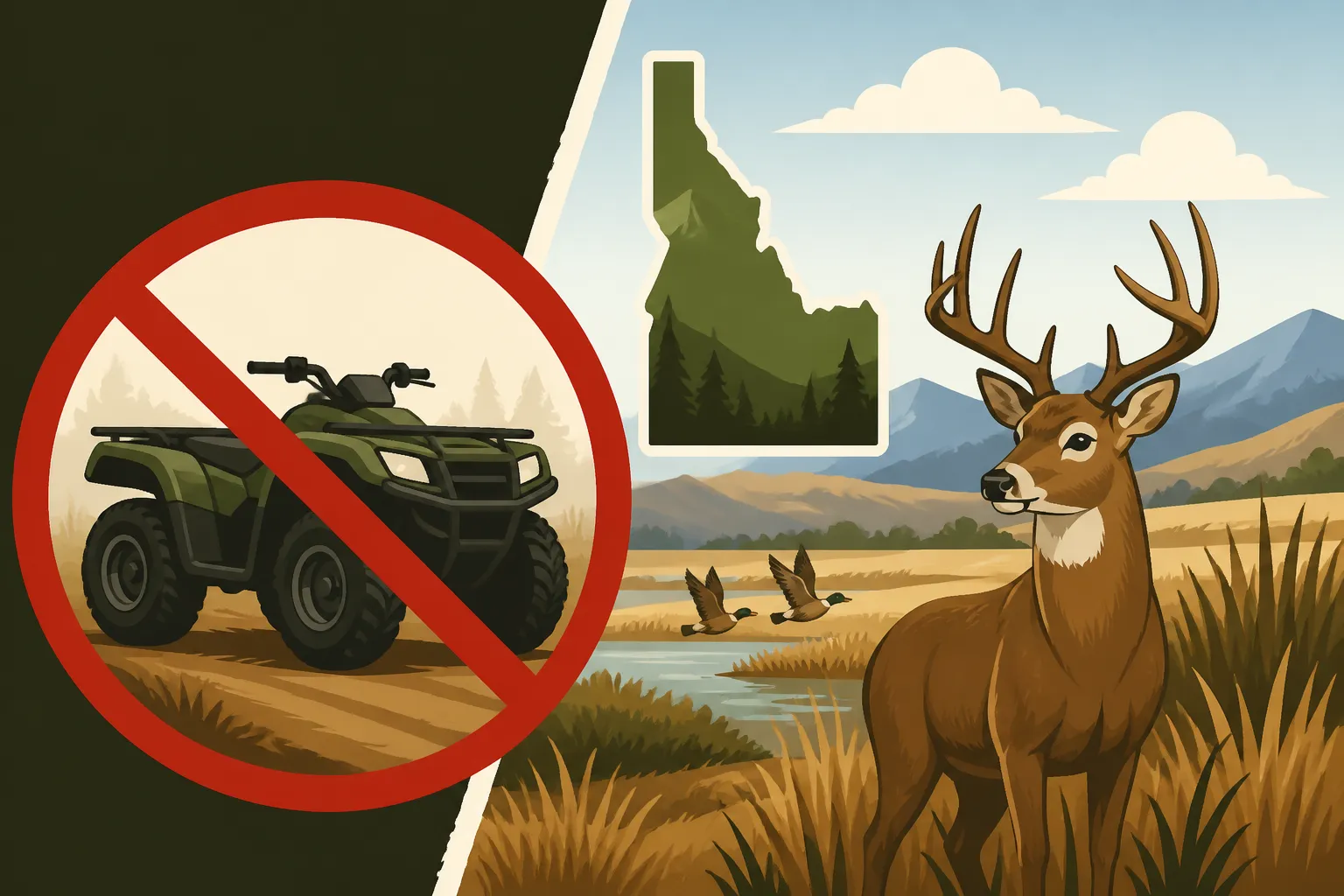
| ATVs/UTVs | Permitted on designated trails/roads. | Permitted only on designated established roads. Check WMA-specific rules carefully. |
| E-Bikes | Generally follow bicycle rules, but check specific land manager regulations. | Often follow bicycle rules, but always confirm WMA-specific policies. |
| Camping | Dispersed camping often allowed, with stay limits (e.g., 14 days). | More restrictive. Often designated sites only, shorter stay limits (e.g., 7 days or less). |
| Scouting with Vehicle | Permitted on open roads/trails. | Limited to open established roads; seasonal closures very common, especially during critical wildlife periods. |
Minimizing Your Impact and Preserving WMA Habitat
Ultimately, these rules aren't designed to make hunting harder, but to ensure the long-term health of Idaho's wildlife resources and the habitats they depend on. Every hunter has a responsibility to minimize their impact, and nowhere is that more crucial than in a WMA. By adhering to motorized rules, staying on designated paths, and respecting closures, you're not just avoiding a ticket – you're actively participating in conservation.
Consider going a step further: pick up any trash you find, even if it's not yours. Stick to Leave No Trace principles. Understand that your presence, even on foot, has an impact. These areas are gifts, providing incredible hunting opportunities. Let's make sure they remain vibrant and accessible for generations to come. Your diligence in following these rules is a direct contribution to preserving Idaho's wild heritage.
Disclaimer
Please remember that hunting regulations, including those pertaining to motorized vehicle use in Wildlife Management Areas, can change. While every effort has been made to provide accurate and up-to-date information, it is your responsibility as a hunter to consult the most current Idaho Fish and Game regulations and WMA-specific rules before engaging in any hunting activity. Always check the official IDFG website or printed regulations booklet.