Can You Drive Off Road to Retrieve Game?
You've just made a great shot, your heart is pounding, and that deer or elk is finally down. You saw it drop just off the road, maybe 50 or 100 yards into the timber or across a sage flat. The immediate thought races through your mind: "Can I just drive my truck or ATV over there to pick it up?" It's a natural, almost instinctive question, especially when you're tired, it's getting dark, or the terrain looks like a nightmare to pack an animal out of. But in Idaho, the answer to driving off-road to retrieve game isn't as simple as it might seem, and often, it's a hard no. This guide will walk you through Idaho's rules, the reasons behind them, and what you absolutely need to know to stay legal and ethical when that animal hits the dirt.
The Harsh Reality of Idaho's Motorized Hunting Rule
Let's cut right to the chase because this is where many hunters find themselves in a bind, often unknowingly. Idaho Fish and Game regulations are pretty clear when it comes to motorized vehicle use, particularly when you're off the established paths. The state is dedicated to preserving its wild character and ensuring fair chase, and that means limiting the impact of vehicles on its incredible landscapes and the wildlife that calls them home.
Defining "Established Roadways" and Off-Road Travel
One of the biggest areas of confusion for hunters is understanding what exactly constitutes an "established roadway" in Idaho. It’s not just about pavement or gravel county roads. In the context of hunting regulations, an established roadway generally refers to a road or trail that has been built, maintained, or designated for motorized vehicle travel. This could be a paved highway, a maintained gravel Forest Service road, or even a two-track dirt trail that’s clearly part of the designated travel system. The key here is "designated."
The frustration sets in when you're looking at what appears to be an old logging spur that hasn't seen a grader in twenty years, or a faint two-track leading into a dry wash. To the untrained eye, these might seem like fair game for your truck or ATV, especially if they look like they've been driven before. However, if that route isn't explicitly open for motorized travel as designated by the land management agency (like the U.S. Forest Service or Bureau of Land Management), or if it's simply a game trail or an unapproved user-created path, then driving on it is considered off-road travel.
This distinction is crucial because the impact of even a single vehicle can be significant. It creates new tracks, disturbs soil, damages vegetation, and can disrupt wildlife patterns. Idaho's rule aims to prevent this cumulative damage, which is why it's so strictly enforced. It's about maintaining the integrity of the wild spaces for both wildlife and future generations of hunters who want to experience the backcountry as it should be.
Why Driving Off-Road for Game Retrieval is a Big No-Go
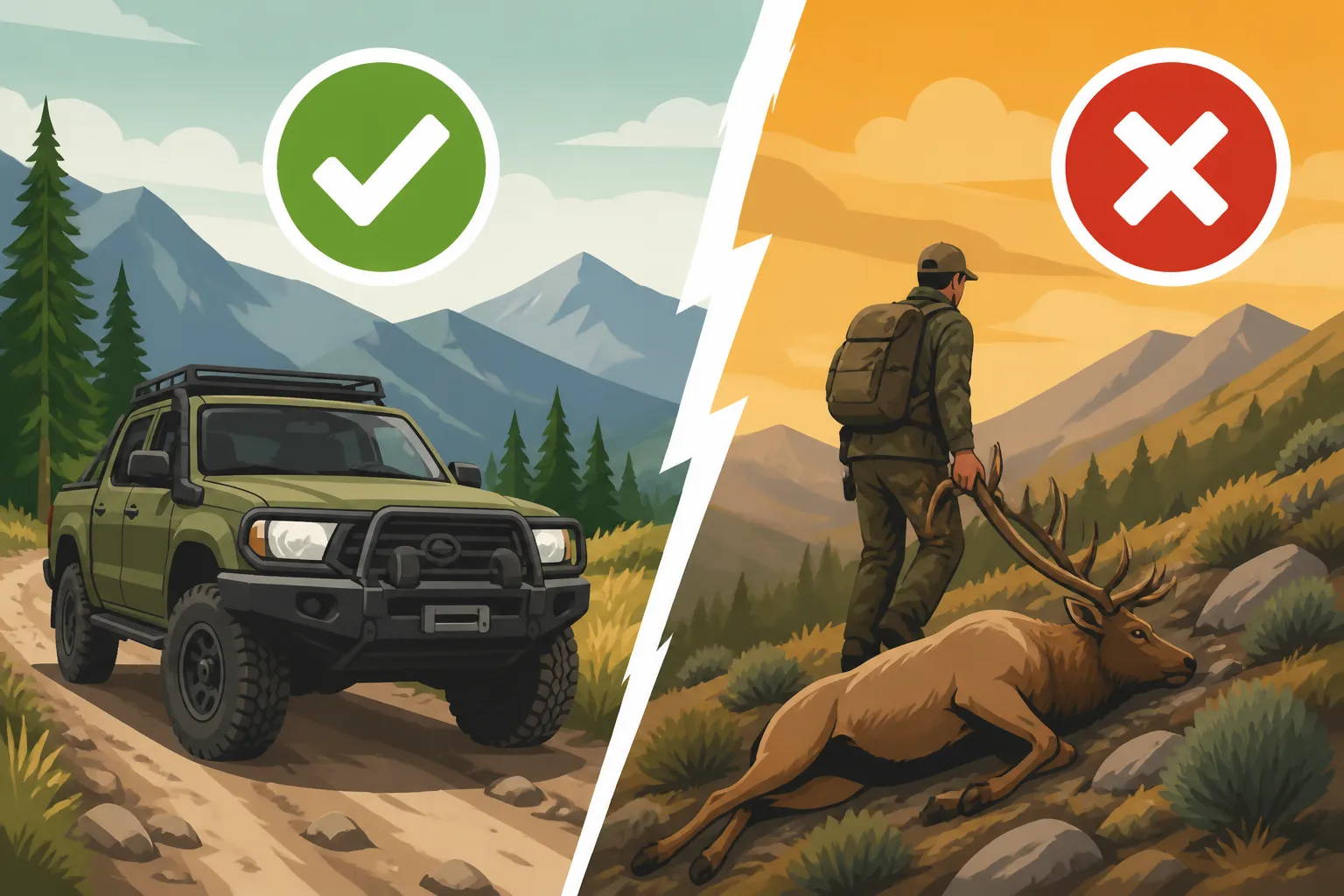
So, to directly answer the burning question: no, you cannot drive off-road to retrieve game in Idaho. The motorized hunting rule explicitly prohibits taking a motor vehicle off established roads or trails for the purpose of hunting, which includes pursuing, spotting, or retrieving game. This rule isn't just about the act of shooting an animal from a vehicle; it extends to the entire process, including getting your downed animal out of the field. You can read more about what this means for other activities in "Idaho's Motorized Hunting Rule Keeps You on the Road".
The rationale behind this firm stance is multi-layered. First, it upholds the principle of fair chase. Using a vehicle to shorten the distance to a downed animal after a shot, especially if it's in difficult terrain, could be seen as gaining an unfair advantage. Secondly, and perhaps more importantly, it's about minimizing habitat disturbance. Imagine if every hunter who shot an animal 100 yards off the road drove their truck in to get it. The landscape would quickly become a spiderweb of tire tracks, destroying sensitive vegetation, compacting soil, and creating erosion issues.
This rule applies universally across public lands where motorized restrictions are in effect, which is a vast amount of Idaho's hunting country. It doesn't matter if your elk dropped just a stone's throw from the tire tracks or a mile deep in the backcountry; if you have to leave a designated, open route to get to it, your vehicle stays on that route. The temptation can be immense, especially after a successful hunt when adrenaline is high and fatigue is setting in, but resisting this urge is critical to hunting legally and responsibly in Idaho.
Navigating the Logistics: Before and After the Shot
Given the strict rules against off-road game retrieval, planning becomes an even more critical component of your Idaho hunt. It forces hunters to think several steps ahead, not just about making the shot, but about what happens immediately after.
Scouting and Strategy for Ethical Retrieval
The old adage "the hunt begins after the shot" is particularly true in Idaho. Before you even head out, thorough e-scouting and on-the-ground reconnaissance are your best friends. Tools like GoHunt's mapping features or onX Hunt are invaluable here. You can identify designated roads and trails, public land boundaries, and potential travel corridors where game might move. This helps you understand the accessibility of different areas. For more details on this, check out "E-Scouting an Idaho Unit Before the Season".
When you're actively hunting, constantly be aware of your surroundings. If you're in an area with restricted motorized access, always consider where an animal might go if you shoot it. Could it run into a steep canyon or thick timber far from any road? This awareness should influence your stalk, your shot angles, and even your decision to take a shot in the first place. Sometimes, passing on a marginal shot that would send an animal into an unreachable area is the most ethical choice, even if it's agonizing.
Imagine you're hunting mule deer on one of Idaho's sagebrush-covered hillsides. You spot a buck bedded on a distant bench, a good mile from the nearest designated road. You plan a careful stalk, finally getting within range. Before you pull the trigger, take a moment to consider the terrain beyond the buck. Is there a deep ravine behind it? Is it likely to run up a steep, timbered slope? Understanding where your animal might go will help you decide if you're prepared for the pack out, regardless of how great the shot opportunity is. This kind of forward thinking is part of responsible hunting in a state with such robust public lands.
What to Do When Your Game Hits the Dirt Off-Road
So, the shot is made, the animal is down, and it's definitely off the designated road. Now what? Your first priority, as always, is to ensure the animal is expired and to tag it immediately as required by Idaho law. After that, the legal and ethical path is clear: you retrieve it under your own power.
This means packing it out. For many, especially those hunting elk or moose, this is a monumental physical challenge. A mature bull elk can weigh upwards of 700-1000 pounds live, and even after field dressing, you're looking at hundreds of pounds of meat, bone, and hide. This is where planning your hunt with partners or considering pack animals becomes invaluable. If you’re hunting alone, the prospect of "Packing an Elk Out of Steep Country Alone" can be daunting, requiring multiple trips and significant physical exertion.
Hunters often use sturdy pack frames, game bags to keep meat clean and cool, and sometimes even sleds for easier dragging in snow. For some, investing in a pack string of horses or mules, or even llamas, is the only practical way to hunt deep in the backcountry and ensure efficient retrieval. These methods are completely legal and align with the spirit of fair chase and minimal impact. It’s a return to the more traditional hunting methods that respect the land and its resources.
The Difference When Game Crosses Onto Private Land
The rules regarding motorized access to retrieve game are almost exclusively focused on public lands. However, what happens if you shoot an animal legally on public land, and it then crosses onto adjacent private property before expiring? This adds another layer of complexity.
In Idaho, there is no automatic right to trespass onto private land to retrieve game, even if you harvested it legally on public ground. You must obtain permission from the landowner before entering their property. This applies whether you intend to walk in, or if you hope to use a vehicle on their private roads. The landowner has the right to refuse entry, or to set specific conditions for your entry, including prohibiting vehicle use entirely.
It's a frustrating scenario, but it highlights the importance of knowing land ownership boundaries before and during your hunt. Utilizing mapping tools that show private land overlays can help you avoid situations where a wounded animal might run onto posted land. Should it happen, your immediate course of action is to contact the landowner and respectfully request permission. Ignoring this step could lead to trespass charges, which only further complicates an already difficult situation. For detailed guidance on this, see "Retrieving Game From Private Land in Idaho". Always prioritize communication and respect for private property rights.
The Strict Enforcement and Rare Exceptions
When it comes to Idaho's motorized hunting rules, enforcement is taken seriously by Fish and Game officers. These regulations are not suggestions; they are laws designed to protect wildlife, habitat, and the hunting experience for everyone.
The Steep Penalties for Illegal Off-Road Retrieval
Attempting to drive off an established, designated road or trail to retrieve game, or for any other hunting-related activity where vehicles are prohibited, carries significant consequences. Game wardens are highly visible in popular hunting areas and actively patrol, especially during peak seasons. They are trained to look for fresh tire tracks leading off designated routes, and they take these violations seriously.
The penalties can include substantial fines, potentially ranging from hundreds to thousands of dollars depending on the severity and specific circumstances of the violation. Beyond financial penalties, you could face the confiscation of your vehicle (ATV, UTV, truck) used in the commission of the offense. Perhaps even more impactful for a passionate hunter, a violation can lead to the suspension or revocation of your hunting license and privileges, not just in Idaho, but potentially in other states through interstate wildlife violation compacts. For a deeper dive into these consequences, you can refer to "Penalties for Breaking the Motorized Rule".
The "it's just this once" mentality is incredibly risky. That momentary convenience of driving a short distance off-road is simply not worth the long-term repercussions to your wallet, your vehicle, and your ability to hunt in the future. It's a tough pill to swallow when you're staring at a big game animal in a difficult spot, but abiding by the rules is paramount.
Understanding Specific Circumstances and Permits
While the general rule is a resounding "no" to off-road game retrieval, it's worth noting that extremely specific circumstances and authorized permits can exist for certain situations. However, these are not loopholes for the average hunter, and they are not about simply driving where you please to pick up an animal.
The primary example would be for hunters with disabilities who possess specific permits issued by Idaho Fish and Game. These permits can grant limited access to certain areas or allow the use of specific types of vehicles (like an ATV or UTV) on designated administrative routes that are otherwise closed to the general public. Even with these permits, the use is still typically restricted to designated routes and not simply driving pell-mell across the landscape off-road to retrieve game. The intent is to provide reasonable access, not to circumvent the conservation principles of the motorized hunting rule.
Another rare exception might arise in a genuine emergency situation, although even then, leaving designated routes without explicit authorization could lead to issues. These situations are few and far between and would require immediate communication with Idaho Fish and Game or law enforcement to prevent misunderstandings or violations. The key takeaway here is that if you're an able-bodied hunter without specific, pre-approved documentation, you should operate under the assumption that driving off-road for game retrieval is strictly prohibited. Always consult the current Idaho hunting regulations or contact Fish and Game directly if you have any doubt about a specific area or situation.
Here's a quick look at how various retrieval methods stack up in Idaho:
| Retrieval Method | Legality on Public Land (Off-Road) | Description & Important Notes |
|---|---|---|
| Driving a Motorized Vehicle Off-Road | Illegal | Strictly prohibited. This includes trucks, ATVs, UTVs, motorcycles, etc., leaving designated, open roads/trails. Penalties are severe. |
| Driving a Motorized Vehicle on Established Road | Legal | You can drive on any road or trail that is clearly designated and open for motorized public travel, even if it's unpaved. The vehicle must stay on the road. |
| Packing Out on Foot | Legal | The most common and widely accepted method. Requires physical fitness and appropriate gear (pack frame, game bags). |
| Using Pack Animals (Horses, Mules, Llamas) | Legal | A legal and effective way to retrieve game from remote areas. Requires proper handling and knowledge of pack animal use. |
| Cart/Game Cart | Legal | A two-wheeled or four-wheeled cart, human-powered, is legal for hauling game out. Can be challenging in very steep or brushy terrain. |
| Bicycle/E-bike | Legal | Generally allowed on trails open to non-motorized public use. Cannot be used off-trail for retrieval. Check specific trail designations as e-bike rules can vary. |
| Drone for Retrieval | Illegal | Using a drone to retrieve game is typically prohibited as it falls under aiding/spotting game with aircraft rules and is not a practical retrieval method for large game. Drones for scouting are also restricted; see "Are Drones Legal for Scouting in Idaho?". |
Disclaimer
Please remember that hunting regulations can change. It is always the hunter's responsibility to consult the most current Idaho Fish and Game regulations specific to the current year's hunting season before heading afield. This guide provides general information and should not be considered a substitute for the official regulations.