Hunting Coyotes in Idaho Year Round
While many Idaho hunting seasons come and go with strict opening and closing dates, leaving us feeling like we've barely scratched the surface, the pursuit of coyotes offers a welcome freedom: it's open year-round. This guide dives deep into what makes year-round coyote hunting possible in Idaho, covering the rules, effective strategies, and how to make the most of this consistent opportunity. It’s a chance to hone your skills, spend more time afield, and contribute to wildlife management, all without the pressure of a limited draw or short season.
The Unrestricted Opportunity: Why Idaho Allows Year-Round Coyote Hunting
For hunters in Idaho, the coyote represents a unique and consistent opportunity. Unlike the highly regulated seasons for deer, elk, or other big game, coyotes in Idaho can be pursued every single day of the year. This open-door policy isn't just about giving hunters more time in the field; it's a strategic approach to wildlife management that acknowledges the coyote's role in the ecosystem.
Predator Management Philosophy
Idaho's approach to coyotes is rooted in a predator management philosophy that recognizes their adaptability, widespread presence, and significant impact on other wildlife populations and livestock. Coyotes are generalist predators, meaning they thrive on a wide variety of food sources, from small rodents and rabbits to deer fawns and elk calves. Their populations can reproduce quickly and expand rapidly, leading to increased predation pressure on vulnerable game species, especially during fawning and calving seasons.
The state doesn't impose closed seasons or bag limits on coyotes because they are generally viewed as a species that benefits from consistent harvest to maintain ecological balance. Without such ongoing management, coyote numbers could escalate, potentially impacting the survival rates of young big game animals that hunters cherish, as well as posing a threat to livestock for ranchers across the state. This year-round hunting season empowers hunters to become active participants in balancing the predator-prey dynamic, providing a constant presence that helps keep coyote populations in check.
Skill Development and Scouting Advantage
Beyond the management aspect, the year-round coyote season offers an unparalleled training ground for hunters. It's a fantastic way to keep your outdoor skills sharp, practice calling sequences, refine stalking techniques, and become more proficient with your chosen weapon, whether it's a rifle or shotgun. You don't have to wait for a specific draw or season to get out there and stay connected with the land.
Think of it as continuous education for your hunting acumen. You can experiment with different calls in various conditions, learn how coyotes respond to pressure, and understand their movement patterns in deep snow, open sagebrush, or dense timber. This constant engagement allows you to become a more well-rounded and effective hunter. What's more, a day spent chasing coyotes can double as an excellent scouting mission for other species. As you move through potential deer or elk habitat, you'll naturally be looking for sign, observing terrain features, and noting water sources or bedding areas. This casual scouting, aided by tools like GoHunt's detailed mapping, can provide invaluable insights for when your big game tags finally come around. It’s an invaluable way to learn new country and keep your senses tuned to the rhythms of the wild.
Navigating the Legal Landscape for Idaho Coyote Hunters
While the year-round nature of coyote hunting provides immense freedom, it's crucial to understand the specific legal framework that governs this pursuit in Idaho. This isn't a free-for-all; rather, it's a set of guidelines designed to ensure safety, respect for private property, and responsible hunting practices.
The Open Season and Bag Limit
One of the most appealing aspects of coyote hunting in Idaho is the absence of a closed season and a bag limit. This stands in stark contrast to the strict regulatory structure for other game animals where specific dates dictate when you can hunt and how many animals you can harvest. For coyotes, there are no limitations on when you can hunt them or how many you can take. This flexibility allows hunters to pursue them whenever opportunity knocks, whether it's a quick morning hunt before work, an afternoon venture, or an extended trip.
However, even though there's no specific "coyote tag," a valid Idaho hunting license is still required for both residents and non-residents to hunt furbearers, which includes coyotes. It's a small investment that grants you access to this continuous hunting opportunity. Always ensure your license is current before heading afield. The Idaho Nonresident Hunting License Price will give you an idea of the cost, and it's essential for nonresidents to secure this before hunting any species.
Legal Weapons and Equipment
Idaho is quite accommodating when it comes to the legal weapons you can use for coyote hunting, offering a wide array of choices to suit different preferences and scenarios. Hunters can typically use rifles of various calibers, shotguns, and even archery equipment. The choice often depends on the terrain, expected shooting distances, and personal preference. For instance, a .223 Remington or a .204 Ruger is popular for flatter, open country due to their flat trajectories, while a shotgun with appropriate loads might be favored in dense cover where shots are close and fast.
Furthermore, Idaho permits the use of certain equipment that might be restricted for big game. For example, Suppressor Legality for Hunting Big Game is a non-issue for coyotes; suppressors are perfectly legal for hunting predators, offering a significant advantage in terms of noise reduction and reducing disturbance to other wildlife or nearby residents. Similarly, Electronic Calls for Predators and Varmint Hunting are widely used and entirely legal for coyotes, allowing hunters to mimic distress calls, pup yips, or challenge howls to lure coyotes within shooting range. While some might consider Is Night Hunting Legal for Coyotes Out West?, it's important to remember that general rules regarding spotlighting and night hunting for predators are unit-specific and subject to local ordinances, so always double-check those regulations.
Access and Ethical Boundaries
Knowing where you can hunt coyotes is just as vital as knowing when and with what. Idaho offers vast tracts of public land, including National Forests, BLM ground, and State lands, which are generally open to hunting. However, it's paramount to differentiate between public and private property. Hunting on private land without explicit permission is trespassing, which carries legal consequences and severely damages the image of all hunters. Always obtain Getting Landowner Permission in Idaho before setting foot on private ground, and carry written permission if possible. Tools like GoHunt's public land maps can be incredibly useful for clearly identifying land ownership boundaries, helping you plan your approach and avoid accidental trespass.
Additionally, pay close attention to Idaho's motorized hunting rules. On many public lands, Idaho's Motorized Hunting Rule Keeps You on the Road from August 30 through December 31, and often year-round on specific roads or areas. This means you generally cannot drive off established roads to pursue or retrieve coyotes, even if there's no big game season. Always consult Motor Vehicle Use Maps (MVUMs) for National Forests and BLM travel plans to understand specific restrictions in the area you plan to hunt. Disregarding these rules can lead to citations and closures, impacting future hunting opportunities for everyone.
| Regulation Category | Coyote Hunting in Idaho | Big Game Hunting (e.g., Deer/Elk) |
|---|---|---|
| Season Length | Year-round | Specific, limited dates/windows |
| Bag Limit | None | Species- and tag-specific limits |
| Hunting License | Required (General) | Required (General + Species Tag) |
| Weapon Rules | Broad (rifle, shotgun, archery, suppressor legal) | More specific; suppressors legal, but electronic calls generally prohibited |
| Electronic Calls | Legal | Generally Prohibited |
| Night Hunting | Check local regulations, often restricted/unit-specific | Generally Prohibited |
| Public Land Access | Generally open with motorized restrictions | Generally open with motorized restrictions |
| Private Land Access | Permission always required | Permission always required |
Mastering Coyote Strategies Across Idaho's Diverse Seasons
Coyote hunting is a dynamic pursuit, and what works in January might be entirely ineffective in July. Understanding coyote behavior throughout the year and adapting your strategies accordingly is the key to consistent success across Idaho's varied landscapes and seasons.
Seasonal Calling Tactics
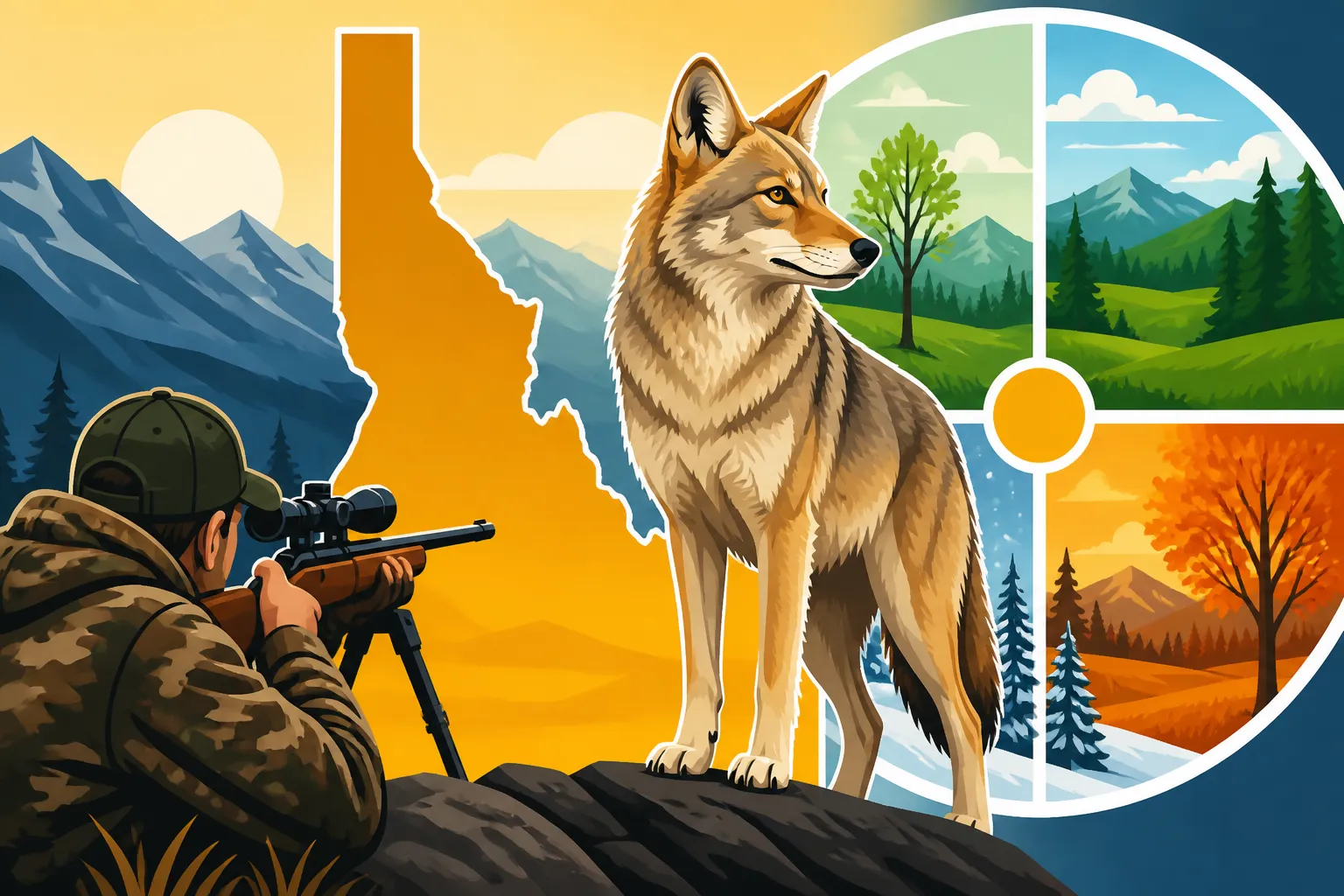
Coyotes respond differently to calls depending on their needs and hormonal drives throughout the year. Mastering seasonal calling is critical. In winter, coyotes are often hungry and focused on survival, making distress calls (rabbit, fawn, bird in distress) highly effective. This is also their breeding season, so female invitation howls or challenge barks can lure in territorial males. As spring arrives, many coyotes are denning and protective of their young. Pup distress calls can be incredibly effective, drawing in anxious parents.
By summer, food is more abundant, and coyotes may be less vocal. Focus on shorter, more subtle distress calls or even combine them with a few quiet whines. They might respond out of curiosity more than hunger. When fall rolls around, young coyotes are dispersing, and adults are re-establishing territories. This is a great time for combination calling: start with a series of howls or barks to locate them, then switch to distress sounds once you pinpoint their general location. Always consider wind direction; coyotes will almost always approach downwind to scent-check the source of the sound. Reading Wind in Steep Timbered Country isn't just for big game; it's absolutely vital for coyote hunting, as their nose is their primary defense.
Understanding Coyote Behavior and Habitat
Coyotes are incredibly adaptable, inhabiting everything from high mountain timber to open sagebrush plains and agricultural lands. Their choice of habitat shifts with the seasons, driven by food availability, denning needs, and cover. In winter, they might concentrate around big game winter ranges, scavenging or preying on weakened animals. You might find them hunting field edges or areas with high rodent populations. As spring approaches, they'll seek out suitable denning sites, often in brushy draws, rocky outcroppings, or even under old farm structures. Knowing where their food sources (like ground squirrels or rabbits) are most active in different seasons can also guide your locations.
A successful coyote hunter studies the landscape, looking for travel corridors, bedding areas, and vantage points. Look for tracks along dirt roads, game trails, or near water sources. Pay attention to scat, which can indicate their recent diet and presence. While you want to be mindful of disturbing dens, understanding these areas (from a respectful distance) can inform your hunting strategy. This intimate knowledge of the land, often gained through consistent observation, is invaluable. Utilizing detailed mapping resources, such as those found on GoHunt, can help you identify these habitat types and potential travel routes before you even step foot in the field, making your scouting efforts much more efficient.
Essential Gear for Year-Round Predator Pursuits
Having the right gear makes a huge difference in your effectiveness and comfort, especially when you're out in Idaho's diverse weather year-round. Optics are paramount: good binoculars (like 10×42) are essential for spotting coyotes at a distance, and for long-range glassing in open country, Spotting Scope Power for Canyon Glassing can really help identify a coyote against a busy background. Your camouflage should be seasonally appropriate – snow camo in winter, muted greens and browns in summer, and broken patterns for fall. Scent control is also important, as coyotes have an incredible sense of smell.
A comfortable, quiet seat or pad can make long sits more bearable, and a good shooting stick or bipod will provide a stable rest for accurate shots, which are crucial for humane harvesting. Don't forget layers of clothing; Idaho weather can change rapidly. For communication and safety, especially if hunting with a partner or in remote areas, Two-Way Radio Use Between Hunting Partners can be a lifesaver. Finally, carrying a reliable flashlight or headlamp is always a good idea, even if you don't plan to hunt past legal shooting hours.
Responsible Coyote Hunting: Ethics and Public Perception
While coyote hunting might not carry the same rigorous regulations as big game, the ethical responsibilities of a hunter remain just as high. Maintaining a strong ethical compass not only ensures humane practices but also protects the public perception of hunting in general.
Respecting Property and Wildlife
Beyond merely obtaining permission for private land, respecting the property you hunt on means leaving no trace, closing gates, and avoiding any disturbance to livestock. If you encounter other hunters pursuing deer or elk, give them a wide berth and don't interfere with their hunt. For your own safety and that of others, especially when you might be sharing the landscape with different users, considering a splash of Blaze Orange Requirements Through the Season on your person or gear, even if not legally mandated for coyotes, is a responsible choice that enhances visibility.
When it comes to the coyotes themselves, responsible hunting means aiming for quick, humane kills. Shot placement is critical. Always be sure of your target and what's beyond it. Avoid taking risky shots that could wound an animal or endanger others. Recognize that while you are managing a predator population, each animal deserves respect. This includes being aware of non-target species; always positively identify your target before pulling the trigger, especially when using distress calls that might attract other animals like bobcats or even domestic dogs.
Utilizing Your Harvest and Public Image
What you do with a harvested coyote is part of responsible hunting. While many people don't consume coyote meat, their pelts can hold value, especially in winter when the fur is prime. If you're interested in fur harvesting, research local fur buyers and proper skinning techniques. If you don't plan to utilize the fur, proper carcass disposal is important. This means either burying the animal in an appropriate location, far from water sources and trails, or removing it from the field entirely. Simply leaving carcasses in visible areas or near public access points creates a negative image and can attract unwanted attention and complaints.
As hunters, we are ambassadors for our sport. How we conduct ourselves in the field, what we post on social media, and how we talk about our activities all contribute to public perception. Presenting hunting as a respectful, ethical, and conservation-minded pursuit is vital. This means avoiding sensationalism or any content that might be misconstrued as disrespectful to wildlife. By demonstrating responsibility and respect for the land, the animals, and other people, coyote hunters can help ensure that this unique year-round opportunity continues to be available for generations to come. The Idaho Hunt Planner Is the Tool to Start With for ensuring you know the rules and respecting local land designations.
Disclaimer
This article is for general informational purposes only and does not constitute professional advice. Laws, prices and regulations vary by location and change over time. Consult a qualified professional for guidance on your specific situation.