Blue and Ruffed Grouse in High Timber
There's nothing quite like the sudden, explosive flush of a grouse from thick timber, sending your heart racing and demanding a quick, instinctive shot. While many hunters flock to Idaho for its big game, the opportunities for chasing blue and ruffed grouse in the state's expansive high timber are often overlooked, yet incredibly rewarding. If you've been frustrated by chasing birds in open country or want to experience the thrill of hunting with a close-working dog, this guide will walk you through everything you need to know to successfully pursue these fantastic upland birds in Idaho's rugged, beautiful mountains.
Understanding Idaho's Forest Grouse Species
Before you even load a shell, it's crucial to understand the distinct characteristics of the two primary forest grouse species you'll encounter in Idaho: the blue grouse and the ruffed grouse. While both call the timber home, their specific preferences and behaviors can vary significantly, influencing how and where you hunt them.
Identifying Blue Grouse (Dusky and Sooty Grouse)
In Idaho, what many hunters collectively refer to as "blue grouse" are actually two distinct species: the Dusky Grouse and the Sooty Grouse. They're both robust, slate-gray birds that blend remarkably well into the shadows of their coniferous forest habitat. The Dusky Grouse is more widespread in Idaho's interior mountain ranges, preferring higher elevations and drier conifer forests. Sooty Grouse, on the other hand, are typically found in the wetter, coastal-influenced forests of the Idaho Panhandle, though their ranges can overlap.
Visually, distinguishing them can be tough, but generally, Sooty Grouse tend to be a bit darker with a more yellowish comb over their eyes, while Dusky Grouse have a reddish comb. Both species exhibit a distinctive hooting call, especially during breeding season, which sounds like a series of low, resonant hoots. When flushed, they often fly upwards into a tree or sail downhill, sometimes offering a momentary window for a shot before disappearing into the canopy or thick brush. Their diet shifts with the seasons, from insects and berries in summer to primarily conifer needles in winter, which is why you'll find them associated with Douglas fir, grand fir, and lodgepole pine.
Identifying Ruffed Grouse
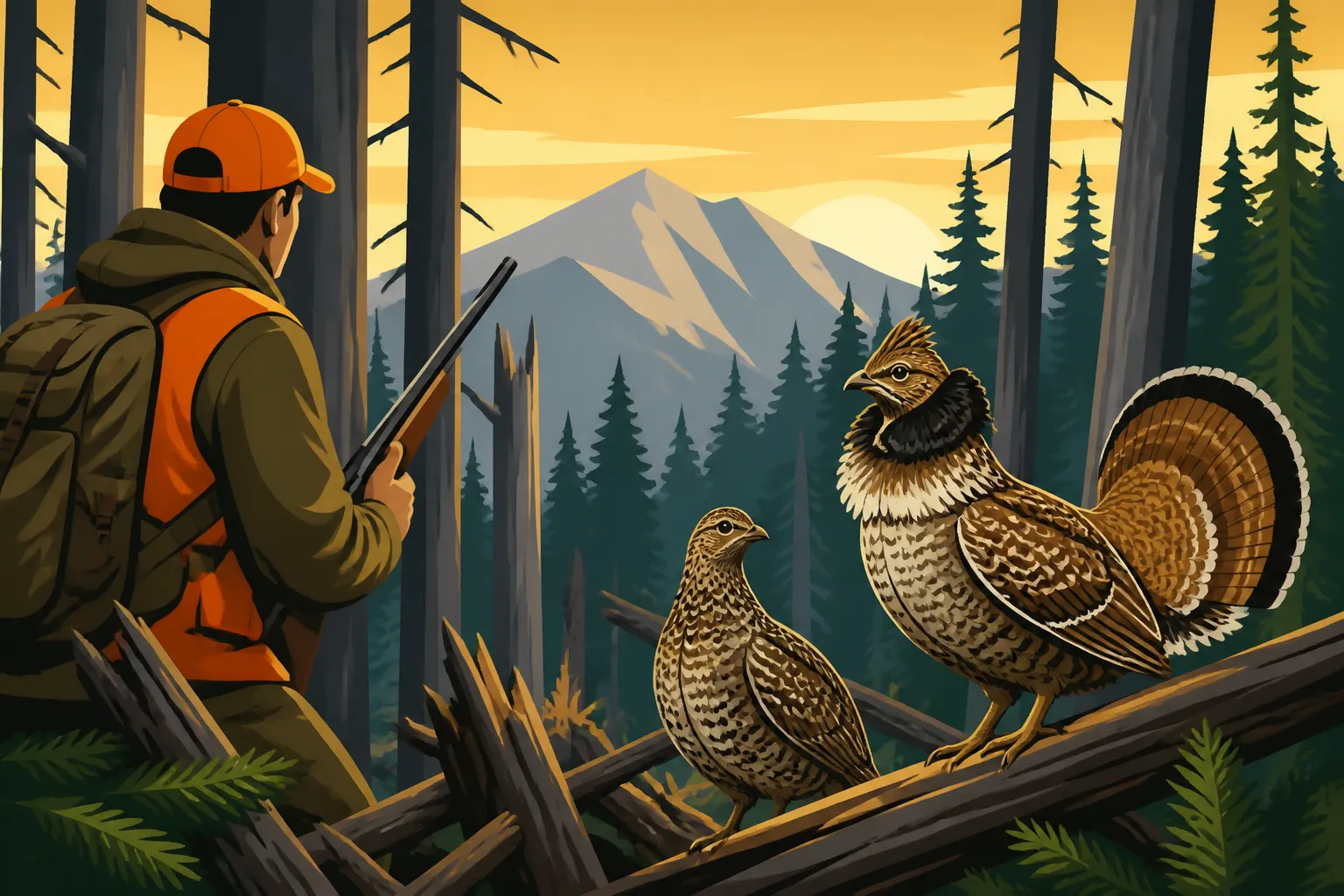
The ruffed grouse is a smaller, quicker bird, instantly recognizable by its fan-shaped tail banded with a broad, dark stripe and the distinctive ruff of feathers on its neck. Unlike the blue grouse's preference for high-elevation conifers, ruffed grouse favor younger, denser deciduous or mixed forests, often near riparian areas or old logging cuts where aspen, willow, and alder thrive alongside conifers. You'll find them frequently along stream bottoms, in dense thickets, and near blackberry or huckleberry patches.
Their most famous characteristic is the "drumming" sound made by the males during courtship, a rapid beat of their wings against the air that sounds like an old gasoline engine starting up. It's an unmistakable sound that signifies prime ruffed grouse habitat. When flushed, a ruffed grouse bursts out with incredible speed and agility, often weaving through dense cover with a surprisingly loud flutter of wings. They rarely fly far, usually just 30-50 yards, often landing behind a tree trunk or in a thicket, daring you to find them again. Their diet is diverse, including buds, catkins, berries, and insects, making them adaptable to various forest types.
Where These Birds Call Home in Idaho
Idaho's vast and varied landscape provides a perfect mosaic of habitats for both blue and ruffed grouse. When you're trying to figure out where to hunt, think about elevation and forest type. Blue grouse, particularly the Dusky variety, are creatures of the high country. You'll find them gravitating towards the upper slopes and ridges of mountains, typically in mature conifer forests of ponderosa pine, Douglas fir, and grand fir. Look for them on northern and eastern aspects where the timber is a bit denser and cooler, often near springs or seeps even in relatively dry areas. In the late season, as snow pushes them down, they might be found on lower, south-facing slopes, but always in or very near timber.
Ruffed grouse are more versatile and generally found at lower to mid-elevations. They'll be where the forest offers a mix of cover and food, particularly in areas with a good understory. This means creek bottoms choked with alder and willow, the edges of clearcuts that have regenerated with young aspen and brush, or older logging roads where sunshine promotes berry growth. Areas of northern Idaho, with its abundant water and mixed forests, are particularly strong for ruffed grouse. Using tools like GoHunt can help you identify public land units with the right elevation profiles and forest types that typically hold these birds. Consider areas where you see evidence of previous logging, as those regenerating areas are magnets for ruffs.
Tactics for Timber Grouse: From Still-Hunting to Dog Work
Hunting grouse in Idaho's timber isn't about covering miles of open ground; it's about being methodical, observant, and often, very patient. The dense cover these birds call home dictates a completely different approach than chasing pheasants in a field.
Still-Hunting the Timber for Grouse
Still-hunting is perhaps the most traditional and effective method for pursuing forest grouse without a dog. This isn't just walking; it's an art form. You move slowly, often taking only a few steps, then pausing for several minutes to scan the forest ahead, listen intently, and let your eyes adjust to the subtle movements and patterns. Grouse are masters of camouflage, and they'll often hold tight, relying on their drab plumage to blend in, only flushing when you're almost on top of them.
Focus your attention on the edges of clearings, logging roads, game trails, and creek bottoms. When you pause, look for the horizontal shape of a bird perched on a branch, or the slight flick of a tail in the underbrush. Don't just look at the trees, look through them. Many a grouse has been spotted because a hunter noticed a small, out-of-place lump on a low branch. The rustle of dry leaves, the soft "cluck" of a grouse, or the faint flutter of wings can all betray their presence. If you hear a distant flush, try to pinpoint the direction and then move even slower in that general area, anticipating another bird or a re-flush. Remember, patience is your biggest weapon in the timber.
Flushing and Shooting Opportunities
The flush of a grouse, especially a ruffed grouse, can be startlingly sudden and incredibly fast. They often explode from cover directly underfoot or from a low branch, offering only a fleeting moment for a shot before they disappear behind trees. This is why quick reflexes and an instinctive shooting style are paramount. You won't have time for a slow, deliberate aim. Instead, focus on mounting your shotgun smoothly, acquiring the bird, and swinging through it.
For blue grouse, the flush might be slightly less frantic. They often fly up into a nearby tree, sometimes giving you a slightly longer shot opportunity as they sail into the canopy. Or, they might pitch downhill and land some distance away. If they tree, take a moment to confirm it's a legal bird and then aim carefully. For ruffed grouse, expect them to hug the cover, flying low and fast through the brush. Being ready with your shotgun at the "ready" position, finger off the trigger until you've positively identified your target, is crucial. Pay attention to safety – always know what's beyond your target in the dense timber.
Using Dog Work for Grouse
While you can absolutely hunt grouse successfully without a dog, bringing a well-trained bird dog into the timber adds an entirely different dimension to the hunt. Pointers, setters, and flushers like spaniels can be invaluable. A good pointing dog will "lock up" on a grouse, holding it in place until you can walk in for the flush, turning a chaotic flush into a more controlled, anticipated shot. Flushing dogs, on the other hand, will work through the cover, pushing birds out for you.
Training is key, especially for timber grouse. Dogs need to learn to stay relatively close, navigating dense undergrowth and avoiding tangles. A GPS collar is almost a necessity in the thick woods, allowing you to keep track of your dog even when they disappear from sight. A bell on their collar can also help you track their movements. When working with a dog, pay attention to their body language. A dog on point will be rigid, intense, and focused. For a flusher, listen for changes in their pace or tail wagging that indicate they're birdy. Remember to hunt with your dog, not just behind them, anticipating where they might find birds based on the cover. Bird Dog Rules for Upland Game Hunting might offer more insights into general dog handling.
Essential Gear and Preparation for Timber Grouse Hunts
Hunting in Idaho's timber, especially in the high country, demands thoughtful gear choices. It's not just about what gun you carry, but how you'll move through the rugged terrain, stay comfortable, and remain safe.
Shotgun and Ammunition Choices
For grouse, a lighter, quick-handling shotgun is often preferred, given the close-range, fast-flushing nature of these birds. A 20-gauge or even a 28-gauge can be an excellent choice, as they are lighter to carry and swing quickly. Many hunters also opt for a 12-gauge, just be mindful of carrying extra weight. Over/under, side-by-side, or semi-automatic shotguns all work well; it really comes down to personal preference and comfort.
As for choke, improved cylinder or skeet chokes are typically ideal, as shots are often close and in dense cover, where a wide pattern is more forgiving. For ammunition, smaller shot sizes like 7.5 or 8 are perfect. They deliver a dense pattern without over-penetrating the relatively small birds. Carrying a limited number of shells in a vest or shell belt is usually sufficient, as you won't be doing volume shooting like duck hunting. Make sure your shotgun is comfortably slung or carried in a way that allows for quick mounting when a bird flushes.
Apparel and Footwear for Mountain Terrain
Layering is absolutely critical when hunting Idaho's timber. You'll be climbing, descending, and pushing through brush, which means your body temperature will fluctuate dramatically. Start with a moisture-wicking base layer, add a fleece or wool mid-layer for insulation, and top it off with a durable, brush-resistant outer layer. A good rain jacket, even on a clear day, is a wise addition; mountain weather can change in an instant. Blaze orange is often a good safety choice, even if not strictly required for all grouse seasons, especially if other hunters are in the area.
Footwear is arguably the most important gear item. You need sturdy, waterproof hiking boots with excellent ankle support and aggressive traction. The terrain will be uneven, potentially wet, and covered in deadfall and loose rock. Blisters or a twisted ankle can quickly end your hunt. Wool or synthetic socks that wick moisture are also crucial to keep your feet comfortable and dry. Don't forget durable hunting pants that can stand up to thorny brush and constant friction.
Navigation and Safety in the Backcountry
Getting turned around in dense timber is easier than you might think, even on familiar ground. A reliable GPS device or a smartphone app like GoHunt with downloaded maps is essential. Always carry a physical map and compass as a backup, and know how to use them. Mark your starting point and any key features like roads or trails. E-Scouting an Idaho Unit Before the Season can help you pre-plan your navigation.
Beyond navigation, basic safety gear is paramount. A small first-aid kit, a headlamp, a fire starter, and some emergency food and water can be life-savers if you get lost or injured. If hunting in areas known to have larger predators like bears, carrying bear spray is a prudent precaution. Always let someone know where you are going and when you expect to return. Cellular service is often nonexistent in Idaho's high country, so a satellite communication device like a Garmin inReach or a Zoleo can provide peace of mind and emergency contact capability.
Season Dates, Regulations, and Locating Prime Habitat
Understanding the legal framework and how to effectively scout for grouse habitat will significantly increase your chances of success. Idaho offers generous seasons for forest grouse, but knowing the specifics is key.
General Season Dates and Bag Limits
Idaho typically offers a long, combined season for forest grouse (Dusky/Sooty Grouse and Ruffed Grouse), often running from late August or early September well into December or even January. This provides ample opportunity, from early-season hunts when birds are often still in family groups and feeding on berries, to late-season hunts when they've shifted to conifer needles and can be found in deeper snow.
Bag limits are generally quite liberal, often with a daily bag of 4 birds and a possession limit of 12 for the combined species. This means you can have a very successful day without worrying too much about hitting your limit too quickly. However, always double-check the current Idaho Fish and Game regulations for the specific year you plan to hunt, as dates and limits can sometimes be adjusted. You can find detailed information in the Idaho Upland Game, Furbearer, and Turkey Seasons and Rules brochure. Idaho Forest Grouse Season Length Explained gives a great overview of the typical season.
Finding Public Land for Grouse
Idaho is a treasure trove of public land, with vast tracts of National Forest and Bureau of Land Management (BLM) ground open to hunting. These are your prime destinations for grouse. The key is to find areas with the right mix of habitat: mature conifers at higher elevations for blue grouse, and younger, mixed forests or riparian areas at mid-elevations for ruffed grouse.
Start with the Idaho Fish and Game website's hunt planner. Tools like The Idaho Hunt Planner Is the Tool to Start With are invaluable. You can overlay public land boundaries with satellite imagery and topographic maps to identify promising areas. Look for sections of National Forest or BLM that have a good network of old logging roads or trails, as these often provide access into prime grouse country. Pay attention to features like creek drainages, north-facing slopes with dense timber, and areas adjacent to recent logging activity (but make sure they are legally accessible). GoHunt's mapping features can further refine your search, allowing you to filter by land ownership and identify specific habitat types.
Here's a quick comparison of blue and ruffed grouse characteristics:
| Feature | Blue Grouse (Dusky/Sooty) | Ruffed Grouse |
|---|---|---|
| Appearance | Large, slate-gray, robust; reddish/yellowish comb | Smaller, mottled brown/gray, fan-shaped tail with dark band |
| Habitat | High-elevation mature conifer forests (Douglas fir, pine) | Mid-elevation mixed forests, dense young growth, riparian areas |
| Flush Behavior | Often flies up into trees or sails downhill, sometimes slower | Explosive, fast, weaving through dense cover, flies short distances |
| Vocalizations | Low, resonant "hooting" | Distinctive "drumming" sound by males, soft clucks |
| Primary Food | Conifer needles (winter), berries, insects (summer) | Buds, catkins, berries, leaves, insects |
| Typical Range | Widespread in Idaho mountains, Panhandle for Sooty | Widespread in diverse timbered areas, especially northern Idaho |
Scouting and E-Scouting for Grouse Hotspots
Before you even set foot in the woods, thorough e-scouting can dramatically increase your efficiency. Use online mapping tools (like those offered by GoHunt) to identify areas with the habitat characteristics mentioned above. Look for:
- Elevation bands: Match the elevation to the species you're targeting.
- Forest types: Differentiate between dense conifer stands and mixed deciduous/conifer areas.
- Water sources: Grouse, like all wildlife, need water.
- Logging activity: Recent clearcuts or thinning operations create excellent ruffed grouse habitat. Old logging roads often provide easy walking and access to good cover.
- Contour lines: Identify saddles, ridges, and creek bottoms where birds might congregate or travel.
Once you have some promising spots identified, if possible, do some pre-season boots-on-the-ground scouting. Look for actual grouse sign: droppings, dusting areas, and primary food sources like huckleberry bushes or aspen groves. Even though grouse are small, their presence leaves clues. A quiet hike through potential areas before the season opens can reveal hidden gems and give you a huge advantage when it's time to hunt. Understanding Reading Terrain Before You Pick a Camp is valuable for any hunt, including grouse, as knowing the lay of the land will inform your hunting strategy.
Disclaimer
This article is for general informational purposes only and does not constitute professional advice. Laws, prices and regulations vary by location and change over time. Consult a qualified professional for guidance on your specific situation.