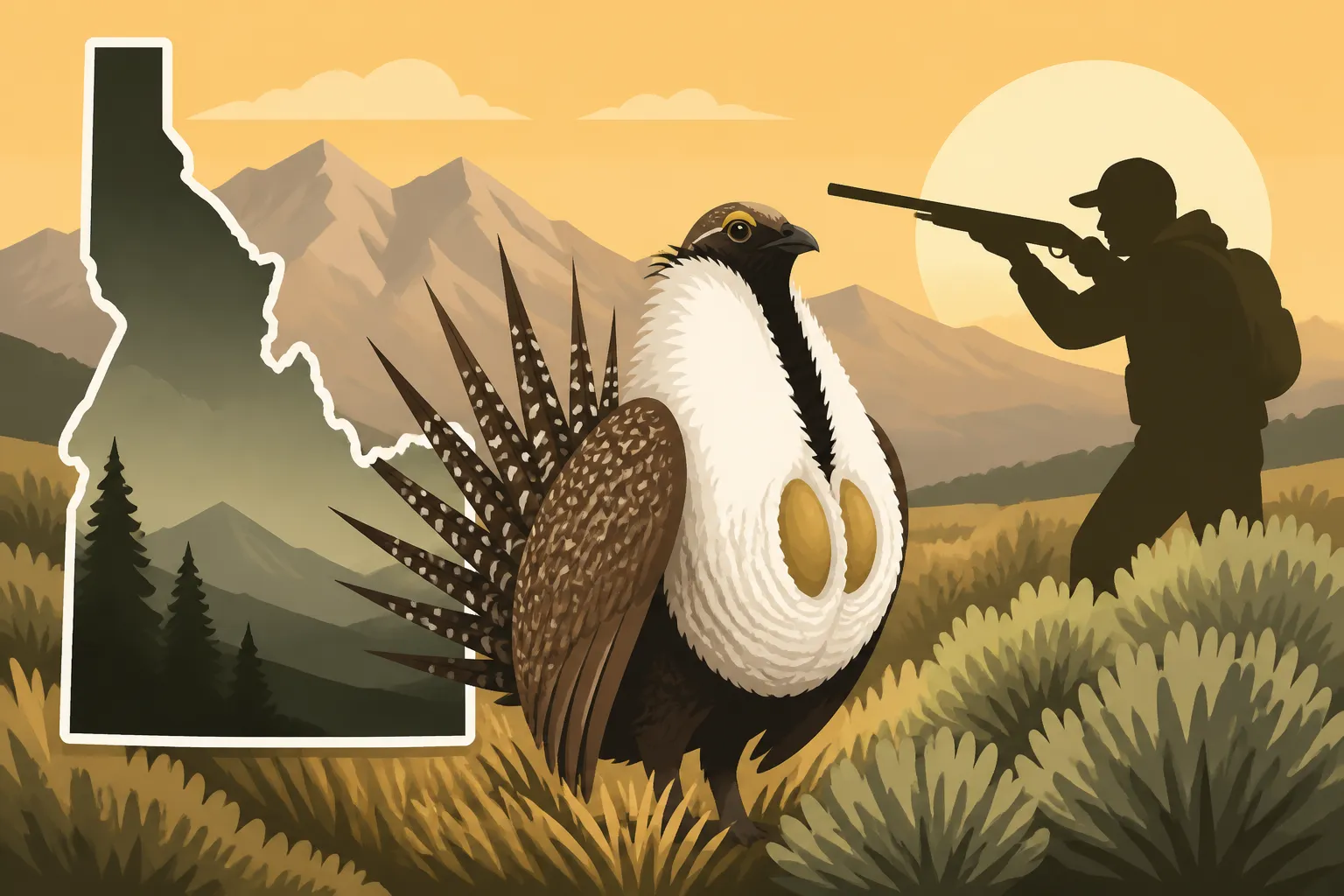
Idaho Sage Grouse Season and Permit
Hunting sage grouse in Idaho offers a truly unique experience, but it’s an endeavor wrapped in strict regulations, limited opportunities, and a deep conservation ethic. Many hunters find themselves scratching their heads, wondering how to even begin navigating the permit system and understanding the incredibly short seasons. This guide is here to untangle those complexities, helping you understand the "why" behind Idaho's strict sage grouse management and outlining the essential steps to participate in this challenging, yet rewarding, pursuit.
Understanding Idaho's Sage Grouse Management
When you hear about sage grouse hunting in Idaho, the first thing that often comes to mind is how rare and challenging it is to draw a tag or even find an open season. This isn't just about making the hunt exclusive; it's deeply rooted in the crucial need to protect these magnificent birds and their unique habitat. Idaho's management strategy is a delicate balance, aiming to provide limited hunting opportunities while ensuring the long-term survival of the species.
The Conservation Imperative for Sage Grouse
Sage grouse are truly a species of the vast, open sagebrush country that defines much of Idaho's landscape. They are entirely dependent on the "sagebrush sea" for every aspect of their lives: food, cover, nesting, and breeding. Unfortunately, this critical habitat has been shrinking and fragmenting for decades due to a variety of factors. Wildfires, often exacerbated by invasive annual grasses like cheatgrass, can quickly destroy vast swathes of sagebrush that take decades to recover. Development, agricultural conversion, and even certain energy projects also chip away at their territories.
Because their survival is so intrinsically tied to this specific habitat, sage grouse populations have faced significant declines across their range. Here in Idaho, the Fish and Game Department, along with other agencies, monitors these populations with extreme care. Their goal isn't just to manage hunting pressure, but to protect the entire ecosystem these birds rely on. Understanding this conservation imperative helps us appreciate why the seasons are so short and the permits so few; it's a direct response to a very real and pressing need to safeguard the species for future generations.
How Seasons and Permits Reflect Conservation Goals
Every decision Idaho makes regarding sage grouse hunting, from the length of the season to the number of permits issued, is directly tied to observed population trends and the health of their habitat. It's a prime example of adaptive management in action. Wildlife biologists conduct annual surveys, often focusing on leks—the traditional breeding grounds where male sage grouse perform their elaborate courtship displays. The number of active leks and the count of displaying males provide crucial data on population dynamics.
If populations are stable or showing signs of slight recovery in certain areas, there might be a very limited, short season. If numbers are low, or if significant habitat loss has occurred (like a large wildfire), a unit might be closed entirely, or the permit numbers drastically reduced. This can certainly be frustrating for hunters who eagerly anticipate the chance to pursue these birds, especially when you apply year after year without drawing a tag. However, this rigorous approach ensures that hunting is never the primary factor in population decline. Instead, it's carefully calibrated to have a negligible impact, putting the birds' long-term viability first. It’s a bitter pill to swallow sometimes, but it’s a necessary one if we want to ensure sage grouse continue to grace Idaho’s landscapes.
Navigating the Sage Grouse Season and Permit Process
Once you understand the 'why' behind Idaho's careful management, the 'how' of actually hunting sage grouse starts to make a bit more sense. It's not like simply buying a general upland bird tag and heading out. This is a highly regulated, controlled hunt, and knowing the specific windows for application and the unique rules is absolutely paramount.
When and Where You Can Hunt Sage Grouse
General sage grouse seasons are not a statewide affair in Idaho. They are incredibly restricted, typically confined to very specific Game Management Units (GMUs) and often limited to just a few days, sometimes even just one or two weekends. The exact dates and open units can change annually, based on the previous year's population data. This means that checking the current Idaho Fish and Game regulations every single year is not just good practice—it's absolutely essential. Never assume the season structure will be the same as last year.
These hunts are primarily focused within what Idaho Fish and Game designates as "Sage Grouse Management Areas" (SGMAs), which are regions identified as critical habitat where these birds exist. You won't find sage grouse season across the forested Panhandle or in areas lacking extensive sagebrush cover. Instead, you'll be looking at units primarily in southern, central, and eastern Idaho's high desert and rangelands. These are typically vast, open areas, often interspersed with private ranchland, but with significant amounts of public land, including Bureau of Land Management (BLM) ground and National Forests.
When researching potential units, resources like the GoHunt platform can be incredibly valuable for visualizing unit boundaries and understanding historical draw odds for specific areas. It’s a good way to see where previous hunts have occurred and get a feel for the landscape, even if the exact season parameters might shift. The key takeaway here is hyper-specificity: you must consult the latest Idaho hunting regulations to pinpoint the exact open units and dates for the upcoming season. For a broader overview, you might want to consult the Idaho Upland Bird Season Opening Dates to get a general idea of when other bird seasons kick off.
The Crucial Permit Requirement
This is where sage grouse hunting truly diverges from other upland bird pursuits. You absolutely, unequivocally need a special controlled hunt permit to hunt sage grouse in Idaho, in addition to your regular Idaho Resident Hunting License Price (or nonresident equivalent) and an upland bird validation. You can't just buy an over-the-counter tag and head afield.
The application period for these controlled hunt permits usually occurs in the spring or early summer, typically aligning with the general controlled hunt application period for species like deer and elk. It's a draw system, meaning you apply for a specific unit and hunt number, and then hope your name is selected. Idaho does not use a preference point system, which means that every applicant, whether it's your first time applying or your tenth, theoretically has an equal chance of drawing a tag each year. This can be both a blessing and a curse; it's exciting to know you have a fair shot right out of the gate, but it can also be disheartening if you apply for several years without success.
Here's a breakdown of the key steps you'll likely follow when applying for an Idaho sage grouse permit:
| Step | Description |
|---|---|
| 1. Purchase Hunting License | Before you can even apply for a permit, you'll need to purchase your annual Idaho hunting license. This is a prerequisite for any tag or permit application. |
| 2. Purchase Upland Bird Permit | You'll also need to purchase the general upland bird permit/validation for the current year. This is a separate validation that allows you to hunt various upland species. |
| 3. Consult Regulations | Crucially, review the current year's Idaho Big Game & Upland Game Regulations booklet (available online or at license vendors) to identify the open units, season dates, and hunt numbers for sage grouse. |
| 4. Choose Your Unit & Hunt | Decide which specific unit and hunt period you wish to apply for. This often involves research using resources like the Idaho Hunt Planner or GoHunt to evaluate draw odds and habitat. |
| 5. Apply Online | Submit your application through the Idaho Fish and Game online licensing system during the designated application period. Ensure you select the correct species, unit, and hunt number. |
| 6. Monitor Results | Wait for the draw results to be posted, usually a few weeks after the application deadline. You'll typically be notified via email or can check your account online. |
| 7. Purchase Tag (If Drawn) | If you are successfully drawn, you will have a specific deadline to purchase your controlled hunt tag. Missing this deadline will forfeit your tag! |
Remember, missing any of these deadlines or overlooking a requirement can mean missing out on your chance to hunt. It's a small window with high stakes for those hoping to chase these iconic birds.
Bag Limits and Other Important Regulations
Given the delicate status of sage grouse populations, the regulations once you actually do draw a tag are also quite stringent. The bag limits are typically very conservative, often set at one bird per season, or sometimes one per day within a very short season window, with a possession limit that mirrors the daily limit. This stands in stark contrast to the more generous limits for other upland species mentioned in the Idaho Small Game Seasons at a Glance.
Beyond bag limits, there are other critical rules to be aware of:
- Shooting Hours: Sage grouse hunting adheres to legal shooting hours, which are typically from half an hour before sunrise to half an hour after sunset. Always confirm the exact times for the period you're hunting.
- Proof of Species: When transporting your harvested bird, Idaho law usually requires that you leave a feathered wing or the head attached to the carcass. This allows wildlife officials to identify the species and sometimes the sex, ensuring compliance with regulations. Removing both can lead to a violation.
- Motorized Travel: Most sage grouse habitat is in vast, open country, but this doesn't mean you can drive wherever you please. Idaho has clear rules about motorized vehicle use on public lands. Remember that Idaho's Motorized Hunting Rule Keeps You on the Road and driving off established roads, even to retrieve game, is generally prohibited. This is particularly important in the delicate sagebrush ecosystems, where vehicle tracks can cause long-lasting damage.
- Reporting: While not always mandatory for every small game species, some controlled hunts may have a mandatory harvest reporting requirement. Always check if you need to report your sage grouse harvest to Idaho Fish and Game, even if it's a zero-take season for you.
These regulations are in place to ensure that even with a permit, hunting pressure remains minimal and sustainable. Adhering to them meticulously is part of being a responsible sage grouse hunter and a conservationist.
Strategies for a Successful Sage Grouse Hunt (Even with Limited Opportunity)
Even with the low odds of drawing a tag and the strict regulations, the dream of a sage grouse hunt keeps many hunters applying year after year. If you're lucky enough to draw one of these coveted permits, having a solid strategy in place, both for pre-season scouting and on-the-ground tactics, is essential for turning that dream into a reality.
Researching Units and Habitat Prior to Application
The planning for a sage grouse hunt truly begins long before you submit your permit application. Since the habitat is so specific, your research needs to be laser-focused on finding units that offer extensive sagebrush country. The Idaho Hunt Planner Is the Tool to Start With for this. Dive deep into its map features, looking for unit boundaries and overlaying land ownership layers.
Sage grouse thrive in areas dominated by mature sagebrush, often intermixed with native grasses and forbs. This typically means focusing your attention on the vast tracts of Hunting Idaho's National Forests and BLM Ground in southern and eastern Idaho. These public lands are the backbone of most sage grouse opportunities. Use satellite imagery to identify areas with continuous sagebrush cover, looking for subtle draws, rolling hills, and plateaus. These birds don't generally inhabit the same areas as Chukar, Grouse and Idaho's Upland Country which prefer steep, rocky breaks, or Forest Grouse Through Idaho's Timber.
Early in the season, when temperatures are still high, water sources can be key concentration points. Look for springs, stock ponds, or small creeks within large sagebrush expanses. While sage grouse are adapted to arid environments, they still need water, and broods of young birds will gravitate towards areas with more succulent vegetation found near moisture. Understanding the general lay of Idaho Runs 99 Game Management Units and which ones historically have sage grouse populations is a crucial first step.
Scouting and On-the-Ground Tactics
If you're one of the fortunate few to draw a sage grouse permit, pre-season scouting, even virtually, can dramatically increase your chances. Once you have your unit picked out, use mapping software (like GoHunt) to identify specific areas that fit the habitat profile. Pay attention to changes in elevation, which can sometimes concentrate birds.
On the ground, sage grouse are masters of camouflage, blending seamlessly into their sagebrush surroundings. They often hold tight, only flushing when you're almost on top of them, erupting with a surprisingly powerful, noisy flight. Hunting them effectively often involves walking large circles through prime habitat, covering ground steadily. Work areas with varied sagebrush heights, subtle rises, or shallow drainages. These slight changes in terrain can hold birds.
Many successful sage grouse hunters rely heavily on good bird dogs. A well-trained pointer or flusher can cover far more ground efficiently and locate birds that would otherwise be missed. Their scenting ability is invaluable in pinpointing the location of birds holding tight. Without a dog, you'll need to be incredibly observant, walking at a steady pace and constantly scanning ahead.
Ethical shot placement is paramount, aiming for a clean kill. Since bag limits are so low, making every shot count is crucial, and minimizing lost birds is a sign of respect for the resource.
Ethical Considerations and Species Identification
Hunting sage grouse carries a significant responsibility, not just to abide by the law but to uphold ethical hunting practices that contribute to conservation. One of the most important aspects is positive species identification. While most upland hunters will likely encounter Sharp-Tailed Grouse on Eastern Grasslands or Hungarian Partridge Across Dryland Farm Ground in different habitats, you must be absolutely certain you're targeting a sage grouse if you have a tag.
Sage grouse are quite distinctive – very large, gray-brown, with a long, spiky tail. The males are particularly impressive with their large air sacs. It's especially critical to avoid shooting hen grouse if there are any specific regulations regarding sex. Taking the time to properly identify your target ensures you are compliant and respectful of the populations.
Furthermore, as custodians of this unique species, hunters have a role to play beyond the hunt itself. By adhering strictly to bag limits, avoiding unnecessary disturbance to leks, and reporting any unusual observations to Idaho Fish and Game, we can all contribute to the ongoing conservation efforts for sage grouse. It's about cherishing the experience and recognizing the privilege of pursuing a game bird that truly embodies the spirit of Idaho's wild sagebrush country.
Disclaimer
This article is for general informational purposes only and does not constitute professional advice. Laws, prices and regulations vary by location and change over time. Consult a qualified professional for guidance on your specific situation.