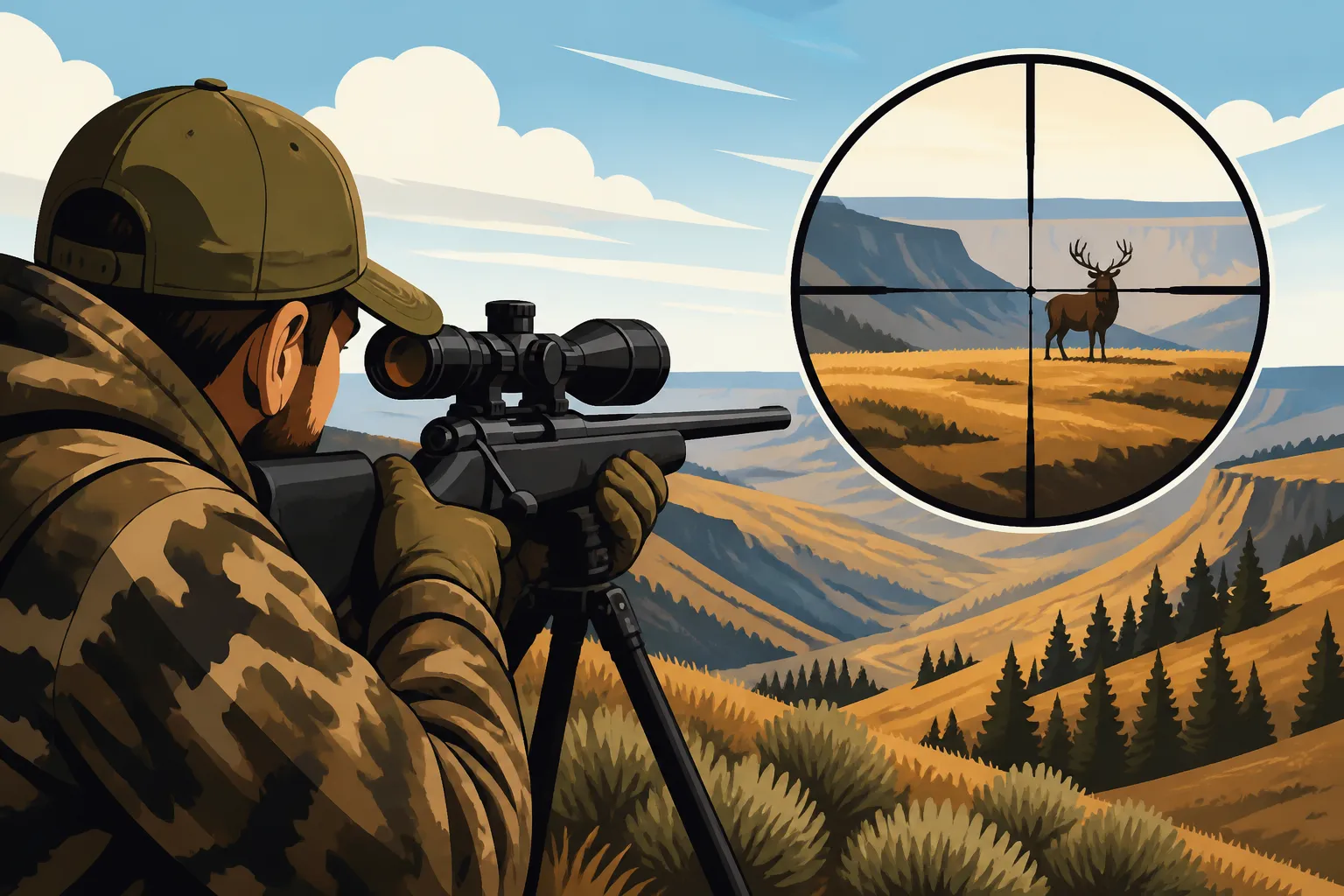
Optics Power for Idaho’s Long Canyon Sightlines
The vast, rugged landscape of Idaho, with its deep canyons, expansive sagebrush flats, and towering timbered mountains, often leaves hunters struggling to pick the right optics. It's a real challenge to differentiate a distant deer from a sun-baked rock, or accurately judge the true size and score of an elk across a mile-wide chasm. This guide will dive deep into understanding optics power, helping you choose the perfect binoculars, spotting scopes, and rangefinders to master Idaho's demanding and truly incredible long canyon sightlines.
Understanding Magnification and Objective Lens Size for Idaho Hunting
Before we even talk about specific gear, it’s crucial to grasp the fundamental numbers you see stamped on every pair of binoculars or spotting scope. These aren't just arbitrary figures; they tell you a lot about how that piece of glass will perform in the varied, often extreme, conditions Idaho throws at you. Ignoring these basic principles is like buying a truck without checking the horsepower – you might get somewhere, but it won't be efficient or enjoyable.
The Power Number: What "10x" Really Means
When you see "10×42" on a pair of binoculars, the "10x" is your magnification. It means that whatever you're looking at will appear 10 times closer than it does to your naked eye. So, a deer that's 1,000 yards away will look like it's only 100 yards away through your 10x binoculars. Seems simple enough, right? But here's where it gets nuanced for Idaho hunting. Higher magnification isn't always better. While it might bring that distant elk on the far canyon wall into sharper focus, it also has trade-offs.
Every increase in magnification generally leads to a decrease in your field of view – how wide an area you can see through the glass. In dense timber or brushy creek bottoms where you might be still hunting for mule deer or trying to pick up a whitetail, a wider field of view is invaluable for quickly locating an animal or noticing subtle movements. Too much magnification can make your image shaky, especially when hand-holding, and it amplifies every tiny tremor in your hands, making sustained glassing a frustrating experience. For those long sessions grid glassing a basin without missing bucks, that shake can cause eye fatigue surprisingly quickly.
Gathering Light: The Objective Lens and Its Importance
Continuing with our "10×42" example, the "42" refers to the diameter of the objective lens, measured in millimeters. This is the large lens at the front of your optics, facing your target. The size of this lens is directly proportional to how much light your optics can gather. And let me tell you, when you’re hunting Idaho, light gathering ability is paramount. Think about those crucial minutes right at dawn or dusk, when elk are most active, stepping out of dark timber, or when a big mule deer buck might be making his way to feed. These are low-light conditions, and a larger objective lens means more available light reaches your eye, resulting in a brighter, clearer image.
However, just like magnification, there’s a balance. A larger objective lens means more glass, which translates to more weight and bulk. Hauling a massive, heavy pair of binoculars or a spotting scope up a steep Idaho mountain trail can be a real burden, especially when you’re already packing an elk out of steep country alone. You need to consider what you're primarily hunting, the terrain, and your physical capacity. For instance, a 56mm objective might be fantastic for low-light elk hunting from a stationary position, but it might be overkill and too heavy for a fast-paced archery hunt where every ounce matters.
Exit Pupil and Low-Light Performance
The exit pupil is a concept many hunters overlook, but it’s critical for those early morning and late evening glassing sessions. It's the diameter of the light beam that exits the eyepiece and enters your eye. You can calculate it by dividing the objective lens diameter by the magnification. So, for our 10×42 binoculars, the exit pupil is 4.2mm (42mm / 10 = 4.2mm). Why does this matter? Because in low light, your pupils dilate to let in more light, typically up to 5-7mm for adults. If your optics' exit pupil is smaller than your dilated pupil, you're essentially wasting some of the light-gathering capability of that large objective lens.
Conversely, in bright daylight, your pupils constrict, making a large exit pupil less critical. For peak low-light performance, you want an exit pupil that is at least as large as your dilated pupil. This is why 8x binoculars with a 42mm objective (8×42, exit pupil 5.25mm) often appear brighter in dim conditions than 10×42 binoculars, even though the 10x has higher magnification. Understanding this helps you choose optics that truly shine when the light fades, giving you those precious extra minutes to identify game when it matters most in Idaho's vast landscapes.
Binoculars: Your Everyday Scouting Partner in Idaho
Binoculars are, without a doubt, the most essential piece of optics a hunter carries into Idaho's wilds. They're your primary tool for scanning terrain, identifying game, and making crucial decisions on the fly. You'll spend more time behind your binos than any other optic, so choosing the right pair is paramount. It’s not just about seeing further; it’s about seeing smarter and more efficiently in a landscape that constantly challenges your vision.
The Sweet Spot: 8x to 12x for General Hunting
For the typical Idaho big game hunter, a binocular in the 8x to 12x magnification range hits the sweet spot. An 8x or 10x binocular, like an 8×42 or 10×42, offers an excellent balance of magnification, field of view, and light-gathering capability without becoming overly cumbersome. These are fantastic for general purpose hunting, whether you're still-hunting the dark timber for a bull elk or slowly traversing the breaks for mule deer. They're light enough to carry comfortably around your neck or in a bino harness all day, and stable enough to hand-hold for quick scans.
When you start pushing into 12x magnification, like a 12×50, you gain noticeable reach, which can be a huge advantage when glassing Idaho breaks for mule deer from a distant ridgeline. However, the increased magnification means a narrower field of view and a more critical need for steady hands. Even slight hand tremor becomes more pronounced, making it harder to hold the image still for extended periods. If you're considering 12x or higher, you really ought to think about investing in a good binocular tripod adapter, which we'll discuss later, because prolonged hand-holding at this power quickly becomes tiring and inefficient.
Balancing Magnification and Field of View
As we touched on earlier, a higher magnification often comes at the cost of a smaller field of view. In Idaho, this balance is crucial. Imagine you're in the thick timber of the Panhandle, hunting whitetail. An 8x binocular will give you a wide view, allowing you to quickly pick up a deer moving through the trees or a subtle twitch of an ear. A 10x will narrow that view slightly, but offer more detail, which can be useful when you need to confirm antlers or judge a deer's size through brush.
However, if you're out on the high desert, picking apart distant sagebrush hills for antelope or mule deer, a 10x or even 12x might be preferable because the distances are so much greater and you're covering vast open ground. Here, the field of view is less of a concern because there's less immediate cover to hide game. It’s about being able to discern movement or a body shape against a distant backdrop. Many experienced Idaho hunters will carry both – an 8x or 10x for quick, general glassing and a higher power spotting scope for detailed examination. The right choice truly depends on the specific terrain and species you're pursuing.
Stabilization for Extended Glassing Sessions
Anyone who has spent hours picking apart a distant mountainside knows the frustration of shaky hands and fatigued eyes. Even the steadiest hunter can't hold binoculars perfectly still for long periods, especially at higher magnifications. This is where stabilization becomes a game-changer. For serious glassing in Idaho's expansive country, particularly when you’re really trying to discern detail, you absolutely need to stabilize your binoculars.
Binocular adapters, often a simple L-shaped plate that screws into the front of your binoculars and attaches to a tripod, are inexpensive and transform your glassing experience. What once looked like a fuzzy, jiggling mess through hand-held 10x binoculars becomes a crisp, steady image when mounted on a tripod. This stability reduces eye strain, allows you to pick up subtle details you would otherwise miss, and makes it possible to truly dissect a distant slope. A stable platform for your binoculars is almost as important as the quality of the glass itself, especially when you're trying to find a bedded buck or a tucked-away elk miles away. Even a simple pair of 10x binoculars, when mounted, can outperform a much more powerful, but handheld, optic. This is a critical consideration for anyone serious about hunting Idaho. For tips on glassing, check out our piece on The Grid Glassing Method, Step by Step.
Spotting Scopes: Reaching Across Canyons and Judging Animals
While binoculars are your bread and butter, a spotting scope is your heavy artillery for Idaho's long-range game. It's the tool you pull out when you've spotted something with your binos way out there – a faint speck on a distant ridge – and need to determine if it's a trophy animal, a doe, or just a gnarled juniper bush. In Idaho's expansive units, where shots can stretch across hundreds of yards and canyons are measured in miles, a quality spotting scope isn't a luxury; it's a necessity for ethical hunting and successful tag filling.
Fixed vs. Zoom Eyepieces for Idaho's Varied Terrain
Spotting scopes typically come with either a fixed magnification eyepiece or a variable zoom eyepiece. Fixed eyepieces, say a 20x or 30x, often offer superior optical clarity and a brighter image compared to their zoom counterparts at similar magnifications. This is due to fewer internal lens elements, which means less light loss and less optical aberration. For hunters who prioritize absolute image quality and know they'll primarily be glassing at a specific high magnification, a fixed eyepiece can be an excellent choice.
However, the versatility of a zoom eyepiece, such as 20-60x or 22-65x, is often more appealing to the average Idaho hunter. It allows you to quickly scan a wide area at a lower magnification (e.g., 20x) and then dial in for detail on a specific animal at a higher power (e.g., 60x). This flexibility is incredibly valuable when you’re picking apart diverse terrain, from the vast openness of the high desert to the broken country of the Salmon River breaks. The ability to transition from a broad overview to a detailed inspection without changing eyepieces makes a zoom scope highly adaptable, and for many, the slight trade-off in ultimate clarity is worth the convenience. For more on getting the most out of your scope, refer to Spotting Scope Power for Canyon Glassing.
Aperture and Resolution for Clarity at Extreme Distances
Just like with binoculars, the objective lens diameter (aperture) of a spotting scope is critical for light gathering. Spotting scopes typically have much larger objective lenses, ranging from 50mm up to 95mm or even larger. The larger the aperture, the more light the scope can gather, and crucially, the higher its resolving power. Resolution refers to the scope's ability to distinguish fine details and separate closely spaced objects. At extreme distances in Idaho, where a deer could be a mile away, high resolution means the difference between seeing a "blob" and clearly counting antler points or confirming that crucial brow tine.
A 65mm or 80mm objective lens is a popular choice for most big game hunters. A 65mm scope offers a good balance of light gathering and portability, while an 80-85mm scope will provide significantly brighter images and better detail, especially at high magnifications and in low light. When you're trying to judge a bull elk that's just barely visible through the heat waves rising off a distant ridge, that extra resolution and brightness from a larger aperture can be the deciding factor between making a long stalk or moving on. Remember, though, increased aperture means increased weight and often, increased cost.
Tripod Stability: Non-Negotiable for Spotting Scopes
If stabilization is important for binoculars, it is absolutely, unequivocally non-negotiable for spotting scopes. Without a rock-solid tripod, a spotting scope is virtually useless. Even the slightest wobble, a breath of wind, or an unsteady hand will render the high magnification unusable, turning your image into an unusable blur. Trying to use a spotting scope hand-held is like trying to drive a nail with a rubber mallet – it just won't work effectively.
Your tripod needs to be sturdy enough to support the weight of your scope without flexing or shaking, even in a light breeze. It should also be tall enough to comfortably glass from a sitting or kneeling position, and ideally, extend high enough for standing if the terrain or vegetation demands it. Many hunters compromise on tripod weight to save ounces, but this is often a false economy. A lightweight, flimsy tripod will frustrate you endlessly. Instead, invest in a quality carbon fiber tripod that offers a good balance of rigidity and manageable weight. It's the foundation upon which your entire long-range glassing strategy in Idaho is built. Don't skimp here; your success hinges on a stable platform.
Rangefinders: Essential for Ethical Long-Range Shots
In Idaho's vast and often steep terrain, accurately determining distance is not just a convenience; it's an ethical imperative. Misjudging yardage by even a small margin on a distant animal can lead to a missed shot, or worse, a wounded animal. A reliable rangefinder eliminates guesswork and gives you the confidence to make precise, ethical shots, whether you're an archer trying to close the distance or a rifle hunter calculating bullet drop across a canyon.
Beyond Line of Sight: Angle Compensation in Steep Country
One of the biggest pitfalls when hunting in mountainous regions like Idaho is misjudging distances on uphill or downhill shots. Gravity affects bullet trajectory based on the horizontal distance to the target, not the actual line-of-sight distance. For example, if an animal is 300 yards away line-of-sight but significantly uphill, the effective horizontal distance might only be 250 yards. If you hold for 300 yards, your shot will go high. This is a common mistake that can cost you an animal.
Modern hunting rangefinders come equipped with angle compensation technology, often marketed as "true ballistic range," "horizontal distance," or similar terms. These devices measure both the line-of-sight distance and the angle to the target, then calculate the "shoots-like" or effective horizontal distance. This is absolutely critical for precision in Idaho's steep draws and canyons. Always ensure your rangefinder has this feature; it's not a gimmick, it's a vital tool for making ethical shots in vertical terrain. It takes the guesswork out of judging those tricky, angled shots, giving you one less thing to worry about when that trophy animal finally steps into view.
Effective Ranging Distance for Big Game Hunting
When choosing a rangefinder, don't just look at the maximum advertised range. Many manufacturers boast ranges of 1,500 yards or even 2,000+ yards, but these figures are often for highly reflective targets under ideal conditions. For an animal in varied terrain, you can usually expect the effective range to be significantly less. For big game hunting in Idaho, you'll want a rangefinder that can reliably give you readings on deer and elk out to at least 800-1,000 yards. Even if you don't plan to shoot that far, being able to range landmarks or animals at those distances helps you confirm distances to closer targets or verify your E-scouting an Idaho unit before the season data.
Consider the clarity and speed of the readout. In the field, you often need a quick, accurate reading. Look for models with a clear display, fast acquisition time, and consistent performance in different light conditions. Features like multiple ranging modes (e.g., "brush" mode to ignore foreground obstacles) can also be incredibly useful. Brands like Leupold, Vortex, and Sig Sauer offer excellent hunting-specific rangefinders that perform well in the challenging conditions of the West. While a 500-yard rangefinder might suffice for some whitetail hunts, for wide-open Idaho, you need more horsepower under the hood.
Integrating with Ballistics Data and Shooting Solutions
The most advanced rangefinders go beyond just giving you a distance; they can integrate with ballistics data to provide a complete shooting solution. Some models, often with Bluetooth connectivity, can pair with a smartphone app (like the one from GoHunt, which is excellent for planning and researching units with detailed maps and drawing odds information), or even come with pre-programmed ballistic profiles for various cartridges. These systems can factor in not just distance and angle, but also temperature, barometric pressure, and even wind to give you a precise holdover or turret adjustment.
This level of integration is a huge advantage for rifle hunters engaging targets at extended ranges in Idaho. Instead of manually calculating drops or consulting a separate ballistics chart, your rangefinder can tell you exactly how many clicks to dial on your scope or where to hold your reticle. It streamlines the process, reduces the chance of error under pressure, and allows for much quicker, more confident shot placement. Even if you're not planning extreme long-range shots, having a rangefinder that offers this capability is a powerful tool for maximizing your accuracy and ensuring ethical harvests in Idaho's demanding environment.
Matching Optics to Idaho's Diverse Terrain and Game
Idaho is a land of incredible diversity, from high desert sagebrush to dense forests and jagged alpine peaks. No single "perfect" optics setup exists for every scenario. The savvy hunter understands that adapting their gear to the specific terrain and game they're pursuing is key to success. What works wonderfully for elk in thick timber might be a hindrance when glassing for sheep above timberline.
High Desert Sagebrush: Pronghorn and Mule Deer
When you’re hunting the vast, open expanses of Idaho's high desert, chasing elusive pronghorn or big mule deer bucks, your optics need to cover serious ground. Distances here are measured in miles, not yards, and game animals can blend seamlessly into the seemingly endless sagebrush. For this terrain, magnification and the ability to pick apart distant details are paramount.
A good pair of 10x or 12x binoculars on a tripod is indispensable. This allows you to steadily scan massive areas for hours without fatigue. Complementing this, a spotting scope with an 80mm+ objective and a 20-60x or 22-65x zoom eyepiece becomes your most powerful tool. You’ll spend most of your time behind the spotting scope, meticulously grid glassing a basin without missing bucks, looking for the tell-tale horizontal line of a bedded deer's back or the white patch of a pronghorn. The extra light gathering and resolution of a larger objective spotting scope are critical for discerning antler size and body details at extreme ranges, helping you determine if a two-mile stalk is worth the effort. For these hunts, a rangefinder capable of reliable readings out to 1,000+ yards on animals is also vital.
Timber and Breaks: Elk and Whitetail Tactics
Moving into the dense timber and broken country of northern and central Idaho, the optics strategy shifts. Here, shots are often much closer, and quick target acquisition is more important than extreme long-range detection. Elk often hold tight in the dark timber, and whitetail in the Panhandle are masters of evasion in heavy cover.
For these environments, a high-quality 8x or 10×42 binocular is usually ideal. The wider field of view from an 8x allows for faster scanning in thick cover, helping you pick up movement or a partial animal quickly. A 10x is also excellent, providing a bit more reach for the occasional opening or clear-cut. Hand-held stability is more important here, as you'll often be on the move, making quick observations. While a spotting scope might still be useful for confirming distant animals across clear-cuts or valleys, it's less of a primary tool than in the open desert. Your rangefinder needs to be accurate, but maximum distance isn't as critical; often, 500-800 yards is plenty. Focus on crispness, durable construction, and ease of use in wet, brushy conditions. For more on the specific gear needs for these environments, consider our guide on Choosing a Rifle for Idaho's Timber and Breaks.
Alpine Basins: Goats, Sheep, and Far-Off Critters
Hunting high above timberline for mountain goats or bighorn sheep in Idaho's rugged alpine basins presents a unique set of optical challenges. The air is clear, the views are spectacular, and animals can be incredibly distant, often appearing as tiny specks against rock faces. Weight is also a major factor here, as every ounce counts on strenuous climbs.
For alpine hunting, a premium 10x or 12x binocular is a must, ideally mounted on a lightweight carbon fiber tripod. This combination allows for extensive, steady glassing of vast basins and rocky slopes. A top-tier spotting scope with a 65mm or 80mm objective and a powerful zoom (e.g., 20-60x) is your best friend for picking apart the mountainsides. You'll use it to meticulously examine every rock outcrop, searching for the tell-tale white of a goat or the curl of a ram. The ability to distinguish between a distant goat and a patch of snow, or to judge the curl of a ram, requires exceptional optical performance and resolution. While weight is a concern, you cannot compromise on glass quality here. A lightweight, accurate rangefinder with angle compensation is also vital for those steep, open shots.
Tripods, Adapters, and Accessories: The Unsung Heroes of Optics
Having top-tier glass is only half the battle in Idaho. The other half is maximizing its potential, making it comfortable to use, and protecting your investment. This is where quality tripods, adapters, and proper care come into play. These are the unsung heroes that turn good optics into great hunting tools. Ignoring them is like buying a Ferrari but putting bicycle tires on it – you'll never realize its full performance.
Choosing a Stable Tripod: Weight vs. Sturdiness
A good tripod is the foundation of effective glassing in Idaho. It transforms your binoculars and spotting scope from shaky hand-held devices into steady, fatigue-free viewing instruments. The core dilemma for hunters is always balancing weight against sturdiness. Ultra-light tripods save precious ounces, but often come at the cost of stability, especially in windy conditions or on uneven terrain. A slight breeze can cause a flimsy tripod to vibrate, negating the benefits of your expensive optics.
For serious backcountry hunting, where every pound matters, a carbon fiber tripod is often the best choice. While more expensive than aluminum, carbon fiber offers an excellent strength-to-weight ratio and better vibration dampening. Look for a tripod with a solid, stable head (a ball head is often preferred for quick adjustments) and sturdy leg locks. Consider its packed length and extended height – can you comfortably glass from sitting, kneeling, and even standing positions? Don't just look at the overall weight, but also its maximum load capacity to ensure it can handle your spotting scope and binoculars without straining. For those long days in the field, a steady platform is invaluable, as outlined in Tripod Setup for Glassing From a Vehicle even applies to a backcountry setup.
Binocular Adapters: Turning Handhelds into Steady Scopes
Even if you primarily use a spotting scope for long-range work, don't underestimate the power of mounting your binoculars to a tripod. A simple, inexpensive binocular adapter can dramatically improve the performance of your 10x or 12x binoculars. These L-shaped adapters typically screw into the standard 1/4"-20 threaded port found on the front hinge of most binoculars and then attach directly to your tripod head.
The difference is astounding. What was once a mildly shaky image becomes rock-solid, allowing you to pick out subtle details and reduce eye strain over prolonged glassing sessions. For quick scans of a mountainside before deploying the spotting scope, or for extended periods of glassing when you don't need the extreme magnification of a scope, tripod-mounted binoculars are incredibly effective. They allow you to maintain a wide field of view while still benefiting from stability. It's a small investment that yields huge returns in glassing efficiency and comfort, particularly when you're hunting in exposed, windy areas.
Care and Maintenance for Your Investment
Your optics are precision instruments, exposed to dust, dirt, moisture, and impact in the rugged Idaho backcountry. Proper care and maintenance are crucial to ensure their longevity and performance. Always keep lens caps on when not in use and store them in a protective case or bino harness. Regularly clean the lenses with a dedicated lens pen, microfiber cloth, and lens cleaning solution. Never use your shirt or abrasive materials, as this can scratch the delicate lens coatings.
Check your optics for any signs of fogging or internal moisture, especially after significant temperature changes or heavy rain. If you notice persistent fogging, it might indicate a seal issue and warrant professional service. Also, inspect your tripod and adapter regularly for loose screws, worn leg locks, or damage. A small issue with your tripod can lead to a catastrophic fall for your expensive optics. Remember, these tools are an investment in your hunting success. Treat them with care, and they'll serve you faithfully for many seasons to come in the challenging, yet rewarding, landscapes of Idaho.
Disclaimer
Please note that hunting regulations, seasons, and licensing requirements in Idaho are subject to change. Always consult the latest official Idaho Fish and Game regulations or use resources like the Idaho Hunt Planner before planning any hunting activity. This guide is for informational purposes only and should not be considered legal advice.