Single Pin or Multi Pin in Steep Country
Idaho’s breathtaking mountains offer some of the most challenging and rewarding bowhunting experiences in the West, but they also throw a serious wrench into your gear choices. One of the biggest dilemmas hunters face when gearing up for a backcountry elk or deer hunt in the Gem State is deciding between a single-pin or multi-pin bow sight. The steep climbs, sudden descents, and ever-changing shot distances in places like the Salmon River Breaks or the forested slopes of the Clearwater National Forest can make picking the right sight feel like a make-or-break decision, leading to a lot of second-guessing and uncertainty. This guide will walk you through the nuances of both options, helping you understand which sight might best suit your hunting style and the rugged demands of Idaho's terrain.
Understanding the Core Differences: Single-Pin vs. Multi-Pin Sights
When you're perched on a ridge, glassing a distant basin, or sneaking through dark timber, the last thing you want is a sight setup that adds to the complexity. Your bow sight is your aiming system, and its design fundamentally impacts how quickly and accurately you can get an arrow on target. Let's break down the two main types and what they bring to an Idaho hunt.
The Simplicity and Precision of a Single-Pin
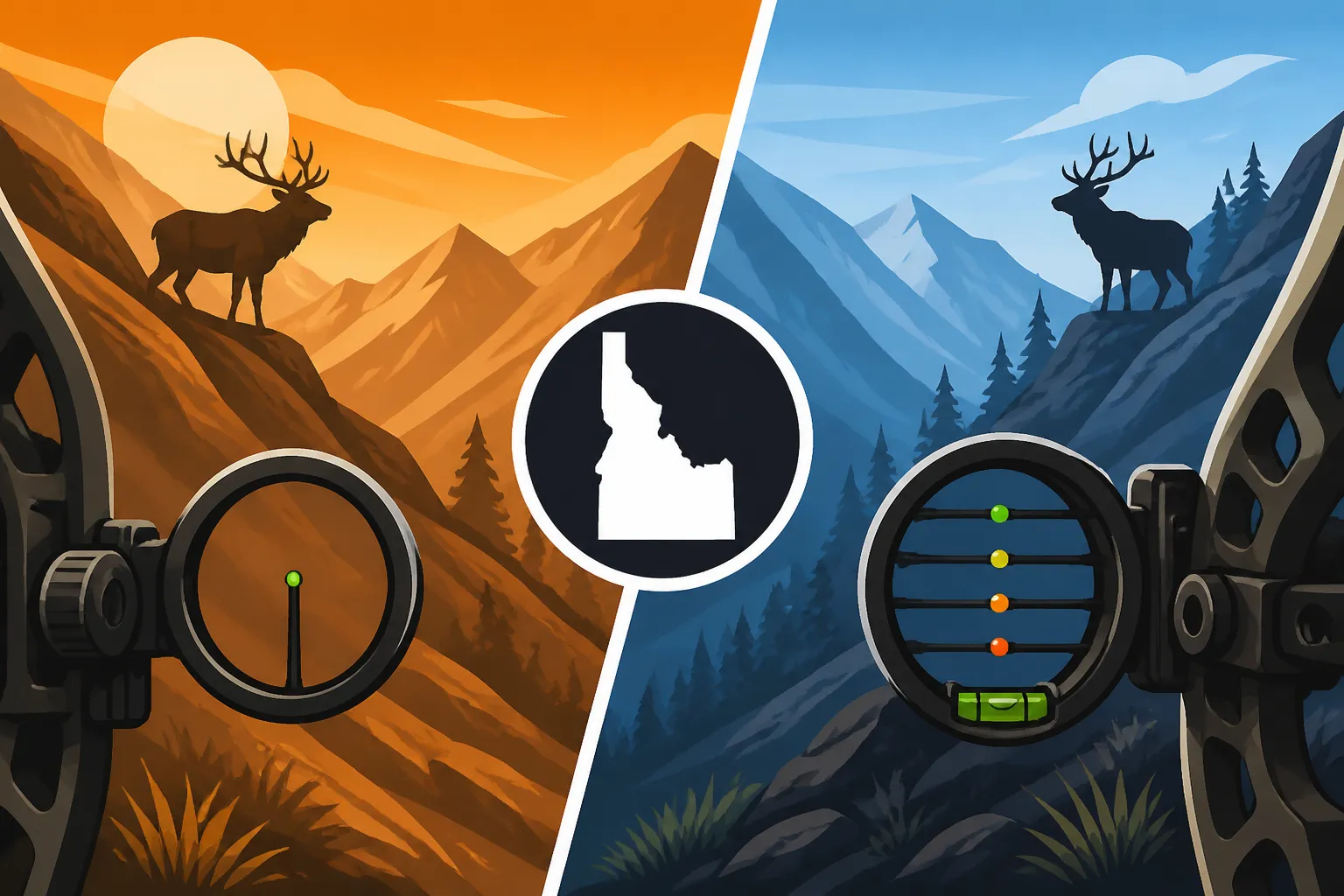
A single-pin sight, sometimes called a movable or slider sight, is built around one adjustable pin that you set to the exact yardage of your target. This design offers a wonderfully clean and uncluttered sight picture. Instead of a stack of pins, your eye focuses on just one glowing dot, which can be a huge advantage for mental clarity and precise aim, especially at longer distances where a slightly misaligned pin can mean a significant miss. Many hunters who prioritize accuracy above all else, and who are willing to take the extra moment to dial, gravitate towards this style.
For hunters who find themselves in situations with known or deliberate shot opportunities, the single-pin truly shines. Imagine you've got a bedded mule deer buck on an open sagebrush flat in eastern Idaho. You’ve ranged him carefully, confirmed the distance, and now you have the time to dial your single pin to the exact yardage, letting you hold dead-on without having to float between pins. This level of precision can inspire immense confidence, especially when that trophy animal is finally in your crosshairs and the shot is well within your comfort zone.
However, this precision comes with a trade-off: speed. If that same mule deer suddenly stands up and bolts, or an elk unexpectedly appears in a clearing at an unknown range, you might not have the precious seconds needed to range the animal, adjust your sight to the new distance, and execute a shot. This delay, while seemingly minor, can be the difference between a successful hunt and watching a prime opportunity disappear into the timber. The reliance on manual adjustment means that in fast-breaking scenarios, a single-pin can leave you feeling a step behind.
Another consideration, particularly in Idaho's steep country, is how angle compensation integrates with a single-pin. While many modern rangefinders offer excellent angle-compensating features, using a single-pin often means you're making a calculated dial based on that "shoot-to" distance. There isn't an array of pins to visually "gap" for angle. This means you need to be acutely aware of your rangefinder's output and trust your dial implicitly, adding another layer of concentration to an already intense moment.
The Versatility and Speed of a Multi-Pin
On the flip side, a multi-pin sight provides multiple fixed pins, each pre-set to a specific distance, typically in 10-yard increments (e.g., 20, 30, 40, 50, 60 yards). The primary benefit here is speed. When an animal steps into view, you quickly estimate the range, pick the corresponding pin, and shoot. There's no dialing, no fumbling with knobs; just pick your pin and execute. This speed is often a game-changer in the dynamic and unpredictable environments common to Idaho hunting.
Think about a scenario where you're pursuing a herd of elk through the dark timber of the Panhandle National Forests, or trying to intercept a bull responding to a locator bugle during the rut. Animals are often on the move, and shot opportunities can materialize and vanish in mere seconds. With a multi-pin sight, you can quickly assess, for instance, that a bull is at 35 yards, and instinctively know to hold your 30-yard pin a little high or use your 40-yard pin a little low, without ever taking your eyes off the target to adjust a dial. This makes it incredibly effective for active hunting styles and for hunters who thrive on quick target acquisition, especially during a Bugling Elk in Idaho's Timbered Zones encounter.
However, the versatility of a multi-pin sight comes with its own set of challenges. The biggest complaint is a cluttered sight picture. Having three, five, or even seven pins stacked up can create visual noise, making it harder to focus on a single aiming point, especially for those with less experience or under high-stress situations. In low-light conditions, like dawn or dusk when big game is most active, distinguishing between similar-colored fiber optic pins can also be tricky, leading to the dreaded "pin confusion" and a potential high or low miss.
While multi-pin sights offer speed, they don't inherently provide angle compensation. You'll still need a rangefinder with angle compensation to get the correct "shoot-to" distance in steep terrain, and then translate that to the appropriate pin. For instance, if your rangefinder tells you to shoot for 43 yards on a steep downhill shot, you'll still have to decide whether to use your 40-yard pin or adjust your aim slightly between your 40 and 50-yard pins. The key is knowing your arrow's trajectory intimately and practicing those in-between distances.
Navigating Idaho's Steep Terrain with Your Bow Sight
Idaho is not flat. From the rugged peaks of the Sawtooths to the deep canyons carved by the Salmon and Snake Rivers, you'll be dealing with significant elevation changes that dramatically impact arrow trajectory. Your bow sight needs to be able to handle these challenges effectively if you're going to consistently make ethical shots.
Angle Compensation: A Critical Factor
In the world of archery, what goes up (or down) must be understood. When shooting at an animal directly uphill or downhill, gravity acts on your arrow for a shorter period relative to the horizontal distance, causing the arrow to strike higher than it would on flat ground at the same straight-line distance. This phenomenon is why angle compensation isn't just a fancy feature; it's a critical tool for anyone hunting in Idaho's steep country. Failing to account for angles can lead to significant misses, potentially wounding an animal.
Modern rangefinders equipped with Angle Range Compensation (ARC) technology are practically mandatory for hunting in Idaho's mountains. These devices calculate the true horizontal "shoot-to" distance, rather than just the line-of-sight distance. So, if you're aiming at an elk 50 yards away on a 30-degree downhill slope, your rangefinder might tell you to shoot for 40 yards. Trusting this number and adjusting your sight or pin selection accordingly is paramount. Without it, you'd likely shoot over the animal. This is equally true for uphill shots into the steep timber where you might be chasing a bull elk, or downhill shots across a canyon while Glassing Idaho Breaks for Mule Deer.
Some advanced bow sights, often those reviewed by outdoor gear experts like GoHunt, have angle compensation built directly into the sight. These can simplify the process even further by providing a single, compensated aiming point or adjusting the pin position automatically based on the angle. While these can be incredibly convenient, they often come at a higher price point. Regardless of whether your sight or rangefinder does the heavy lifting, understanding the principles of angle compensation and practicing shots at various inclinations are vital. It builds intuition and confidence, which is irreplaceable. Regularly practicing shots from elevated positions or steep slopes, as recommended in Realistic Archery Practice Distance for Big Game, will ingrain the necessary adjustments into your muscle memory.
Quick Ranging and Target Acquisition in Dynamic Environments
Idaho's backcountry hunting is often dynamic. Elk herds move quickly through dense timber, mule deer bucks might appear briefly on a bench before disappearing into a draw, and whitetails can ghost through the brush in a blink. In these situations, every second counts, and your ability to quickly range an animal and get your pin on target can be the difference between a shot opportunity and a missed chance.
Consider the speed contrast: with a single-pin sight, a dynamic situation means drawing your bow, ranging the animal, lowering your bow to adjust the pin, re-drawing, and then shooting. This sequence, while precise, can be too slow when a bull elk is trotting through thick cover. The animal might have moved, or a shooting lane might have closed by the time you're ready. This is a common frustration for hunters in fast-paced scenarios.
A multi-pin sight, on the other hand, allows for much faster target acquisition. Your pins are already set. Once you range the animal (or make a quick estimate), you can immediately choose the appropriate pin without further adjustment. This "read and react" capability is invaluable when you're in the thick of things. Imagine an elk answering your calls, suddenly appearing at 35 yards, then darting to 45 yards before pausing. With a multi-pin, you simply switch your focus from the 30-yard pin to the 40-yard pin. This often means the arrow is in the air much faster, maximizing your chances in a fleeting moment. Building the muscle memory to efficiently draw, range, and shoot in rapid succession is crucial, especially when you consider How Close a Bowhunter Needs to Get on Elk in such situations.
Making Your Choice: Factors to Consider for Idaho Hunting
Choosing between a single-pin and multi-pin sight isn't about one being inherently "better" than the other. It's about finding the best fit for your personal hunting style, the conditions you expect to encounter, and your comfort level with different aiming methods.
Hunting Style and Preferred Distances
Your hunting style should heavily influence your sight choice. Are you a patient ambush hunter who sits in a treestand over a waterhole or wallow, with pre-ranged lanes and ample time to prepare for a shot? If so, a single-pin sight could be a fantastic choice. You can dial in the exact yardage once the animal presents itself, offering maximum precision for those longer, deliberate shots. Hunters often find this approach relaxing, knowing they’ve eliminated the guesswork of pin selection.
However, if your style is more aggressive—spot-and-stalk across vast sagebrush flats for mule deer, or silently still-hunting through dense timber for whitetails—your shot opportunities will likely be more dynamic and at rapidly changing distances. In these scenarios, the speed of a multi-pin sight can be a huge advantage. You might be targeting game that's moving between 20 and 60 yards, and having pins already set for those common ranges means you can react instantly. Understanding your typical engagement range is key, and it ties into the power needed to humanely harvest game, as discussed in Recurve Poundage That Will Kill an Elk. A bow that meets Compound Bow Let-Off and Measured Draw Weight requirements and is properly set up for your preferred distances will allow your sight choice to truly shine.
The Importance of Practice and Familiarity
Ultimately, the most effective bow sight is the one you are most familiar and confident with. No matter how advanced a sight is, it's only as good as the practice you put into it. For a single-pin setup, consistent practice involves quickly ranging targets at unknown distances, efficiently dialing your pin, and executing the shot under time pressure. You need to build the muscle memory for the dialing motion so it becomes second nature.
For multi-pin users, practice needs to focus on quick target acquisition and instinctively choosing the correct pin without hesitation or confusion, especially when moving between different yardages. This means shooting at various distances and angles, forcing yourself to react as if an animal just stepped into a shooting lane. Building this proficiency means more than just shooting groups; it means practicing the entire shot sequence—from ranging to drawing to releasing—as quickly and smoothly as possible. A dedicated practice regimen that includes shooting at varying yardages and angles, simulating hunting conditions, will be far more beneficial than simply shooting at a fixed target, underscoring why Realistic Archery Practice Distance for Big Game is so important.
Budget and Features
Bow sights, much like other hunting gear, span a wide range of price points and feature sets. While you don't necessarily need the most expensive sight to be successful, investing in quality components that can withstand the rigors of Idaho hunting is always a smart move. Cheaper sights might have less robust construction, leading to pins bending or fiber optics breaking, which is the last thing you want when you're miles into the backcountry.
When evaluating sights, consider features like micro-adjustments for precise windage and elevation settings, a clear and easy-to-read level bubble to prevent torque, and bright, durable fiber optics for low-light visibility. Some advanced models, often highlighted in GoHunt's gear reviews, offer tool-less adjustments, which can be a lifesaver in the field if you need to make a quick tweak. If you opt for an illuminated pin (common on both single and multi-pin models), consider battery life and how easy it is to change batteries. For a multi-day hunt, you'll want something reliable that won't leave you in the dark. Durability against impacts and weather is also paramount; Idaho's rugged terrain can be unforgiving on delicate equipment.
Optimizing Your Setup for Success in the Gem State
No matter which sight you choose, optimizing your entire bow setup is paramount for success in Idaho. Your sight is just one part of the equation, albeit a critical one.
Pin Gapping and Calibration for Mountain Hunting
This is where the rubber meets the road, especially in varied terrain. For a single-pin sight, proper calibration involves precisely matching your sight tape to your arrow's trajectory. This means shooting at measured distances and marking your sight tape accordingly. Many archers will create multiple sight tapes for different arrow setups (e.g., different Arrow Weight That Gets Through an Elk) or even for different environmental conditions if they're particularly meticulous. The goal is to be able to dial the exact yardage shown on your rangefinder and have your arrow hit precisely where you aim.
For multi-pin sights, pin gapping involves setting your pins at strategic intervals. A common setup might be 20, 30, 40, 50, and 60 yards. The key is to then practice not just hitting those exact distances, but also the "in-between" yardages. If an animal is at 45 yards, you need to know exactly how much to hold high with your 40-yard pin or low with your 50-yard pin. This precise understanding comes from extensive practice at a variety of distances, preferably on a range with undulating terrain that mimics Idaho's landscape. Don’t just shoot on flat ground; find hills or slopes to practice your angled shots and confirm your pin gaps.
The Role of a Rangefinder
As mentioned earlier, a quality rangefinder is not optional for Idaho bowhunting; it's essential. It removes the guesswork and provides the critical data needed for an accurate shot. For mountain hunting, prioritize rangefinders with angle compensation (ARC). This feature calculates the true horizontal distance, allowing you to use your pins or dial your single pin to the "shoot-to" range, preventing those high shots on steep angles.
Speed and ease of use are also crucial rangefinder characteristics. In a tense moment, fumbling with a complicated device can cost you an opportunity. Look for models that are quick to power on, provide rapid readings, and are comfortable to hold and manipulate with one hand. Brands often highlighted by sources like GoHunt often excel in these areas. Integrate your rangefinder into every practice session. Make it part of your shot sequence: range, draw, aim, shoot. This builds the muscle memory necessary for smooth, efficient operation when it counts.
Tuning Your Bow: The Foundation of Accuracy
Even with the most expensive, feature-rich bow sight, you won't be consistently accurate if your bow isn't properly tuned. Bow tuning is the process of adjusting your bow's components—cams, rest, string, cables—to ensure your arrow leaves the string cleanly and flies true. A poorly tuned bow will send arrows erratically, making consistent accuracy impossible regardless of your aiming system. This is why Bow Tuning Worth Doing Before a Mountain Hunt is perhaps the most critical preparation step.
Proper tuning involves several steps, including paper tuning to check for fletching contact, walk-back tuning to ensure consistent vertical and horizontal alignment, and broadhead tuning to make sure your hunting broadheads fly identically to your field points. The confidence that comes from a perfectly tuned bow is immense. When you know your equipment is performing optimally, you can trust your sight, focus entirely on the animal, and execute your shot with conviction, even under the intense pressure of a backcountry encounter. Whether you do it yourself or have a professional archer tune your bow, this foundational step cannot be overlooked.
Single-Pin vs. Multi-Pin: A Comparison for Idaho Terrain
To help visualize the considerations, here's a table summarizing the pros and cons of each sight type in the context of Idaho's rugged hunting environment:
| Feature | Single-Pin Sight | Multi-Pin Sight |
|---|---|---|
| Sight Picture | Clean, uncluttered; one aiming point | Cluttered; multiple pins can obscure target |
| Precision | Excellent for exact yardages; highly accurate | Good at set yardages; less precise for "in-between" |
| Speed of Use | Slower; requires dialing for each new distance | Faster; quick pin selection for pre-set ranges |
| Adaptability | Good for deliberate, ranged shots | Excellent for dynamic, fast-changing ranges |
| Angle Comp. | Relies heavily on rangefinder's ARC for "shoot-to" | Relies on rangefinder's ARC for "shoot-to" |
| Low Light | One bright pin, easy to discern | Multiple pins can blur or be confused |
| Idaho Terrain | Best for open country, patient stalking, deliberate | Best for timber, quick encounters, varied terrain |
| Practice Focus | Efficient ranging/dialing, precise aiming | Quick target acquisition, pin selection, gaps |
Choosing between a single-pin and multi-pin sight for your Idaho hunting adventures is a personal decision that hinges on your hunting style, the terrain you frequent, and your comfort level with each system. Both can be highly effective with diligent practice and a solid understanding of your equipment. Focus on familiarity, master your rangefinder, and always, always prioritize a properly tuned bow. The mountains of Idaho demand nothing less.
Disclaimer
The information provided in this article is for general guidance only and should not be considered legal advice. Hunting regulations, seasons, and requirements in Idaho can change frequently. It is the responsibility of every hunter to consult the most current Idaho Fish and Game regulations before participating in any hunting activity.