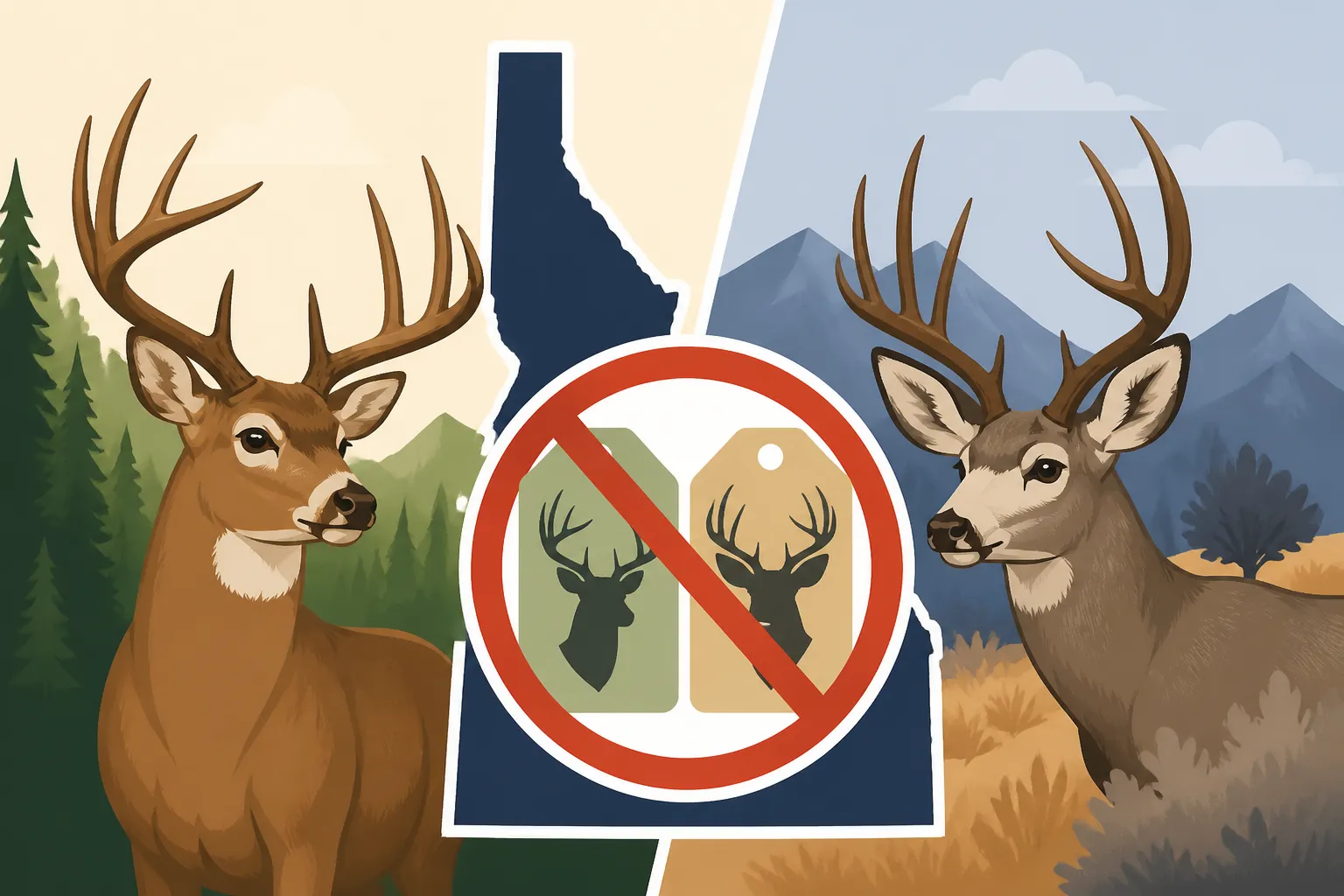
Whitetail and Mule Deer Tags Are Not Interchangeable
It can be incredibly frustrating to be out in the beautiful Idaho backcountry, spot a majestic deer, and then hesitate, wondering if your hard-earned tag is even for that particular animal. Many hunters, especially those new to the Gem State, mistakenly believe that "a deer tag is a deer tag." But Idaho’s management system is more nuanced than that, and mixing up your whitetail and mule deer tags can lead to a costly mistake or a missed opportunity. This guide will walk you through why Idaho differentiates these two iconic species on your tag, how to tell them apart, and how to navigate the regulations so you're ready for the field.
Understanding Idaho's Deer Management Philosophy
Idaho's diverse landscapes, from the thick timber of the Panhandle to the high desert breaks of the south, support two distinct deer species: the mule deer and the whitetail deer. Managing these populations effectively requires recognizing their unique ecological needs and behaviors. It’s not just about counting deer; it’s about sustaining healthy herds for generations to come.
Why Idaho Separates Deer Species
Idaho Fish and Game (IDFG) actively manages whitetail and mule deer populations separately because they are, quite frankly, different animals with different challenges and opportunities. Mule deer, often found in more open, rugged country, are particularly susceptible to harsh winters and habitat changes on their expansive winter ranges. Their population dynamics are very different from whitetails, which typically prefer denser cover and river bottoms, often thriving closer to agricultural areas and human development. If Idaho issued a single, generic deer tag across the board, it would be much harder to implement specific management strategies tailored to each species' needs and local conditions.
For example, harvest quotas might need to be tighter on mule deer in certain zones recovering from severe winters, while whitetail populations might be robust in other areas, allowing for more generous opportunities. This targeted approach helps ensure sustainable hunting experiences for both species, preventing overharvest in one population while optimizing opportunities in another. Tools like GoHunt can really help hunters understand these species-specific population trends and management goals in different units.
The Practical Impact on Hunters
For you, the hunter, this separate management means that your deer tag isn't a universal pass. When you apply for or purchase a deer tag in Idaho, it's often explicitly designated as either a "mule deer tag" or a "whitetail deer tag" for specific units or hunt areas. This can feel like a curveball, especially if you're used to states where any deer is fair game on a general deer tag.
Imagine spending days glassing Idaho Breaks for Mule Deer, finally spotting a magnificent buck, only to realize, upon closer inspection, it's a whitetail, and your tag is for mule deer only. Or vice-versa, hunting the dense woods of the northern panhandle and seeing a muley step out, but your tag is for whitetail. It's a gut punch, to say the least! This system places a real emphasis on pre-hunt scouting and identification skills, ensuring you’re pursuing the correct species in the correct unit with the correct tag. It adds a layer of complexity, but it’s a necessary one for sound wildlife management.
Identifying Your Target: Whitetail vs. Mule Deer
Before you even think about pulling the trigger, knowing the difference between a whitetail and a mule deer is paramount. Misidentification isn't just a missed opportunity; it can lead to legal complications if you harvest the wrong species for your tag. Trust me, it's a lesson you don't want to learn the hard way.
Key Physical Characteristics and Habitat Differences
When you're out in the field, these subtle differences become crystal clear once you know what to look for.
- Antlers: This is often the easiest distinguishing feature, especially on bucks. Whitetail antlers typically grow one main beam forward, from which all other tines (points) branch off individually. Think of it like a candelabra. Mule deer antlers, however, are known for their "forked" characteristic, where the main beam forks, and then each of those forks usually forks again. It’s a double-forking appearance.
- Ears: The clue is right in the name! Mule deer have notably larger ears, often described as resembling those of a mule. They are long, broad, and seem disproportionate to their head size. Whitetail ears are smaller and more pointed, in proportion to their head.
- Tail: The tail is a dead giveaway, especially when the animal is alarmed. A whitetail's tail is broad, typically reddish-brown on top, and pure white underneath. When a whitetail runs, it flags this bright white underside, like a beacon. A mule deer's tail is narrower, often rope-like, usually white with a black tip. It doesn't "flag" in the same dramatic way; it's typically held down while running or slightly elevated.
- Coloration and Body Shape: While there's variation, mule deer tend to be a bit stockier and can have a more grizzled, grayish-brown coat, particularly in winter. Whitetails are generally more reddish-brown, often appearing sleeker.
- Gait: Observe how they move when spooked. Whitetail deer run with a fluid, galloping motion, keeping their tail flagged. Mule deer, particularly when moving at speed in open country, often exhibit a distinctive "stotting" or "pronking" gait, where all four feet push off the ground simultaneously in a bounding motion. This springy bounce helps them navigate rough, uneven terrain.
As for habitat, you'll generally find whitetails in the denser, often wetter, environments like river bottoms, agricultural fields, and the thick forests of northern Idaho, as highlighted in "Whitetail Range Through Idaho's Panhandle". Mule deer are creatures of the open sagebrush, canyon country, and higher alpine areas, often seeking out steep, broken terrain for escape and cover. "Mule Deer Population Trends Across the West" often discusses their preference for these rugged landscapes. Learning to read the terrain and knowing Telling a Whitetail From a Mule Deer quickly can make all the difference.
Behavioral Clues in the Field
Beyond physical appearance, paying attention to how these deer behave can also offer clues.
- Flight Response: When a whitetail senses danger, its first instinct is often to bolt into the thickest cover available, flagging its prominent white tail as it goes. They might run a short distance, then stop and look back, using the dense foliage to their advantage. They rely on concealment. Mule deer, inhabiting more open spaces, tend to rely on their superior eyesight and hearing. When spooked, they often "stott" away, covering significant ground and often stopping on a distant ridge to assess the threat. They rely on distance and their bounding ability in broken terrain.
- Group Dynamics: While both species can be found alone or in groups, mule deer often form larger, more open herds, especially in winter. Whitetails, especially bucks, can be more solitary or found in smaller family groups, using cover for security.
- Curiosity: I've noticed that whitetails can sometimes be more apt to sneak away silently, whereas mule deer, after an initial dash, might pause and look back with a strong sense of curiosity before disappearing completely. This isn't a hard and fast rule, but it's something to consider.
Knowing these behavioral traits can help you make a positive identification even before you get a clear view of their antlers or tail. Every bit of information helps when that moment of truth arrives.
Navigating Idaho's Tag System and Regulations
The complexities of Idaho's tag system can feel like trying to untangle a knot, especially when you're dealing with species-specific distinctions. It's crucial to understand that your "deer tag" isn't a generic license to harvest any deer you encounter.
Specificity of Deer Tags in Idaho
In Idaho, many general season and controlled hunt tags are indeed species-specific. This means if your tag is for a "Whitetail Deer," you can only legally harvest a whitetail. If it's for a "Mule Deer," then only a mule deer is on the menu. This distinction is clearly printed on the tag itself and outlined in the hunting regulations for each hunt unit and season.
There are, of course, exceptions. Some hunt units or specific seasons might offer a "General Deer" tag that allows for the harvest of either a whitetail or a mule deer. However, these are less common or might be tied to specific conditions, like spike-only regulations or antler point restrictions. This is why a thorough review of the current year's Idaho hunting regulations is absolutely non-negotiable before you even start E-Scouting an Idaho Unit Before the Season. Don't rely on last year's rules or hearsay; wildlife management objectives can shift, and regulations are updated annually. Resources like the official IDFG website or platforms like GoHunt provide the most current information, including Reading an Idaho Harvest Statistics Report by species and unit, which can give you an idea of deer populations. It's also worth noting that changes like Idaho Moved Nonresident Deer and Elk Tags Into a Draw for 2026 can sometimes influence tag availability and type, adding another layer of complexity.
Consequences of an Incorrect Tag
Harvesting the wrong species, even by accident, can have serious repercussions. It's considered a violation of hunting regulations and can result in:
- Fines: These can be substantial, often hundreds or even thousands of dollars.
- Loss of hunting privileges: You could lose your hunting license for a period of time, both in Idaho and potentially in other states through interstate compacts.
- Seizure of game: The harvested animal will be seized, and you won't be able to keep the meat or trophy.
- Confiscation of equipment: In some severe cases, your firearm, bow, or other hunting equipment could be confiscated.
I’ve heard stories of hunters heartbroken over making an honest mistake, but the law is quite clear: it's the hunter's responsibility to positively identify their target before taking a shot. There's no "oops" clause when it comes to wildlife regulations. That's why practicing your identification skills, using good optics, and knowing your hunting area inside and out are so critical. If there's any doubt, don't take the shot. Wait for another opportunity where you are 100% certain of the species.
Planning Your Idaho Deer Hunt Strategically
Given Idaho's specific tag system, careful planning is more important than ever. You can’t just show up and hope for the best; you need a strategy tailored to the species you intend to hunt.
Researching Units for Your Desired Species
Your hunt starts long before you ever set foot in the woods. The first step is to pick your target species: do you want to hunt mule deer, whitetail, or are you hoping for a general deer opportunity? Once you’ve decided, you need to dive deep into unit research.
The Idaho Hunt Planner Is the Tool to Start With for this kind of reconnaissance. It provides a wealth of information on specific units (Idaho Runs 99 Game Management Units), including the dominant deer species, season dates, weapon restrictions (like Idaho Minimum Peak Draw Weight for Any Bow for archery hunts), and harvest statistics. You can often filter by species to see where mule deer or whitetail populations are strongest and which units offer tags for your preferred quarry. For instance, if you're set on whitetails, you'll be looking heavily at units in the northern part of the state. If it's muleys, your focus shifts to the more arid, broken country of southern and central Idaho.
Don't just look at the harvest numbers; dig into the public land access, terrain, and motorized vehicle rules. A unit might hold lots of deer, but if it's mostly private land or has difficult access, your hunting experience could be limited. Remember that Idaho's Motorized Hunting Rule Runs August Into December in many units, impacting how you can travel. Use all available resources, including online mapping tools and even forums, to gather as much intelligence as possible.
Double-Checking Regulations and Tag Specifics
This bears repeating: always, always double-check the current year's regulations. Not just once, but multiple times. What may have been a general deer tag last year could be species-specific this year, or vice-versa. The specific wording on your tag and in the regulations is your ultimate authority.
When you purchase your tag, confirm that the species listed on the tag matches what you intend to hunt. If you’re buying a What a Nonresident Idaho Deer Tag Costs, make sure you understand which species it covers. Don't be afraid to ask questions at the license vendor or contact IDFG directly if you're unsure. It's far better to clarify beforehand than to face the consequences of a misunderstanding in the field. Also, be aware of any special provisions, like youth hunter requirements (e.g., The Idaho Hunter Education Birth Year Cutoff) or specific weapon restrictions that might be tied to certain deer seasons.
Table: Key Differences Between Whitetail and Mule Deer
| Feature | Whitetail Deer | Mule Deer |
|---|---|---|
| Antlers (Buck) | Tines grow off a single main beam (candelabra) | Forked antlers, often double-forked |
| Ears | Smaller, pointed, proportionate to head | Large, "mule-like," disproportionate to head |
| Tail | Broad, reddish-brown top, white underside; "flags" | Narrow, rope-like, white with black tip; held down |
| Gait (Spooked) | Fluid gallop, often flags tail | Distinctive "stotting" or bounding (all four feet) |
| Habitat | Dense timber, river bottoms, agricultural areas | Open sagebrush, broken country, mountains |
| Color | Generally reddish-brown, sleeker appearance | Often grayish-brown, stockier build |
This careful approach ensures that when you finally spot that deer of a lifetime, you can focus on making a clean shot, confident that you have the right tag in your pocket. Happy hunting!
Disclaimer
This article is for general informational purposes only and does not constitute professional advice. Laws, prices and regulations vary by location and change over time. Consult a qualified professional for guidance on your specific situation.