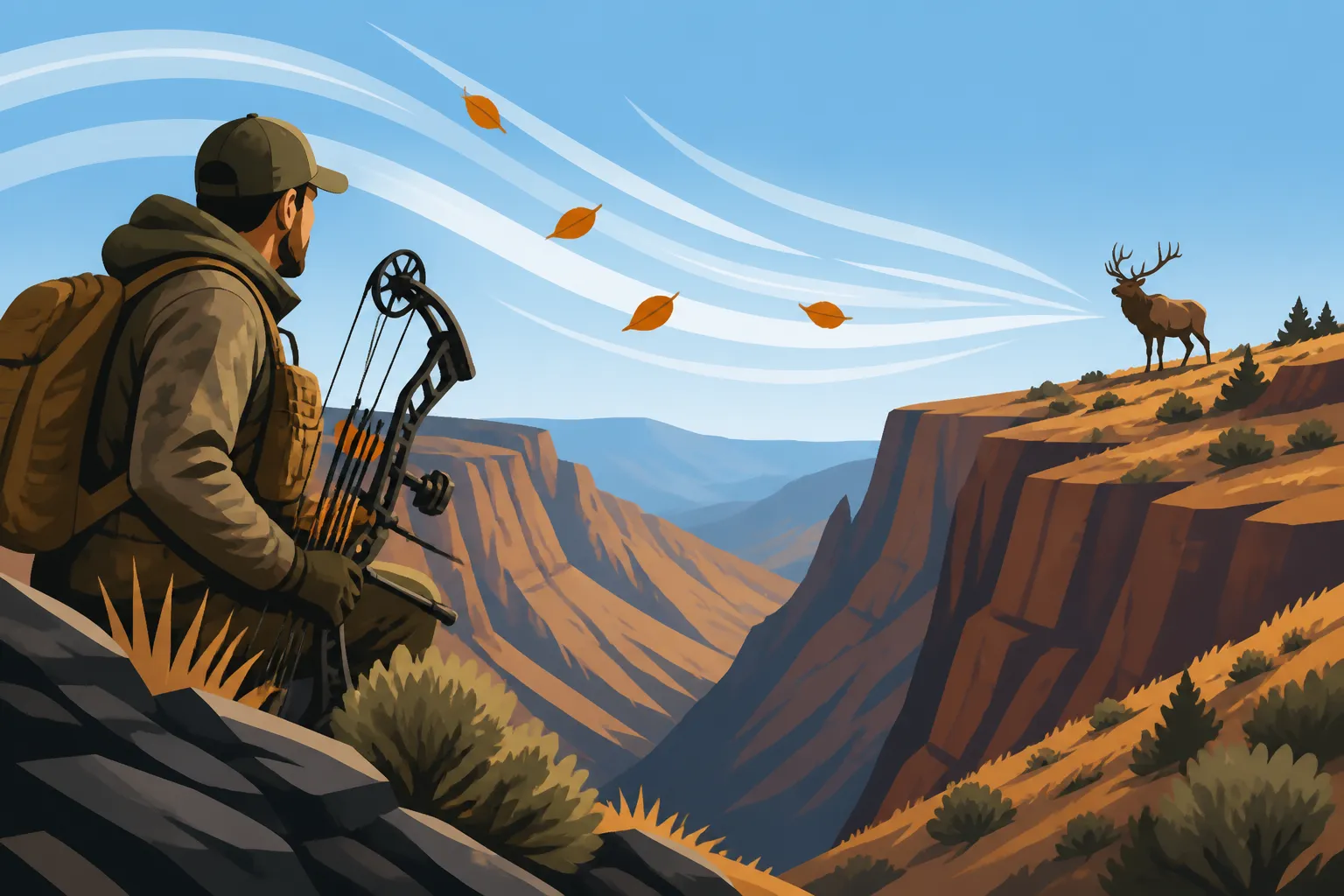
Holding for Wind Across a Deep Canyon
There’s almost nothing more frustrating for an Idaho hunter than lining up a perfect shot on a magnificent bull elk or a trophy mule deer across a canyon, only to have a sudden, inexplicable gust of wind completely derail your carefully aimed bullet. The wild, swirling air currents that characterize deep canyon country can turn what looks like a straightforward shot into a bewildering guessing game, leaving many of us wondering how in the world to account for such unpredictable forces. This guide is dedicated to demystifying canyon winds and providing practical, real-world strategies for accurately holding for wind across those challenging deep canyons so you can make that critical shot count.
The Unpredictable Nature of Canyon Winds
Hunting in Idaho's rugged terrain often means navigating vast, broken landscapes defined by steep canyons and deep draws. While these features can funnel game and provide spectacular glassing opportunities, they also create some of the most complex wind conditions imaginable. It’s not just a steady breeze you’re dealing with; it’s a chaotic system of air movement that can change in an instant, making shot placement a serious challenge. Understanding why these winds are so tricky is the first step toward effectively compensating for them.
Microclimates and Swirling Air Currents
Deep canyons are natural incubators for localized microclimates. Imagine a sunny canyon wall heating up rapidly, causing air to rise, while the shaded wall across the way remains cool, with air sinking. This differential heating and cooling creates convection currents that are constantly shifting. What you feel on your cheek might be entirely different from the wind affecting your bullet 300 yards away, and even more so different from the wind at the target. These aren't just gentle breezes; they can be violent updrafts, downdrafts, and crosswinds, all happening simultaneously within the canyon's confines.
Furthermore, the irregular topography of a canyon—its various benches, ridges, and side draws—acts like a series of baffles and funnels, directing the air in unpredictable ways. A wind might blow steadily down the main canyon for a quarter-mile, then suddenly hit a cliff face and be deflected straight up, creating a swirling eddy that pulls a bullet off target. You might even see wind moving in opposite directions at different elevations within the same canyon. This phenomenon makes it incredibly difficult to accurately predict a consistent wind value for your shot. Many hunters have experienced the heartbreak of a bullet sailing wide because of an unseen cross current, reinforcing the need for careful observation before pulling the trigger.
The Coriolis Effect and Terrain Interaction
While the Coriolis effect is typically discussed in large-scale weather patterns, its principles can subtly manifest in how air moves through significant geographical features like long, deep canyons, especially when combined with prevailing weather systems. Essentially, the Earth's rotation can exert a deflection force on moving air masses. For a hunter trying to make a precise shot, this isn't about the grand scale of global wind patterns, but how these larger forces interact with the very specific contours of an Idaho canyon.
More immediately impactful is the way terrain itself interacts with any prevailing wind. A steady wind coming from the west might hit a major ridge line and be forced upwards, creating a localized high-pressure area that then spills into the adjacent canyon as a downdraft or a powerful crosswind. The wind you feel on your shooting position on one side of a canyon might be a direct, strong headwind or tailwind, but the moment that air crests the ridge or dips into the main gorge, it can be entirely transformed. This complex interaction between the terrain's shape and the larger atmospheric conditions means that "Reading Wind in Steep Timbered Country" or open breaks becomes less about feeling the direction and more about visualizing the path of the air and how it’s being manipulated by every contour between you and your target. Hunters often underestimate how much a bullet can be pushed, even over seemingly moderate distances, when these forces are at play.
Reading the Wind at All Ranges
Given the complexity, how do you even begin to read these capricious canyon winds? It's a combination of constant observation, utilizing available tools, and building experience. You can't just lick a finger and hope for the best; you need to become a student of the air currents around you and extending to your target.
Visual Cues: Vegetation, Dust, and Mirages
Your primary tools for reading wind are your eyes. Long before you even think about taking a shot, constantly observe your surroundings. Look for subtle movements in vegetation: the swaying of distant pine branches, the trembling of sagebrush, or the bending of tall grasses. Pay attention to how intensely they move and in what direction. If there are small pockets of dust or loose dirt, tossing some into the air can reveal immediate wind direction and strength at your position. On a larger scale, observe any dust devils or thermals rising from the canyon floor; these are clear indicators of significant air movement.
Mirage, the shimmering distortion of objects seen through heated air, is another critical visual cue, especially when you're glassing for a trophy mule deer across the breaks. While it can make judging distance difficult, it's an excellent indicator of wind. If the mirage is boiling straight up, you might have a vertical thermal with little crosswind. If it’s leaning sharply to one side, that’s your crosswind, and the speed of its lean gives you a sense of the wind's velocity. This takes practice to interpret accurately, but a leaning mirage is often the most reliable indicator of bullet-deflecting wind between you and your target, especially at longer ranges when you’re assessing an animal found by using optics like those needed for "Optics Power for Idaho's Long Canyon Sightlines". Use your binoculars or spotting scope, like those often used for "Glassing Breaks and Benches for Mule Deer", to scrutinize the mirage across the entire bullet path.
Practical Tools: Kestrels and Wind Flags
While visual cues are invaluable, sometimes they aren't enough, or the conditions don't allow for clear observation. This is where modern tools like Kestrel meters come into play. A Kestrel, or similar handheld weather meter, gives you precise data on wind speed and direction at your location. While it won't tell you the wind at the target, it provides a crucial baseline. Some advanced Kestrel models can even be integrated with ballistic calculators, making on-the-fly adjustments much faster. You can take readings at your position, and if you have a spotter, they can move to a position closer to the target (if safe and ethical) to get a more localized reading.
For truly understanding the wind downrange, especially in situations where you might have time to set up, small, lightweight wind flags can be incredibly revealing. While not always practical for mobile hunting, if you’re positioned in a spot for an extended period, a piece of surveyor's tape tied to a small stick or a lightweight feather can show you exactly what the wind is doing at a specific point. Of course, you can't place these mid-canyon. However, observing how a piece of grass or a leaf flutters near your target (or a similar landmark near your target) can give you a better idea of the prevailing forces on the bullet. Many hunters using tools like those found in the GoHunt app for detailed mapping and terrain analysis will often e-scout an area, looking for potential areas where wind might be an issue. They can then note visual indicators on their map to reference later when in the field, making the most of every scouting opportunity.
Ballistic Considerations and Doping the Wind
Once you’ve done your best to read the wind, the next challenge is translating that information into a precise hold or turrets adjustment. This isn’t just guesswork; it involves understanding basic ballistics and applying learned principles.
Wind Direction and Value vs. Full Value
The "value" of the wind refers to how much effect it will have on your bullet, based on its direction relative to your bullet's path. A "full value" wind is blowing directly across your line of sight (either 90 degrees from left to right, or right to left). This is the most impactful wind, and it requires the most compensation. A quarter-value wind (blowing at 45 degrees to your path) will have half the effect of a full-value wind, and a headwind or tailwind (0 or 180 degrees) will have very little effect on horizontal bullet drift, though they can impact vertical drop.
In a canyon, you often don't get simple full-value winds. You might have a wind at your position that’s a slight quarter-value, but then it switches to a full-value crosswind mid-canyon, and then maybe a tailwind at the target. This is where the challenge lies. You must try to estimate the average wind value across the entire bullet flight path. It's often helpful to break the shot into segments in your mind – first 100 yards, middle 200 yards, final 100 yards – and try to average the conditions. This is where a detailed understanding of "Rifle Zero Distance for Canyon Country Shooting" and your chosen cartridge's ballistic performance becomes non-negotiable. Knowing your bullet's drift at different ranges is paramount before you ever head into such unpredictable environments.
Estimating Wind Speed and Applying Holds
Estimating wind speed is perhaps the most difficult part. Here’s a rough guide, but remember, practice makes perfect:
| Wind Speed (MPH) | Effect on Environment (General) | Approximate Hold for .308 Win (168 gr, 2700 fps, 400 yards, Full Value) |
|---|---|---|
| 1-3 MPH | Light breeze, smoke drifts | 0.5 – 1 MOA (e.g., 2-4 inches) |
| 5-8 MPH | Gentle breeze, leaves rustle, flags extend | 1.5 – 2 MOA (e.g., 6-8 inches) |
| 10-12 MPH | Moderate breeze, small branches move | 2.5 – 3 MOA (e.g., 10-12 inches) |
| 15-20 MPH | Strong breeze, small trees sway | 3.5 – 5 MOA (e.g., 14-20 inches) |
Note: These are approximations. Actual bullet drift varies greatly with caliber, bullet weight, ballistic coefficient, velocity, and atmospheric conditions. Always consult your specific ballistic data.
Once you have an estimated average wind speed and value, you can apply your hold. Modern scopes with reticles that have hash marks (like MOA or MRAD) are invaluable here. If your ballistic calculator tells you that a 10 MPH full-value wind at 400 yards will push your bullet 12 inches, and your target represents roughly 3 MOA, then you’d hold 3 MOA into the wind. Some hunters prefer to dial corrections directly into their turrets, but in rapidly changing canyon conditions, holding off can sometimes be faster. The key is consistent practice and knowing your gear inside and out. A common mistake is to over-compensate for perceived wind, so always err on the side of slightly less adjustment if you're unsure, especially on a broadside animal. For a robust setup for varying conditions, consider "Choosing a Rifle for Idaho's Timber and Breaks" to ensure your equipment is up to the task.
Real-World Application and Practice
Knowing the theory is one thing, but applying it successfully when the adrenaline is pumping and a bull elk is standing in a deep Idaho canyon is another entirely. This is where preparation and thoughtful execution come into play.
Setting Up for the Shot in Challenging Conditions
When you find your target animal, whether it's a deer you've been "Glassing Breaks and Benches for Mule Deer" or an elk responding to a locator bugle, immediately assess the wind. Don't rush. Position yourself so you have the most stable shooting platform possible. This usually means going prone if the terrain allows, or using a sturdy set of "Shooting Sticks or Bipod on Steep Ground" if going prone isn't an option. Stability minimizes shooter error, which becomes even more critical when you're trying to account for external factors like wind.
Then, re-evaluate the wind. Don't just trust your initial feeling. Take multiple readings if you have a Kestrel, and observe the visual cues continuously. Watch the animal itself—if its hair is ruffling, or its ears are twitching with the breeze, that's more real-time information. You might notice that the wind is swirling, but there's a distinct lull or a consistent direction for a few seconds. That’s your window. Develop a shot routine that includes a final wind check just before you touch the trigger. This might involve a quick glance at a piece of surveyor's tape tied to your bipod or watching a few blades of grass. It’s a lot to process, but integrating it into your mental checklist becomes second nature with enough practice. The GoHunt platform can also be a fantastic resource for pre-scouting units, allowing you to identify potential wind corridors or highly exposed ridges, helping you formulate a game plan before you even step foot in the field.
Training for Success in Windy Idaho Terrain
The only way to get truly good at holding for wind in deep canyons is to practice, and not just on a calm day at the flat range. Seek out shooting opportunities in windy conditions. If you can, find a location with some topographical features that mimic canyon conditions. Set up targets at varying distances and practice reading the wind, estimating its value and speed, and then applying your holds.
Don't be afraid to record your shots. Use a spotter to observe bullet impacts and call out what they see. Did the wind shift mid-flight? Was your hold too much or too little? Every shot is a learning experience. Pay close attention to how different wind speeds affect your specific rifle and ammunition. This firsthand knowledge is far more valuable than any chart or calculator alone. Consider dedicating range time specifically to shooting in adverse conditions. This will build confidence and help you develop that critical intuition needed when a trophy animal presents itself on a blustery Idaho morning. After all, the better you understand your rifle's capabilities, the better prepared you'll be for every shot.
Ultimately, mastering wind holds in Idaho's deep canyons is a journey of continuous learning and adaptation. It requires patience, keen observation, and consistent practice. There's no single magic formula, but by understanding the forces at play, utilizing your tools, and diligently refining your skills, you'll significantly increase your chances of making that challenging shot when it truly matters. When you are planning your hunts, using tools like "The Idaho Hunt Planner Is the Tool to Start With" can help you identify units with specific terrain features that you might want to practice for, or consider units that may offer "Units With the Highest Public Land Percentage" for ample practice ground.
Disclaimer
Always consult the most current Idaho Fish and Game regulations for all hunting laws, rules, and licensing requirements. This guide provides general information and recommendations and should not be considered a substitute for official regulations or professional instruction. Hunting conditions can be dangerous, and personal safety should always be the top priority.