Shooting Sticks or Bipod on Steep Ground
There’s almost nothing more frustrating than finally getting on an animal in Idaho's rugged backcountry, only to realize the shot angle is so severe, or the ground so uneven, that getting a stable rest feels impossible. That moment of truth, where all your preparation culminates, shouldn't be undermined by shaky crosshairs. This guide dives deep into the pros and cons of shooting sticks and bipods, helping you master stability on those infamous steep slopes and broken ground so you can make the shot when it truly counts.
The Unique Challenges of Steep Idaho Terrain
Hunting in Idaho often means tackling steep, unforgiving terrain, whether you're chasing mule deer in the high desert breaks or stalking elk through dark timber. This isn't your flat-ground range shooting, and the stability you achieve (or don't achieve) dramatically impacts your success.
Why Stability is Everything on Angled Shots
When you're aiming uphill or downhill, gravity plays tricks on your bullet's trajectory, and any wobble is magnified. A slight cant of your rifle, coupled with an unstable rest on a steep hillside, can send your bullet significantly off target. It’s not just about accuracy; it’s about ethical hunting. No one wants to wound an animal because they couldn't get a solid hold. Imagine that mature bull elk finally steps out at 300 yards, a perfect broadside presentation, but you're clinging to a 45-degree slope, your heart pounding. Without a reliable rest, that dream shot can quickly turn into a nightmare of tracking a wounded animal through dense brush, if you even manage to hit it at all. The physics of an angled shot are complex enough; introducing instability just adds layers of unnecessary challenge, making precise bullet placement incredibly difficult. Every degree of cant, every inch of wobble, translates to feet of deviation at longer ranges, which is simply unacceptable when hunting big game.
Common Frustrations with Improvised Rests
We’ve all been there: you spot a deer, and there’s no time to set up properly. You try to prop your rifle on your backpack, a jagged rock, or a flimsy tree branch. More often than not, these improvised rests introduce their own set of problems. Your backpack might be too soft, causing the rifle to sink or shift. That perfect rock might be too low, or too high, forcing an awkward shooting position that compromises your form. A tree branch might look sturdy, but the moment you put weight on it, it wiggles, or worse, breaks, sending your rifle off target right when you need it most.
These quick, makeshift solutions rarely offer the consistent, repeatable stability required for a clean shot, especially when the animal is aware or moving. They often force you into uncomfortable stances, making it harder to manage recoil, maintain sight picture, and execute a smooth trigger squeeze. Many a hunter has watched an animal walk away because they couldn't get a stable shot off a wobbly knee or a precariously balanced pack. The frustration builds quickly, and the memory of that missed opportunity lingers far longer than the effort it would have taken to carry a proper shooting aid.
Breaking Down Shooting Sticks for Mountain Hunting
When it comes to the dynamic, often unpredictable nature of hunting in Idaho’s mountains, shooting sticks offer a level of adaptability that’s tough to beat. They’ve become an indispensable tool for many hunters precisely because of their versatility on varied terrain.
The Versatility and Adaptability of Shooting Sticks
Shooting sticks, particularly the tripod configurations, are the chameleons of shooting rests. They shine brightly when you're navigating constantly changing elevations and slopes. Their individual legs can be adjusted to different lengths, allowing them to conform to wildly uneven ground that would render a fixed-height bipod useless. Imagine you're still hunting timber for bedded mule deer, moving slowly and deliberately through dense forest. You suddenly jump a buck that stops briefly in a small opening, presenting a shot. With a set of good shooting sticks, you can quickly extend them to standing height, providing a stable platform in seconds.
The best shooting sticks are lightweight, often made from carbon fiber, making them easy to carry all day without adding significant burden to your pack. They deploy rapidly, which is crucial when an animal appears unexpectedly. While they might require a bit more active user input to maintain perfect stability compared to a rock-solid bench rest, their ability to adapt to virtually any position – prone, kneeling, sitting, or standing – on any angle, makes them incredibly practical for mountain hunting. Many even double as a walking stick, a monopod for a spotting scope, or a support for binoculars, adding even more value to their presence in your kit. They are especially useful if you're trying to read wind in steep timbered country and need a quick, stable reference for your rifle.
Practical Deployment and Use on Steep Angles
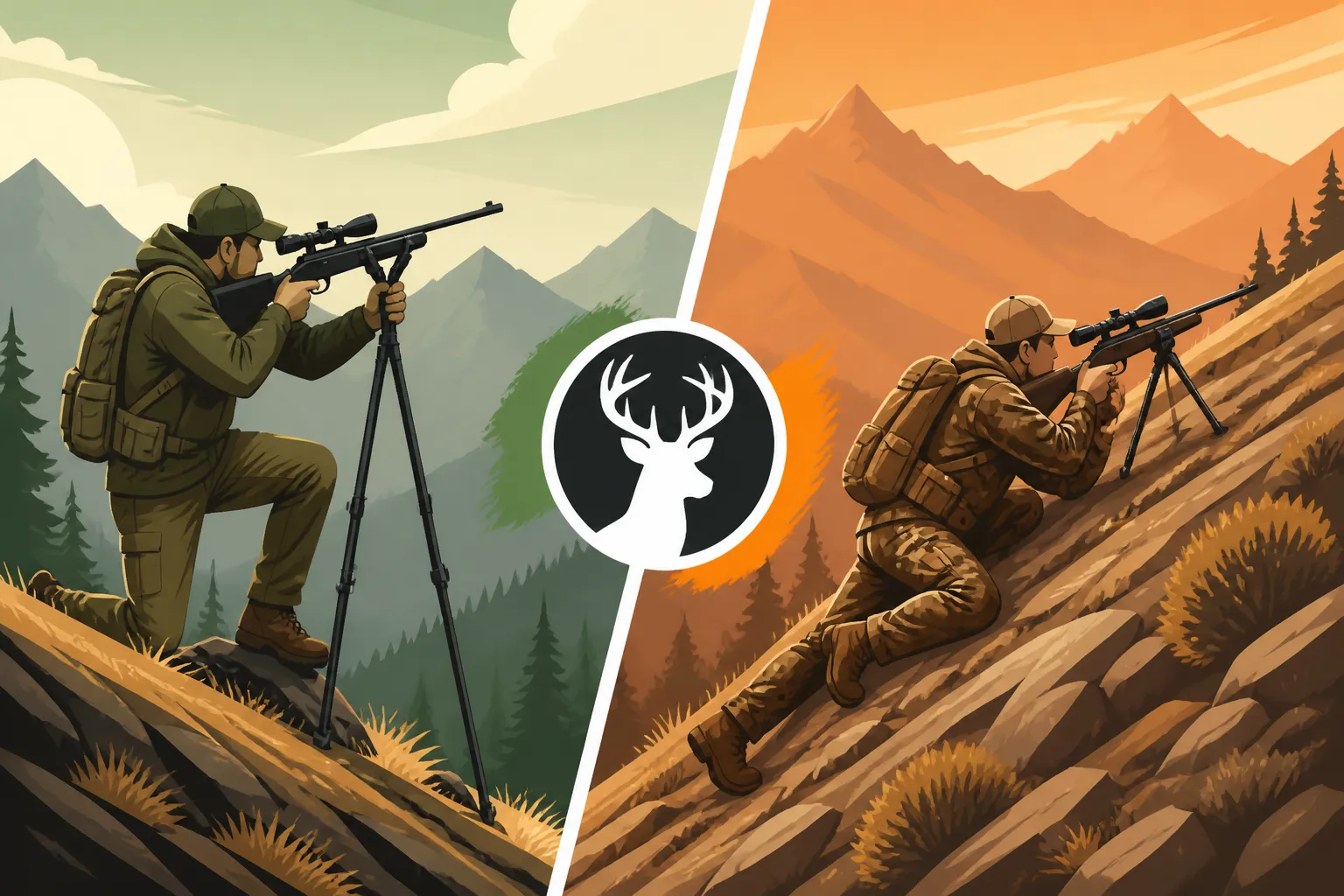
Deploying shooting sticks effectively on steep ground is an acquired skill that comes with practice. The key is to create a wide, stable base, even if it means adjusting each leg to a different length. For a tripod, try to position two legs downhill and one uphill, forming a natural triangle that resists tipping. Lean into the sticks, using your body weight to add stability and absorb some recoil. Think of yourself as the fourth leg of the tripod.
When shooting uphill, extend the front legs more to keep the rifle barrel from pointing too far into the sky, allowing you to settle into a more natural shooting position. Conversely, when shooting downhill, shorten the front legs to avoid having to lift your head too high off the stock. Practice deploying them from different positions – standing, kneeling, even sitting on a steep slope. Get comfortable with the quick-release mechanisms or twist locks that allow for rapid height adjustments. The more muscle memory you build, the faster and more instinctively you’ll be able to set up for that critical shot. Remember, your rifle zero distance for canyon country shooting needs to account for those angles, but a stable platform is the first step in making any compensation worthwhile. Consider using a quality brand like Bog-Pod or Leupold for reliable performance when you're practicing.
Understanding Bipods for Stability in the Idaho Backcountry
Bipods have a well-deserved reputation for stability, particularly in certain hunting scenarios. They offer a hands-free solution that can be incredibly comforting when you're trying to settle a shot. However, their fixed nature can also be their biggest drawback on Idaho's challenging terrain.
The Unyielding Stability of a Bipod (When it Works)
When conditions are right, a bipod can provide rock-solid stability, especially for prone shooting. If you find yourself on a relatively flat bench overlooking a canyon, or in a gradual sagebrush slope, a bipod like a Harris or an Atlas can create a remarkably steady platform. Once deployed, it frees up your hands, allowing you to concentrate solely on your sight picture and trigger control. This can be a huge advantage for longer shots where any movement is magnified, and you might need a few extra seconds to calm your nerves. Many hunters choosing a rifle for Idaho's timber and breaks will opt for a bipod, assuming they'll mostly be shooting from a prone or kneeling position where the terrain is somewhat cooperative.
The inherent rigidity of a bipod, especially those that attach directly to your rifle’s sling swivel stud or M-LOK rail, means less flex and wobble compared to some lighter shooting sticks. This can instill greater confidence, especially for hunters less accustomed to actively managing a flexible rest. For situations where you can lay down, get comfortable, and take your time, a bipod offers an unmatched level of steady support, letting you focus on the fundamentals of marksmanship without fighting your equipment.
Navigating Uneven Terrain with a Bipod
Here’s where bipods can truly present a challenge. Idaho’s terrain is rarely flat or even. Trying to deploy a standard two-legged bipod on a steep, uneven slope often results in one leg being much shorter than the other, creating a canted rifle that’s nearly impossible to shoot accurately. You’ll find yourself constantly trying to compensate by digging one leg into the ground, piling rocks under the other, or twisting your body into an uncomfortable, unstable position. If you're trying to hunt areas like the Frank Church River of No Return wilderness, which is notoriously steep and rugged, a fixed bipod might actually hinder more than help.
Another common frustration is the limited height adjustment. Most bipods are designed for prone or, at best, kneeling positions. If the vegetation is tall, or you need to shoot over a rise, a bipod simply won't get you high enough. You'll end up trying to stack your backpack or rocks under the bipod, which defeats its purpose of providing consistent stability. Moreover, the weight of a bipod adds directly to your rifle, which can make a long hike up terrain that hides a stalk above timberline feel even more arduous. While brands like Magpul offer more versatile bipods with greater articulation, they still face fundamental limitations on severely angled or broken ground compared to multi-legged shooting sticks.
Making the Right Choice: Sticks, Bipod, or Both?
Deciding between shooting sticks and a bipod isn't a simple right-or-wrong answer; it's about understanding your hunting style, the terrain you'll encounter, and your personal preferences. Many seasoned Idaho hunters opt for a combination, leveraging the strengths of each.
Assessing Your Primary Hunting Style and Terrain
Consider how you typically hunt. Are you spending most of your time glassing breaks and benches for mule deer, then making a long, deliberate stalk to get into a prone shooting position? In that scenario, a sturdy bipod might be your best friend. It provides the stability you need for those longer, more calculated shots once you've settled in. Tools like GoHunt can be invaluable here, allowing you to e-scout an Idaho unit before the season and analyze the terrain to anticipate potential shooting scenarios. If the map shows a lot of open, rolling hills, a bipod could be a great choice.
However, if your hunting style involves more active movement, like still hunting dark timber for elk or quickly moving from ridge to ridge, taking opportunistic shots as animals appear, then shooting sticks offer unmatched flexibility. They allow for rapid adjustments to various heights and angles, crucial when an animal might only offer a fleeting shot opportunity. Many hunters find that the lighter weight and versatile deployment of sticks are better suited for the dynamic, often unpredictable nature of following game through the Idaho wilderness. Ultimately, your gear should complement your approach to the hunt.
Training and Familiarization is Key
No matter which shooting aid you choose, or even if you decide to carry both, the most critical factor for success is practice. Owning a piece of equipment doesn't automatically make you proficient with it. You need to train with your shooting sticks or bipod under conditions that simulate your actual hunt.
Head to the range or a safe shooting area and practice deploying your rest quickly. Set up targets at varying distances, uphill, and downhill. Practice shooting from standing, kneeling, and prone positions, exactly as you would in the field. If you’re using shooting sticks, learn how to adjust leg lengths smoothly and efficiently without fumbling. If you're using a bipod, practice canting the rifle to compensate for uneven ground and getting a level shot. The goal is to make the deployment and use of your shooting aid feel like second nature. Building that muscle memory will ensure that when that trophy animal finally appears, you can focus on the shot, not on wrestling with your equipment. Much like how a bowhunter works on realistic archery practice distance for big game, a rifle hunter needs to practice their shooting form and stability from realistic field positions. Using resources like GoHunt to analyze potential shooting lanes and ranges in your chosen unit can also help guide your practice sessions.
Here’s a quick comparison to help you weigh your options:
| Feature | Shooting Sticks (Tripod/Bipod styles) | Bipod (Attached to Rifle) |
|---|---|---|
| Stability | Good, especially with user input and tripod | Excellent on level ground, struggles on very uneven/steep |
| Height Adj. | Highly adjustable, from prone to standing | Limited, typically prone to kneeling |
| Terrain Adapt. | Excellent, individual leg adjustment | Poor on highly uneven ground, requires workarounds |
| Weight | Generally lighter (depends on material/type) | Adds weight directly to rifle |
| Deployment | Quick, especially for variable heights | Fast for prone, slower for height changes |
| Versatility | High, acts as walking aid, spotting scope mount | Low, only for rifle support |
| Portability | Carried separately, can be bulky | Integral to rifle, always there |
| Cost | Varies, from budget to high-end carbon fiber | Varies, from budget to high-end |
| Best Use | Dynamic hunting, varied terrain, standing shots | Static positions, prone, flatter ground |
Disclaimer
The information provided in this guide is for informational purposes only and is not a substitute for official Idaho Fish and Game regulations. Always consult the most current Idaho hunting regulations before heading into the field. Hunting laws and regulations can change, and it is the hunter's responsibility to stay informed and compliant.