Driving Off Established Roads Is Prohibited in Idaho
There’s nothing quite like the excitement of finally getting into your Idaho hunting unit, loaded up with gear, ready to chase big game. But that excitement can quickly turn to frustration or even a costly mistake if you’re not crystal clear on Idaho’s motorized hunting rules. It’s a common pain point for hunters, both resident and nonresident, trying to figure out where they can and cannot take their vehicle. This guide is here to untangle the complexities of driving off established roads, ensuring you stay legal and respectful of Idaho’s wild places.
Understanding Idaho's Motorized Hunting Rule
The Gem State takes its motorized vehicle regulations seriously, particularly when it comes to hunting. These rules are in place for a good reason, primarily to protect wildlife, preserve habitat, and maintain the quality of the hunting experience for everyone. It's not just about what feels convenient; it's about stewardship and ensuring these resources are around for generations to come.
The Rationale Behind Vehicle Restrictions
The primary reason Idaho Fish and Game, alongside land management agencies like the Forest Service and BLM, implements these vehicle restrictions is to minimize human impact on sensitive wildlife habitats. Driving off-road can compact soil, destroy vegetation, create new unauthorized trails that lead to erosion, and disrupt wildlife patterns. Imagine a delicate alpine meadow or a critical winter range being torn up by vehicles – it directly harms the very animals we’re trying to hunt responsibly. These rules also help manage hunting pressure, encouraging fair chase by preventing hunters from driving directly to animals in remote areas.
Beyond habitat protection, these rules contribute significantly to the hunting experience itself. Part of the challenge and reward of hunting in Idaho is often the physical effort involved in accessing remote areas. If everyone could drive wherever they pleased, the wilderness feel would diminish, and certain areas would be over-pressured, leading to a poorer experience for all. It’s about creating a balance where technology assists, but doesn’t replace, the fundamental act of hunting.
Defining "Established Roads" and "Off-Road"
This is where many hunters get hung up, and it's a critical distinction to understand. An "established road" in Idaho is generally defined as a route that is publicly maintained, designed for vehicle travel, and clearly visible on official maps, like those produced by the Forest Service or BLM. These are typically gravel roads, two-track roads, or paved surfaces. What they are not are game trails, old logging skid roads that have long been reclaimed by nature, or simply flat stretches of sagebrush that look easy to drive across.
"Off-road" means any travel outside of these designated, established routes. This includes driving through meadows, timber, dry creek beds, or creating new routes across the landscape. Even driving alongside an established road, just off the shoulder, can be considered off-road travel in certain areas. It's less about the surface and more about whether the route is officially sanctioned for motorized use. When in doubt, if it's not clearly marked or shown on a Motor Vehicle Use Map (MVUM), assume it's off-limits. This cautious approach is your best defense against inadvertently breaking the rules.
When and Where the Rule Applies
Idaho's motorized hunting rule generally applies statewide on public lands, though specific regulations and enforcement might vary slightly between different land management agencies (e.g., National Forests versus BLM lands) and individual Game Management Units. Importantly, this rule is often in effect during the hunting season, with many restrictions active from August into December, which covers most major big game seasons. However, always double-check the current Idaho Fish and Game regulations for the specific unit you plan to hunt, as they can update or have special provisions.
You'll find these rules are particularly stringent in areas designated as Wildlife Management Areas (WMAs), wilderness areas, and on some state endowment lands. For example, some Wildlife Management Areas might have additional seasonal closures or limitations on vehicle size and type. It’s crucial not to assume that just because a road appears on a general map, it’s always open. Seasonal gate closures are common, especially on Forest Service roads, intended to protect roads during wet conditions or to prevent disturbance to wintering wildlife. Always verify the status of access before you head out.
Navigating Public Lands and Forest Service Regulations
Public lands—our National Forests and BLM ground—are fantastic resources for hunters in Idaho, offering millions of acres of wild country. But accessing them responsibly, especially with a vehicle, requires a bit of homework and understanding of specific mapping tools.
Motor Vehicle Use Maps (MVUMs) as Your GPS
If you’re planning to hunt on National Forest land, the Motor Vehicle Use Map, or MVUM, is your absolute best friend. These are official, agency-issued maps that specifically designate which roads and trails are open to motorized vehicles, and for what type of vehicle (e.g., highway legal, ATV, motorcycle). These maps are often printed on waterproof paper and are available free of charge at Forest Service ranger stations or can be downloaded digitally. They are legally binding documents, meaning if a road or trail isn't on the MVUM as open, it's considered closed to motorized use.
MVUMs are incredibly detailed, showing not just the route itself but also any seasonal restrictions that might apply. They use specific symbols to denote different types of access, so it's vital to learn how to read them correctly. Don't rely solely on popular hunting apps like onX without cross-referencing with an official MVUM for the area. While helpful for overall land ownership and topography, these apps often pull their motorized route data from various sources, and the official MVUM is the ultimate authority. Getting to know your MVUM is paramount for legal access and avoiding fines.
Designated Trails and Routes Versus Open Terrain
It’s easy to get confused between designated trails and what might seem like open terrain, especially in less rugged areas like sagebrush flats. On public lands, particularly Forest Service and BLM lands, vehicle travel is generally restricted to designated roads and trails. This means you cannot just drive across open country, even if it looks undisturbed. The concept of "open terrain" for motorized vehicles is rare in Idaho's hunting units, with most areas requiring you to stick to marked routes.
A "designated trail" explicitly permits motorized use for specific vehicle types (ATVs, dirt bikes, or UTVs), and these will be clearly marked on an MVUM. If a trail isn't explicitly designated for motorized use, it's considered non-motorized and is for foot traffic, horses, or mountain bikes only. This distinction is crucial for hunters using ATVs or UTVs, as they must also adhere to these designated routes. It's a system designed to concentrate vehicle impacts and preserve the vast majority of the landscape for foot and hoof travel, which significantly enhances the hunting experience.
Specific Rules for National Forests and BLM Lands
While the general principle of sticking to established roads applies across most public lands, there can be subtle differences between National Forests and BLM lands in Idaho. For instance, National Forests typically have very explicit MVUMs detailing every single open road and trail. On BLM lands, especially in the more open, high desert regions of southern Idaho, there might be areas designated for "open travel" where you can venture off established routes, but these are becoming increasingly rare and will be clearly marked if they exist. Always assume restricted access unless proven otherwise.
Regardless of whether you're on Forest Service or BLM ground, the onus is on the hunter to know the rules. Ignorance is no excuse, and wardens patrol these areas specifically looking for motorized violations. Using tools like GoHunt's mapping features can help you visualize these boundaries and vehicle use areas, but always confirm with official agency maps. Respecting these boundaries not only keeps you legal but also contributes to the conservation efforts that make Idaho such a premier hunting destination.
| Activity Type | Allowed on Public Lands (Generally) | Prohibited on Public Lands (Generally) |
|---|---|---|
| Vehicle Travel | On established, designated roads (MVUMs) | Off-road, creating new tracks, across open terrain |
| Game Retrieval | Packing out game on foot, horseback, game cart | Driving off-road to retrieve downed game |
| Camping | Designated campsites, dispersed camping near established roads | Driving off-road to establish camp in sensitive areas |
| Scouting | Driving designated roads, walking off-road | Driving off-road to scout new areas |
| ATV/UTV Use | On designated ATV/UTV trails (MVUMs) | Anywhere not designated for ATV/UTV use |
The Strict Stance on Game Retrieval
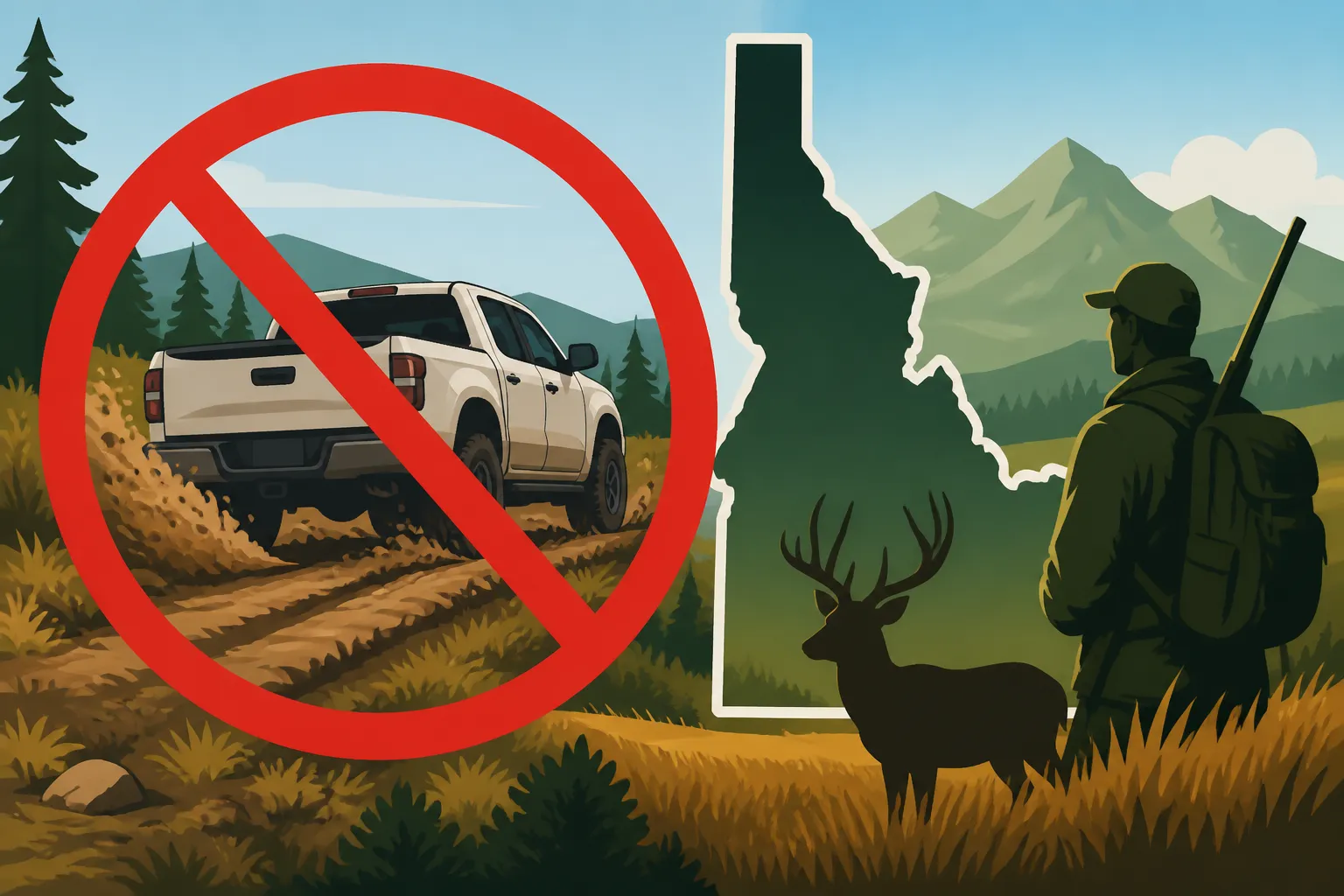
This is perhaps one of the most misunderstood aspects of Idaho's motorized hunting rules, and it’s a source of immense frustration for many hunters. You’ve worked hard, made a clean shot, and now you have a downed animal, perhaps a magnificent bull elk, deep in the backcountry. Your truck or ATV is tantalizingly close, but the rules are clear: you cannot drive off-road to retrieve it.
Why You Cannot Drive to Retrieve Downed Game
The prohibition against driving off-road to retrieve downed game, even if it's just a few hundred yards from a legal road, stems from the same core principles as the general motorized rule: habitat protection and fair chase. Allowing vehicles off-road, even for game retrieval, would create a precedent for environmental damage. Every time a hunter drives off-road to retrieve an animal, it can create ruts, tear up vegetation, and contribute to habitat degradation. If hundreds or thousands of hunters did this each season, the cumulative impact would be devastating.
Furthermore, it prevents what could be seen as an unfair advantage. If a hunter could simply drive to any downed animal, it would significantly reduce the challenge and skill involved in getting an animal out of rugged terrain. The mental and physical preparation for packing out an animal is a fundamental part of the western hunting experience. Idaho Fish and Game emphasizes this "pack it out" mentality as integral to ethical hunting and preserving the wild character of the landscape.
Planning for Manual Game Recovery
Given the strict rules, planning for manual game recovery is non-negotiable for an Idaho hunt. This means bringing the right gear, having a strong back, and ideally, having hunting partners who can help. For deer and especially elk, this is a monumental task. You'll need quality game bags to protect the meat, a sharp knife for field dressing, and a sturdy pack frame designed for heavy loads. Even then, an elk can easily require multiple trips or the help of several strong individuals to get it back to an established road.
Many successful Idaho hunters invest in game carts for deer or even electric bikes (which typically fall under non-motorized definitions, but always check local rules) to aid in covering distance on foot-only trails. Some even employ professional packing services, utilizing horses or mules, for deeply remote kills, particularly in areas like the Frank Church Wilderness, where nonresidents even need an outfitter for elk. The key is to acknowledge the challenge upfront and build a realistic plan for getting your animal from where it falls to where your vehicle can legally access it. This often means scouting not just for game, but also for reasonable retrieval routes from potential kill zones.
Special Considerations for Hunters with Disabilities
Idaho Fish and Game recognizes that not all hunters have the same physical capabilities, and they do offer provisions for hunters with disabilities. Individuals with severe physical disabilities that prevent them from physically retrieving game may apply for a special permit. This permit, often called a "Disabled Hunter Vehicle Permit," allows the use of a motorized vehicle off established roads for the sole purpose of retrieving legally harvested game.
However, these permits are not granted lightly and require extensive documentation of the disability. They are issued on a case-by-case basis, and even with a permit, there are strict rules about how and where a vehicle can be used for retrieval. It's not a blanket pass to drive anywhere. If you qualify, it's essential to understand the specific terms of your permit and carry it with you at all times. For general hunters, though, the rule remains firm: no driving off-road to retrieve game.
Penalties and Consequences of Violating the Motorized Rule
Ignorance of the law is never an excuse, especially when you're out in the field. Violating Idaho's motorized hunting rule can lead to serious consequences that extend far beyond a simple slap on the wrist. It's not just about a fine; it can impact your ability to hunt in the future and carries significant ethical weight.
What Happens If You Get Caught Off-Road
If a Fish and Game officer or a land management agency ranger catches you driving off established roads, even for a short distance, you can expect a citation. The penalties can vary depending on the severity of the violation, the damage caused, and whether it's a first offense. Generally, you're looking at fines that can range from hundreds to thousands of dollars. These aren't minor traffic tickets; they are often considered serious infractions related to wildlife and land management.
Beyond the monetary fine, your vehicle could be impounded, and you might be required to pay for any environmental damage caused, such as repairing ruts or restoring sensitive habitat. It’s a costly lesson that can quickly turn a successful hunt into a financial nightmare. Remember, wardens are often patrolling remote areas specifically because they know hunters might be tempted to bend the rules. They are well-versed in spotting fresh tracks where they shouldn't be.
Impact on Hunting Privileges and Future Opportunities
A violation of Idaho's motorized hunting rule can have long-lasting repercussions on your hunting career. Depending on the nature of the offense, you could face the suspension or revocation of your hunting license and privileges in Idaho. This means you wouldn't be able to purchase tags or hunt in the state for a specified period, which can be years. If you've been planning for an Idaho elk hunt for years and finally draw a coveted tag, losing your privileges because of an off-road transgression would be absolutely devastating.
Furthermore, many states are part of an interstate compact that shares information on hunting violations. A suspension in Idaho could potentially lead to the suspension of your hunting privileges in other states as well. This ripple effect can seriously jeopardize your future hunting opportunities across the West. It's a stark reminder that staying legal isn't just about avoiding a fine; it's about protecting your privilege to participate in the sport you love.
Ethical Considerations and Respect for the Land
Beyond the legal and financial ramifications, there's a significant ethical component to adhering to motorized vehicle rules. As hunters, we are often viewed as conservationists and stewards of the land. Driving off-road, creating new tracks, or damaging habitat directly undermines this image and can fuel anti-hunting sentiments. It shows a disregard for the resource, other users, and the very wildlife we claim to cherish.
Respect for the land and the animals should be at the forefront of every hunter's mind. The rules are designed to ensure sustainable practices and preserve the wild character of Idaho's vast public lands. By consciously choosing to stay on established roads and trails, we contribute to a positive public image of hunting, demonstrate our commitment to conservation, and ensure that these opportunities remain for future generations. It's about being a responsible ambassador for hunting, not just for ourselves, but for the entire community.
Tools and Resources for Staying Legal
Navigating the nuances of Idaho's motorized rules might seem daunting, but thankfully, there are excellent tools and resources available to help you stay on the right side of the law. Leverage technology and official publications to make your scouting and hunting trips worry-free.
Essential Mapping Apps and Digital Tools
In today's age, digital mapping applications are indispensable for backcountry navigation and understanding land use regulations. Apps like onX Hunt, BaseMap, and GoHunt are widely popular among hunters and offer robust layers that can show land ownership, game management unit boundaries, and often, motorized vehicle use areas. These apps can be a fantastic complement to official MVUMs, allowing you to visualize your route in real-time, mark waypoints, and confirm your location relative to restricted areas.
While these apps are incredibly useful for general navigation and e-scouting, always remember that an official MVUM from the Forest Service or BLM is the definitive legal authority for motorized travel. Use the apps to plan and verify, but never solely rely on them without cross-referencing with official, current agency maps. Many apps pull data from various sources, and sometimes those sources can be outdated or interpreted differently than the official regulations. It's your responsibility to ensure you're using the most accurate and up-to-date information.
Consulting the Idaho Fish and Game Regulations
The single most important document for any hunter in Idaho is the official Idaho Fish and Game hunting regulations. These are updated annually and are available online through the IDFG website, as well as in print at license vendors across the state. These regulations detail all the legal requirements, including specific rules on motorized vehicles, game retrieval, and any special restrictions for particular units or seasons.
Don't just skim these regulations; read them thoroughly, especially the sections pertaining to the unit you plan to hunt and general rules of fair chase. They provide comprehensive information that online articles or mapping apps might not cover in full detail. If you have any doubts after reviewing the regulations, don't hesitate to call your local Idaho Fish and Game office. Their officers are there to help clarify rules and ensure hunters have the information they need to hunt legally and ethically.
Using Hunt Planners to Scout Access Points
Effective scouting is the backbone of a successful, legal hunt. Idaho's official "Hunt Planner" tool, available on the Fish and Game website, is an invaluable resource that combines map layers with detailed hunt unit information, drawing odds, and harvest statistics. You can use this tool to identify potential hunting areas, view public land percentages, and, crucially, look at road and trail layers. This helps you understand where legal motorized access points are located and where you'll need to transition to foot travel.
Before you ever set foot in the field, spend significant time e-scouting. Look for areas with a good balance of game habitat and legal access, taking note of how far you might need to pack an animal out from various potential kill zones. Consider using satellite imagery in mapping tools to identify terrain features that might serve as natural barriers or legal, non-motorized routes to get deeper into an area. Thorough planning, facilitated by tools like the Hunt Planner, will prevent you from making impulsive, illegal decisions once you're on the ground and excited by the chase. This diligent approach will help you understand things like the Idaho's Motorized Hunting Rule Runs August Into December and Which Roads Count Under the Motorized Rule.
Planning Your Hunt Around Motorized Restrictions
Understanding the rules is one thing, but effectively planning your hunt around them is where the rubber meets the road—or, more accurately, where your boots meet the trail. These restrictions aren't meant to stop you from hunting, but to guide you towards a more responsible and often, more rewarding experience.
Scouting for Legal Access Points
When you're scouting, whether physically or virtually, your focus shouldn't just be on finding game sign. It absolutely needs to include identifying legal access points and understanding the boundaries of motorized travel. Use your MVUMs and mapping apps to pinpoint where established roads end and foot-only trails begin. Look for trailheads, parking areas, and designated turnarounds. This planning phase can involve some serious investigation, especially if you are Getting Into the Clearwater Country, which is known for its rugged and often remote terrain.
Consider how far you are willing to walk or ride a non-motorized vehicle from your truck or ATV. Are there areas that offer deep penetration into good habitat via designated non-motorized trails? Sometimes, the most productive hunting grounds are those that require a significant hike, simply because they see less pressure from hunters who aren't willing or able to make the trek. This careful scouting will prevent you from getting into a situation where you're deep in the woods, only to realize you can't legally drive your vehicle any further.
Packing Smart for Extended Foot Travel
If you plan to hunt beyond the reach of your vehicle, packing smart becomes absolutely crucial. Every ounce counts when you're covering miles on foot, especially in Idaho's often steep and rugged terrain. This means prioritizing essential gear: water, food, navigation tools, first-aid, and sufficient clothing layers for changing mountain weather. But it also means thinking ahead for the retrieve.
A sturdy backpack and quality game bags are non-negotiable. For an elk, even if you quarter it, you're looking at hundreds of pounds of meat and bone. This could mean multiple trips, or coordinating with partners. Consider lightweight, modular shelter options if you plan to spike camp deep in the backcountry. Every item you bring in will need to be carried out, plus the weight of your harvest. Planning a Packing an Elk Out of Steep Country Alone can be an extremely challenging and sometimes dangerous endeavor if not approached with the right equipment and mindset.
Leveraging Pack Animals or Game Carts
For hunters targeting larger game far from road access, pack animals can be a game-changer. Outfitters offer guided hunts that include horse support, but many DIY hunters also own or rent horses and mules for packing in camp and packing out meat. This traditional method allows you to access truly remote areas, like parts of Hunting the Frank Church River of No Return, and drastically reduces the physical strain of retrieval. However, using pack animals also requires knowledge of their care, specific trail rules, and proper horsemanship.
For shorter distances or smaller game, game carts can be an excellent alternative to pack animals. These wheeled carts are designed to carry heavy loads over varied terrain, though they are most effective on relatively flat or gently sloped trails. An e-bike with a trailer might also fit the bill for some hunters, providing powered assistance on non-motorized trails. Again, always verify local regulations regarding e-bike use on specific trails. By embracing these alternative methods of transport, you can responsibly access more productive hunting grounds while adhering to Idaho's motorized rules and respecting the wild character of its beautiful landscape.
Disclaimer
Please remember that hunting regulations can change. While this article aims to provide accurate and current information, it is your sole responsibility to consult the most recent official Idaho Fish and Game regulations and relevant land management agency rules before engaging in any hunting activities. Always prioritize safety and ethical hunting practices.