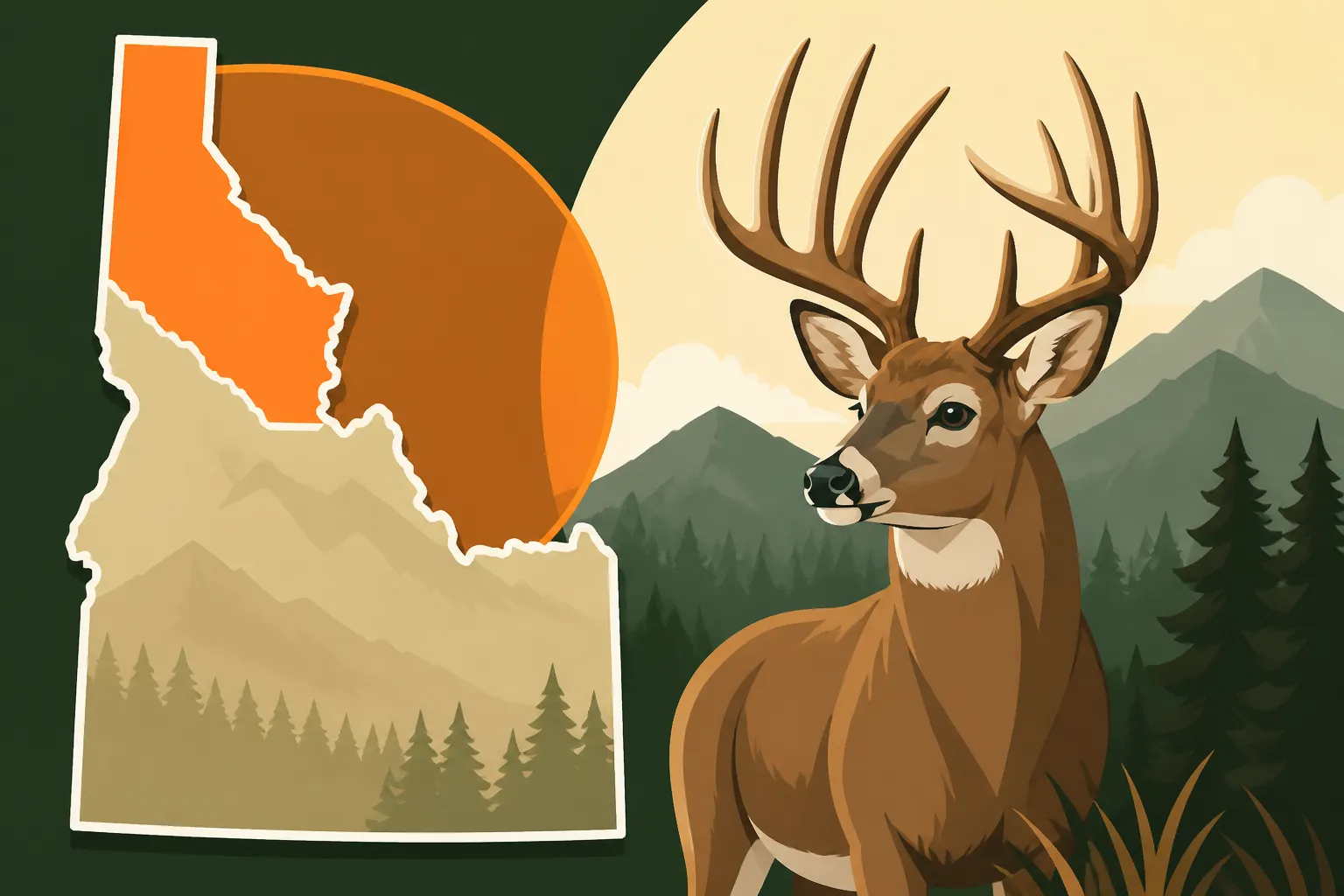
Whitetail Range Across the Northern Panhandle
Hunting whitetails in Idaho’s northern Panhandle is a truly distinct experience, far removed from the wide-open sagebrush flats of the southern part of the state where mule deer often roam, or the high alpine basins that attract elk. Many hunters come to Idaho with visions of vast western landscapes, only to discover that the Panhandle offers a completely different challenge: dense, dark timber, thick river bottoms, and whitetails that are masters of stealth. If you’ve ever found yourself frustrated by the sheer density of cover, or wondering why those big mule deer tactics just aren’t cutting it up north, this guide is for you. We’re going to dive deep into where these elusive creatures call home and how to effectively hunt them in their preferred habitat.
Understanding the Northern Panhandle's Unique Whitetail Habitat
The northern Panhandle of Idaho is a unique corner of the state, distinct from the drier, more open terrain found further south. Here, the landscape is characterized by its lush forests, abundant water, and a mix of timber and agricultural land that creates the perfect sanctuary for whitetail deer. It’s not just a subtle difference; it’s a whole new world of habitat that dictates how whitetails live and how we, as hunters, need to adapt our strategies.
The Dense Timber and River Bottoms
When we talk about whitetail range in the Panhandle, we’re really talking about a kingdom of dense timber and meandering river bottoms. These deer aren't out in the open, casually munching on browse in wide meadows. No, they are masters of concealment, preferring to live their lives in the thickest cover they can find. Think of the river systems like the Coeur d'Alene, St. Joe, Kootenai, and Clark Fork rivers – these aren't just scenic waterways; they're vital arteries of whitetail habitat. The riparian zones along these rivers, with their cottonwoods, willows, and dense undergrowth, provide consistent food, water, and most importantly, incredible security cover. A whitetail buck can live his entire life within a few square miles of such an area, rarely exposing himself in the open.
The dense coniferous and mixed forests, often a mosaic of pine, fir, and cedar, offer the perfect escape routes and bedding areas. These woods are thick enough to hide a deer just yards away, even from an experienced eye. Hunters often get frustrated trying to spot deer in such cover, and it's understandable. The deer aren’t just in the timber; they are part of it, moving silently through the shadows. Understanding that this dense, almost claustrophobic cover is their preferred home is the first step to successful hunting. You’re not looking for deer; you’re looking for parts of deer, or the subtle signs of their passage through what often feels like an impenetrable wall of green.
Agricultural Interfaces and Edge Habitat
While dense timber provides security, whitetails still need to eat, and that's where the agricultural interfaces come into play. Scattered throughout the Panhandle's timbered landscape are pockets of agricultural land, often growing peas, lentils, various grains, or hay. These fields, especially when they butt right up against dense timber, create incredibly productive "edge habitat." Whitetails love edges – the transition zone between two different habitat types – because it offers both food and immediate safety. They can feed openly in a field during low-light hours and then, with a flick of their tail, disappear into the dark timber just feet away.
These agricultural areas are absolute magnets during the evening and morning hours. Deer will emerge from their bedding cover in the timber to feed on the abundant crops, often under the cover of darkness or twilight. This creates predictable movement patterns that hunters can capitalize on. Understanding these patterns, and identifying the key travel corridors between bedding areas in the timber and feeding areas in the fields, is crucial. It’s not about hunting the middle of the field; it’s about hunting the edge where the whitetail feels safe enough to step out but has quick access to cover if spooked. Many successful hunts in the Panhandle happen along these vital transition lines.
Elevation and Terrain Influence
Compared to their mule deer cousins who often favor high-elevation summer ranges and dramatic, open country, northern Idaho whitetails tend to stick to lower to mid-elevations. The rolling, timbered hills of the Panhandle provide excellent concealment without requiring them to scale extreme heights. You might find them on benches or ridges, but they are rarely exposed in vast, treeless basins. This preference for lower elevations often means they’re closer to water sources and agricultural fields, reinforcing their habitat choices.
The terrain might not be as dramatic as some of Idaho's wilderness areas, but it's still rugged enough to provide challenges for hunters. Steep, brushy hillsides can be incredibly difficult to navigate quietly, yet these are often the very places whitetails seek out for bedding. The broken topography creates natural funnels and pinch points that deer use for travel, making scouting these areas vital. Understanding how whitetails use the nuances of the terrain—a small dip, a north-facing slope with dense regeneration, or a finger ridge extending into a clear-cut—is key to predicting their movements and setting up effectively. Tools like GoHunt's mapping features can be incredibly helpful for deciphering these terrain nuances before you even step foot in the woods, allowing you to identify potential travel corridors and bedding areas from above.
Key Whitetail Zones and Population Hotspots
While whitetails are broadly distributed across the northern Panhandle, certain areas consistently hold higher populations and offer better hunting opportunities. Knowing which general areas to focus on can save you a lot of time and effort, especially if you're new to hunting in Hunting Whitetails in Northern Timber Country. It's about putting yourself in the right zip code, so to speak, to increase your chances of encountering these elusive deer.
GMUs with Strong Whitetail Presence
When you're looking at the map of Idaho, the "Panhandle Elk Zone" is a good general indicator of strong whitetail country, as the habitat overlaps significantly. However, to get more specific, many hunters consistently find whitetail concentrations in Game Management Units (GMUs) generally north of Moscow and west of the Bitterroot Mountains. Think areas around towns like Coeur d'Alene, Sandpoint, and Bonners Ferry. Units closer to the Canadian border, and those directly bordering Washington, often have some of the highest whitetail densities.
Units that feature a healthy mix of dense timber, river drainages, and interspersed agricultural land are typically the most productive. These are the areas where the deer can find both ample food and the security cover they crave. While specific unit success rates can fluctuate year to year, historical data, often found through resources like GoHunt's detailed harvest statistics, consistently point to these northern GMUs as whitetail strongholds. If you're poring over maps and trying to decide where to focus your efforts, paying close attention to these general regions will give you a significant head start.
Public Land Access and Private Land Challenges
One of the biggest realities of hunting the Panhandle, particularly for whitetails, is the patchwork of public and private land. You'll find plenty of National Forest ground and some Bureau of Land Management (BLM) acreage, but there's also a significant amount of private timberland, often owned by large logging companies, and smaller private parcels. This creates a challenging access dynamic that every whitetail hunter needs to navigate. Some private timber companies allow public access, while others restrict it, and rules can change.
This is where understanding land ownership maps and local etiquette becomes paramount. You might find incredible whitetail habitat on a private timber parcel that's open to public access, or you might hit a wall with "No Trespassing" signs. Idaho does have programs like Access Yes Opens 328,000 Private Acres in Idaho, which can be a fantastic resource for opening up private ground to hunting. Always check the latest information on these properties, as they can change annually. For any private land, whether it’s a small farmer’s field or a large timber tract, always assume you need permission unless explicitly stated otherwise. Knocking on doors, being polite, and offering to help out can often be the key to unlocking some prime whitetail opportunities on private ground, which often sees less pressure than readily accessible public lands.
Whitetail Rut Timing and Behavior
Knowing the general range is one thing, but understanding when the whitetails are most active and vulnerable is another. In northern Idaho, the whitetail rut typically kicks into high gear in mid to late November. This is a critical period for hunters, as the bucks, normally secretive and nocturnal, begin to throw caution to the wind in search of does. Their focus shifts from survival to reproduction, making them more visible and predictable in their movements.
Leading up to the peak rut, you’ll see increasing buck activity – more rubs appearing on saplings and small trees, and scrapes popping up as bucks start to mark their territory and check for does. During the peak, bucks will be actively cruising, often revisiting scrapes and running does. This is when still-hunting through thick timber can be particularly effective, as you might catch a buck moving during midday. Understanding When Whitetail Rut Dates Fall Up North is crucial for planning your hunting trip, as even a week's difference can change the entire dynamic of the woods. The post-rut can also offer opportunities as bucks feed heavily to recover, but the intensity of their movement typically declines after the peak.
Hunting Strategies for Northern Idaho Whitetails
Hunting whitetails in the Panhandle demands specific strategies. Unlike elk or mule deer, where glassing vast expanses might be your primary tactic, whitetail hunting here is often a much more intimate, close-quarters affair. It requires patience, keen observation, and an understanding of how these deer utilize their dense environment.
Still Hunting and Stand Hunting in the Timber
Given the dense cover, two primary tactics often rise to the top for northern Idaho whitetails: still hunting and stand hunting. Still hunting, for those unfamiliar, involves moving incredibly slowly and deliberately through the woods, pausing frequently to scan for deer. It’s not about covering ground quickly; it’s about observing. Take a few steps, then stop and look for five minutes, scanning every tree, every shadow, every cluster of brush for the tell-tale horizontal line of a deer’s back, the flick of an ear, or the dark patch of an eye. This method is particularly effective during the rut when bucks are cruising. You might cover only a quarter-mile in an hour, but you’ll be doing so with extreme focus and stealth, hoping to spot a deer before it spots you.
Stand hunting, whether from a tree stand or a ground blind, is another highly effective tactic, especially when you’ve identified key travel corridors, feeding areas, or bedding sanctuaries. Look for natural funnels, saddlebacks, or pinch points where deer are forced to travel through a narrower area. Placing a stand overlooking a fresh rub line, a well-used game trail, or an active scrape can put you right in the deer’s path. The goal is to set up where you can remain undetected and intercept deer as they move naturally through their habitat. Think about positioning your stand downwind of expected travel routes and ensuring you have good shooting lanes. This can be especially productive during the mornings and evenings when deer are transitioning between bedding and feeding areas.
Utilizing Calls and Scents
During the whitetail rut, calls and scents can be powerful tools in your arsenal. While not a guaranteed success, they can often be the tipping point that brings a curious buck into range. Grunt calls, which imitate a buck's vocalizations, can be used to challenge a nearby buck or to stop one that's passing by too quickly. Doe bleats, on the other hand, mimic a receptive doe and can attract bucks looking for a mate. Experiment with different sequences and volumes, always being mindful of the deer's response. Sometimes, less is more.
Deer scents, such as doe estrus or buck urine, can also be effective. These are often deployed near your stand, on scent wicks, or used to create mock scrapes to entice bucks. The key with both calls and scents is timing and placement. They are most potent during the rut when bucks are driven by their breeding instincts. Outside of the rut, their effectiveness drops significantly. Always consider the wind direction when using scents; you want the scent to drift into areas where deer are likely to travel, not blow your human scent directly into their noses.
Reading Whitetail Sign
Becoming a proficient whitetail hunter in the Panhandle means becoming a master at reading sign. These deer leave a trail of clues, and learning to interpret them can tell you where they’re going, what they’re doing, and even how big they might be. Fresh rubs, where a buck has scraped his antlers against a sapling, tell you a buck is actively marking his territory and often indicate his general travel route. The size of the rub can sometimes give you an idea of the buck's antler size – bigger rubs usually mean bigger antlers.
Scrapes, on the other hand, are pawed-out areas of bare earth, typically with an overhanging branch (the "licking branch") above them, where bucks deposit urine and scent. These are communication hubs for deer, especially during the rut. An active scrape, with fresh dirt and a strong scent, indicates a buck is frequently visiting the area. Game trails, especially those heavily used, are obvious indicators of deer movement. Look for tracks, droppings, and fresh browsing on plants. By connecting these pieces of sign, you can start to build a picture of deer movement patterns in a particular area. GoHunt often compiles historical harvest data that can help you understand general areas of deer density, but ground scouting to read fresh sign is what will put you on an individual deer. For a deeper dive, checking out Reading an Idaho Harvest Statistics Report can provide invaluable context on regional whitetail activity.
Important Considerations for the Whitetail Hunter
Beyond the specific tactics, there are broader considerations that can significantly impact your success and enjoyment while hunting whitetails in the northern Panhandle. This isn't just about what gun or bow to carry; it's about preparing for the environment, understanding the nuances of the deer themselves, and respecting the regulations that ensure hunting remains a sustainable activity.
Gear for Dense Cover and Wet Conditions
The Panhandle is often characterized by its dense vegetation and, especially in the fall, its wet conditions. This means your gear choices need to reflect the environment. Forget long-range optics and lightweight, minimalist clothing often favored for high-country mule deer. For whitetails in the timber, you'll want durable, brush-resistant clothing that can stand up to constant pushing through thickets. Rain gear is non-negotiable; precipitation is a common occurrence during the hunting season, and staying dry is crucial for comfort and safety. Layers are your friend, as temperatures can fluctuate wildly between morning and midday.
When it comes to optics, less can often be more. While powerful binoculars are useful for scanning distant ridges, in dense timber, a good pair of 8x or 10x binoculars with excellent light-gathering capabilities will serve you well for spotting deer in low light and close cover. A single-pin or multi-pin sight that performs well in low light is often preferred for bowhunters. Footwear needs to be waterproof and provide excellent traction on slick, muddy, and leaf-covered terrain. Consider knee-high rubber boots for wading through marshy areas or crossing small streams, or high-quality waterproof hiking boots for traversing the hills. Your success will largely depend on your ability to remain comfortable and mobile in challenging conditions.
Understanding Whitetail and Mule Deer Differences
Idaho is unique in that it offers both mule deer and whitetail hunting opportunities, sometimes even in overlapping areas. However, these are two distinct species with different behaviors, habitat preferences, and even appearances. Being able to tell them apart in the field is not just good practice; it can be crucial if you have a tag for one species but not the other, or if harvest regulations differ. Whitetails are generally smaller-bodied than mule deer, with narrower faces and a distinctive reddish-brown coat that turns grayer in winter. Their antlers typically feature a main beam with tines growing upward from it, often called "points." The most obvious identifier, of course, is their tail: a broad, flag-like tail that they raise high when spooked, flashing its white underside.
Mule deer, conversely, are typically larger with bigger ears (hence "mule"), and their antlers usually fork and re-fork. Their tail is rope-like, often with a black tip, and they don't "flag" it in the same way. When spooked, they often "pogo stick" or "stot" away with all four feet hitting the ground simultaneously. Understanding these distinctions is fundamental for ethical hunting and proper tag validation. If you're hunting in an area where both species coexist, taking the time to confirm identification before pulling the trigger is paramount. For more detailed insights, check out Telling a Whitetail From a Mule Deer.
Regulations and Licensing
Navigating hunting regulations can sometimes feel like trying to solve a puzzle, but it’s absolutely essential. Idaho Fish and Game sets specific rules for whitetail hunting, including season dates, legal weapons, tag requirements, and reporting protocols. These regulations can vary by Game Management Unit (GMU), so always ensure you are familiar with the rules for the specific area you plan to hunt. Before you even apply for a tag or head into the field, dedicate time to reading the current year's Idaho big game regulations. Don't rely on last year's knowledge or hearsay.
Remember that you’ll need a valid hunting license, in addition to the specific whitetail deer tag. Nonresidents, for example, will need to purchase an Idaho Nonresident Hunting License Price before they can even apply for a tag. Residents will have the Idaho Resident Hunting License Price. Always carry your license and tag(s) with you while hunting, and understand the requirements for tagging a harvested animal immediately after it's down. Checking the official Idaho Fish and Game website is the best way to get the most up-to-date information. They are the ultimate authority, and their resources, sometimes in conjunction with data presented on platforms like GoHunt, can provide a clear picture of what’s expected of you as a hunter in the Gem State.
Disclaimer
This article is for general informational purposes only and does not constitute professional advice. Laws, prices and regulations vary by location and change over time. Consult a qualified professional for guidance on your specific situation.