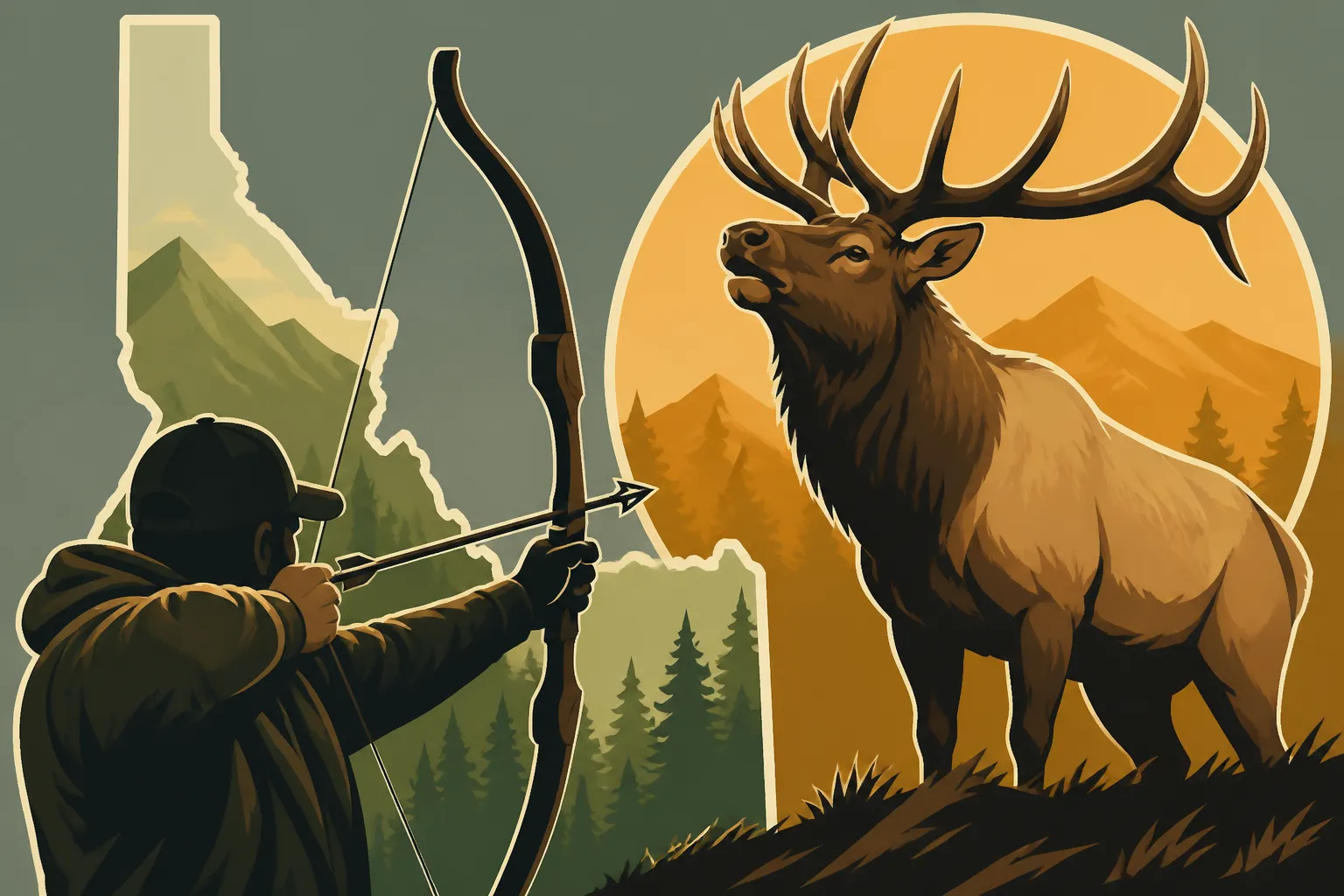
Recurve Poundage That Will Kill an Elk
One of the most common questions that keeps traditional archers up at night, especially when those Idaho elk tags are burning a hole in their pocket, is about recurve poundage. It's easy to get caught up in the "more power is better" mindset, but when it comes to taking down an elk ethically with a recurve, there's a lot more to consider than just raw draw weight. This guide will dive deep into what it truly takes to make an ethical shot on an Idaho elk with a recurve, balancing power, penetration, and the all-important factor of shootability.
Understanding the Power Requirements for Elk
Hunting elk with a recurve is a challenge, but it’s incredibly rewarding. However, it requires a deep understanding of what it takes for your arrow to do its job. It's not just about the numbers on the bow; it's about the entire system working together.
What it Takes to Penetrate an Elk
An elk is a formidable animal, built with dense bones, thick muscle, and tough hide. For an arrow to achieve a quick, ethical kill, it needs to penetrate deep enough to reach the vitals – the heart and lungs – and ideally pass through, creating two holes for a better blood trail. This isn't just about the initial kinetic energy from your bow; it's about retaining that energy as the arrow moves through the animal.
Think about it: a broadhead has to slice through layers of hair and skin, muscle, and potentially bone (ribs, shoulder blade) to get where it needs to go. A light, fast arrow from a high-poundage bow might look impressive on paper, but if it sheds all its energy on a rib bone, it's not doing you any favors. This is where the combination of sufficient draw weight, heavy arrow weight, and an incredibly sharp, well-designed broadhead becomes paramount. The broadhead acts like a surgical tool, and if it's not razor-sharp, even the heaviest bow will struggle to get it through effectively.
Idaho's Minimum Draw Weight for Any Bow
Idaho, like many states, has established minimum requirements for bow hunting. For anyone looking to hunt big game, including elk, the Gem State dictates that your bow must have a minimum peak draw weight of 40 pounds at a 28-inch draw. You can read more about this in our detailed post, "Idaho Requires a 40-Pound Bow at a 28-Inch Draw." It’s a common misconception that this minimum is somehow adequate for all species. While 40 pounds might suffice for smaller deer species with perfect shot placement and optimal arrow setup, it's generally considered insufficient for elk, especially from a recurve where stored energy isn't as high as a compound.
This regulation ensures a baseline level of power, but for elk, most seasoned traditional archers would tell you to aim significantly higher. The legal minimum is simply that – the absolute lowest you can go and still be legal. It doesn't necessarily translate to ethical hunting for all big game animals, particularly something as robust as an elk. It's also worth understanding exactly how the state measures this, which you can find in our article, "How Idaho Measures Draw Weight at 28 Inches."
Recommended Recurve Poundage for Elk Hunting
So, if the legal minimum isn't the actual recommendation, what is the sweet spot for recurve poundage when chasing Idaho elk? The answer isn't a single number, but rather a range that prioritizes both penetration and, crucially, your ability to shoot accurately under pressure.
The "Sweet Spot" for Ethical Kills
For recurve bows, most experienced elk hunters recommend a draw weight between 50 to 60 pounds, measured at your actual draw length. Some highly experienced and physically strong archers might go a bit heavier, into the low 70s, but this is less common and often unnecessary with the right arrow and broadhead combination. The goal is to generate enough force to propel a heavy arrow with a fixed-blade broadhead through an elk's vitals from a reasonable hunting distance.
What makes this range the "sweet spot" is the balance it strikes. It's heavy enough to provide the necessary kinetic energy and momentum for deep penetration, but not so heavy that it compromises your form and accuracy, especially when you're cold, tired, or shaking with adrenaline. Remember, a 55-pound recurve might feel easy in your backyard, but holding it at full draw while a bull elk is staring a hole through you on a cold morning in the Idaho backcountry is an entirely different experience.
The Importance of Shootability and Form
This is perhaps the most critical factor, often overlooked in the quest for maximum poundage. A 65-pound recurve that you can't consistently shoot accurately at 20 yards is far less effective than a 55-pound recurve that you can put into a tight group every single time. Ethical hunting demands precise shot placement. You need to be able to draw your bow smoothly, hold it steadily, and release consistently, even when your muscles are screaming, and your heart is pounding.
If you're struggling to hold your bow at full draw for more than a few seconds, or if your form breaks down during the shot, you've chosen too much poundage. It's better to shoot a slightly lighter bow with perfect form than to muscle a heavy bow and risk a wounded animal. Consistent practice is key, and you'll want to extend your practice sessions to realistic archery practice distance for big game scenarios, which often means pushing beyond 20 yards to build confidence and muscle memory. Remember, an arrow that misses its mark or only wounds the animal isn't just ineffective; it's unethical.
Arrow Weight and Broadhead Selection
For recurve hunters, particularly when targeting elk, your arrow setup is arguably even more important than your draw weight, provided you meet a sufficient minimum. Forget about light, fast arrows. We're talking about heavy, high-momentum projectiles. For elk, a total arrow weight of 500-600 grains is a great starting point for many recurve setups. This heavy mass helps the arrow retain energy and drive through tough hide and bone. You can dive deeper into this topic in "Arrow Weight That Gets Through an Elk."
Coupled with a heavy arrow, a fixed-blade broadhead is non-negotiable for elk with a recurve. Mechanical broadheads, while popular with compound bows, require more kinetic energy to deploy and penetrate effectively, making them less ideal for the lower energy output of a recurve. A two or three-blade fixed broadhead, sharpened to a surgical edge, will perform much more reliably on a large animal like an elk. We extensively compare these options in "Fixed Blade Against Mechanical Broadheads on Elk," but for recurves and elk, fixed blades are king. Ensure your broadheads are tuned perfectly with your arrows to fly true out of your specific bow. This meticulous bow tuning worth doing before a mountain hunt can make all the difference when it counts.
Factors Influencing Your Recurve Choice in Idaho
Idaho hunting isn't just a walk in the park; it's a demanding environment that can test both your gear and your physical limits. Your recurve choice needs to reflect these realities.
Physical Conditioning and Practice
Hunting in Idaho's mountains, especially for a challenging animal like elk, requires serious physical conditioning. You're often dealing with steep ascents and descents, high altitudes, and potentially long days far from any road. This level of exertion will affect your ability to draw and hold a heavy bow. If you're winded and your muscles are burning from hiking, that 55-pound bow might feel like 70 pounds when a bull finally steps into range.
Consistent practice throughout the year, not just a few weeks before the season, is absolutely crucial. You need to build the muscle memory and stamina to handle your recurve confidently under duress. This includes practicing from awkward positions, after a strenuous "hike," and in varying weather conditions. Your mental game is just as important as your physical strength; visualize success and trust your preparation.
Terrain and Shot Opportunities
Idaho's diverse landscapes offer a variety of hunting opportunities, but they rarely offer flat, open shots. From the steep, timbered slopes of the Panhandle to the rugged breaks of the Salmon River, you'll often find yourself in situations where a clean, open shot is a luxury. This means you might be shooting downhill, uphill, from your knees, or around brush. These awkward positions demand a bow you can manage comfortably, without sacrificing form.
Furthermore, with a recurve, your effective range is generally much shorter than with a compound bow. While some master traditional archers can consistently hit targets at 30-40 yards, most advise keeping shots on elk within 20-25 yards for the highest probability of an ethical kill. This means that closing the distance to a wary elk is paramount, a skill that demands patience, stealth, and a deep understanding of animal behavior. Our article, "How Close a Bowhunter Needs to Get on Elk," provides excellent strategies for this very challenge.
| Recurve Draw Weight (at 28") | General Suitability for Elk | Key Considerations |
|---|---|---|
| 40-45 lbs | Legal Minimum Only | Not recommended for elk. Lacks sufficient energy for consistent ethical penetration, even with perfect setup. Better for smaller deer or practice. |
| 45-50 lbs | Borderline/Experienced | Requires exceptional shot placement, heavy arrow (550+ grains), and razor-sharp broadhead. Only for highly skilled traditional archers confident in tight ranges. |
| 50-55 lbs | Recommended Range | Excellent balance of power and shootability for most hunters. Allows for a solid, heavy arrow setup (500-600 grains) and good penetration on vitals. |
| 55-60 lbs | Stronger/Experienced | Provides more energy for increased penetration potential. Best for physically strong archers who can maintain perfect form under pressure. Ideal for heavier arrows. |
| 60+ lbs | Advanced/Specialized | Only for very experienced and conditioned archers. While powerful, accuracy often degrades for many hunters, increasing risk of poor shots. |
Considering Traditional vs. Compound
Switching from a compound bow to a recurve for elk hunting is a significant commitment. Compound bows often have higher kinetic energy, a significant let-off at full draw, and pin sights, which make longer shots and holding at full draw much easier. Recurves offer a more primal, intuitive hunting experience, but they demand a higher level of skill and physical conditioning.
There's no let-off with a recurve, meaning you're holding the full draw weight throughout the aim. This demands immense strength and focus. Your aiming method will likely be gap shooting, aiming off the point of the arrow, or instinctive shooting, all of which require thousands of repetitions to master. It's a journey, not a shortcut. Many archers choose to hunt A tags, which often favor archery and muzzleloader hunters, giving them prime opportunities to get close enough for a recurve shot. If you're new to traditional archery, consider starting with smaller game or deer before tackling an Idaho elk.
GoHunt and Resources for Recurve Hunters
Preparing for an Idaho elk hunt with a recurve requires meticulous planning, from physical training to choosing the right unit. Fortunately, there are resources available to help you make informed decisions.
Researching Units with Traditional Archery Success
Choosing the right hunting unit can significantly impact your success, especially when you're limited by the effective range of a recurve. You'll want units with high elk densities, good public land access, and terrain that allows for effective stalking and close encounters. The GoHunt platform is an invaluable tool for this. Their Insider membership provides detailed unit profiles, drawing odds, harvest statistics, and public land percentages, allowing you to narrow down your options based on your specific hunting style. It's like having an advanced "A Walkthrough of the Idaho Hunt Planner" at your fingertips, but with a deeper dive into unit specifics.
You can use GoHunt's filtering tools to look for units with higher archery success rates, which might indicate better opportunities for close-range engagements. While they might not specifically break down traditional archery success, a good overall archery success rate combined with high elk numbers (because, after all, elk are why most hunters come to Idaho!) is a strong indicator. Look for areas with diverse terrain, including dark timber and river breaks, where elk often feel secure and allow a hunter to get within recurve range.
Finding Mentors and Community
One of the greatest assets for any traditional archer, especially one venturing into elk hunting with a recurve, is the traditional archery community itself. Unlike buying the latest compound bow, traditional archery often involves more nuanced skills that are best learned from experienced mentors. Seek out local traditional archery clubs, online forums, or even dedicated traditional archery shops. These communities are often incredibly welcoming and filled with seasoned hunters eager to share their knowledge and help you improve your form, tuning, and hunting strategies.
Mentors can offer advice on everything from arrow building and broadhead sharpening to calling techniques specific to traditional hunting. They can help you assess if your chosen recurve poundage is right for you and guide you in your practice routines. Beyond the technical aspects, they can provide invaluable insights into the mental game of traditional hunting, helping you develop the patience and discipline required for success. Don't be afraid to ask questions, share your struggles, and learn from those who have walked the traditional path before you. And remember, once you've successfully tagged an elk, the hard work truly begins with packing an elk out of steep country alone or with partners.
Disclaimer
Always consult the latest Idaho Fish and Game regulations for specific rules and requirements, as these can change annually. The information provided here is for general guidance and educational purposes only.