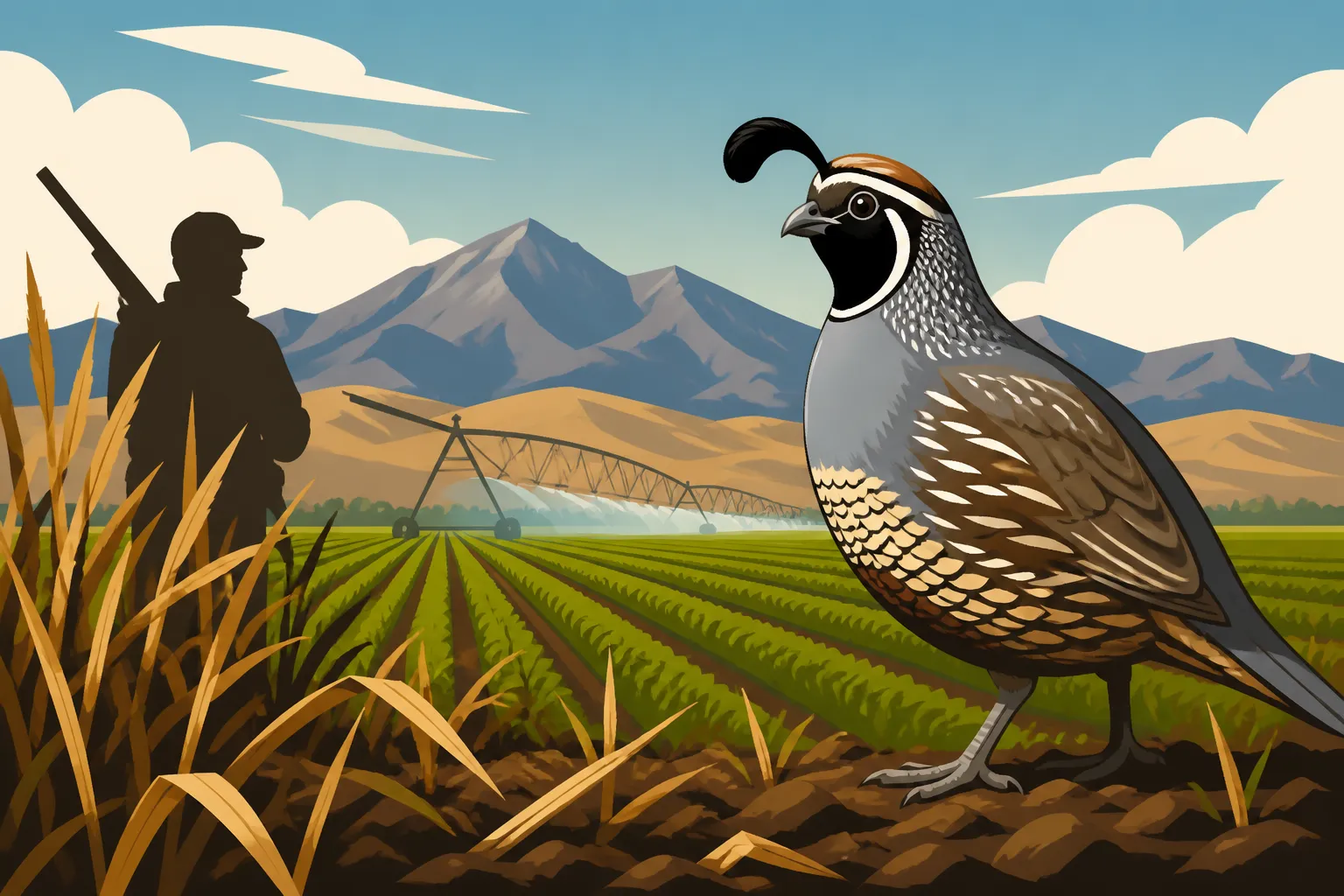
California Quail on Irrigated Farm Ground
Hunting upland birds can sometimes feel like trying to find a needle in a haystack, especially when you're targeting a specific species in a particular habitat. If you’ve ever found yourself wondering where to even begin looking for California quail in Idaho, particularly away from the classic rocky canyon breaks, you're not alone. Many hunters assume these little dynamos stick exclusively to rough, arid terrain, but that's simply not the whole story. This guide is here to shed light on a highly productive, often overlooked habitat for California quail: Idaho's irrigated farm ground, and how you can successfully hunt these birds where agriculture meets wild.
Understanding California Quail Habits on Irrigated Farm Ground
California quail are incredibly adaptable birds, and while they absolutely thrive in sagebrush and bitterbrush country, they're not shy about making a living in the patchwork of Idaho's agricultural landscapes. The key is understanding what makes these farm fields so appealing, especially when they're consistently watered.
The Allure of Water and Cover on Farmland
Picture this: vast, dry plains or rugged, sun-baked hillsides. Now imagine, right next to that, a lush, green field sustained by irrigation. It's a stark contrast, and one that doesn't go unnoticed by wildlife. California quail, like all living creatures, need water, and irrigated farm ground provides a consistent, reliable source that simply isn't present in many of their more traditional habitats during dry periods. This constant moisture doesn't just benefit the crops; it creates vibrant, often dense, vegetation along field edges, ditches, and unused corners that acts as ideal cover.
This cover isn't just for hiding from predators; it's a place to roost at night, to escape the heat of the midday sun, and to raise their broods away from prying eyes. Think about the thick fencerows that farmers leave, the unkempt borders where sprinklers don't quite reach, or even dense stands of weeds that pop up in fallow fields. These spots, nourished by the same water that feeds the crops, become crucial refuges for quail, offering both concealment and a microclimate cooler than the surrounding open country.
Diet and Foraging Patterns in Agricultural Settings
What's on the menu for a California quail in Idaho's farm country? A surprising amount, actually. While they'll always gravitate towards natural seeds and insects, irrigated farmland offers a smorgasbord of agricultural bounty. They'll scratch and peck at fallen grain kernels left after harvest, forage on the seeds of various weeds that grow alongside crops, and feast on the occasional insect population that thrives in moist soil.
Different crops offer different benefits. A wheat field might provide excellent stubble and fallen grain after harvest, while a cornfield offers incredible overhead cover and plenty of seeds. Alfalfa and other hayfields, especially when irrigated, are magnets for insects and provide a constant source of green forage. These birds aren't picky; they're opportunists. They’ll move through these fields, especially during morning and evening feeding periods, gleaning whatever sustenance they can find, always staying close to good cover for a quick dash if a hawk or coyote makes an appearance. You'll often find them working the edges of fields where they can quickly duck into a fencerow or dense patch of brush.
Roosting and Escape Cover Necessities
For California quail, "home" means a place to feel safe. On irrigated farm ground, this typically means dense, low-lying cover that provides both concealment from aerial predators and a barrier against ground-based threats. This could be a thicket of blackberry bushes along a ditch, a tangled mass of Russian olive, or even a dense stand of tall, sturdy weeds that have grown up in an abandoned corner of a field. These spots are critical for roosting at night, especially during colder periods, where the covey can huddle together for warmth and security.
During the day, they use similar cover for escape. When a hawk circles overhead or a fox makes a pass, the quail burst into flight, often making a short, rapid escape back into the nearest dense brush. This cover also provides shade from the intense Idaho sun, which is particularly important during late season hunts when the birds are looking for respite. Understanding their need for this constant interplay between food sources and secure cover is paramount to finding them. Look for mosaics of agricultural fields with adjacent unkempt areas, thickets, or deep ditches—those are your hotspots.
Identifying Prime Irrigated Farm Ground Habitat
Finding California quail isn't just about driving around hoping to spot them. It's about looking for specific habitat characteristics that make certain irrigated farm grounds more attractive than others. Think like a quail: where would you feel safe, fed, and hydrated?
Edges and Transitional Zones
Quail are birds of the edge. They rarely venture far into the middle of a vast, open field, as that exposes them to too much danger. Instead, they hug the boundaries where one type of habitat transitions into another. On irrigated farm ground, these transitional zones are goldmines. This includes the edges where a cultivated field meets a treeline, a brushy fencerow, a pasture, or even a riparian corridor.
These edges provide a linear escape route and a buffet of both natural and agricultural food sources. They can feed on crop leavings in the field, then dart back into the safety of the brush if disturbed. Think about where irrigation pivots stop, leaving triangular or rectangular corners of un-farmed land. These often grow up into dense cover, providing perfect sanctuary right next to a food source. Mapping tools, like those you can access through a GoHunt membership, can be incredibly useful for identifying these specific edge habitats from an aerial perspective before you even step foot in the field. They help you visualize how a property lays out and where these critical transitions occur.
Irrigation Ditches, Canals, and Seeps
If there’s one thing that draws California quail to irrigated farm ground like a magnet, it’s water, and the cover associated with it. Irrigation ditches and canals, especially those that carry water for much of the growing season, are prime real estate. The banks of these waterways often sprout dense stands of weeds, cattails, and brush, creating linear strips of perfect quail cover. These can stretch for miles, providing a highway for quail to move through the landscape, always with access to water and concealment.
Seepy areas, where water leaks from irrigation pipes or naturally collects, also create small, lush oases that quail adore. These might be small patches of reeds or tall grass in a low spot. Even dry ditches that only carry water seasonally can still offer valuable cover once vegetation takes root. When you're scouting, pay close attention to the vegetation density around these water features. The thicker and more tangled it is, the better. These aren't just pathways; they're entire ecosystems for quail.
Crop Types and Their Attractiveness
Not all crops are created equal in the eyes of a California quail. While they’ll utilize almost any field edge, some crop types offer more consistent food and cover throughout the season. Cereal grains like wheat, barley, and corn are fantastic. After harvest, the stubble provides excellent short-term cover, and the spilled grain is a crucial food source, particularly in the late season when other forage might be scarce. Soybeans and sunflowers also leave behind a wealth of seeds and cover.
Conversely, fields that are kept completely clean, like some potato or sugar beet fields, might offer less immediate attraction, but even their borders can hold birds if there’s good cover nearby. Alfalfa and other hay crops, while not offering direct grain, are insect factories and provide consistent green feed. The key is diversity. Farm ground with a rotation of different crops, interspersed with brushy fencerows, small woodlots, or un-farmed areas, will almost always hold more birds than a monoculture landscape. It provides a constant shift in food sources and cover throughout the year.
Hunting Strategies for California Quail in Farm Country
Hunting California quail on irrigated farm ground requires a slightly different approach than chasing them up rocky canyons. The terrain might be flatter, but the cover can be deceptively thick, and the birds are just as explosive.
Working with the Landscape
When you’re hunting farm ground, your approach needs to be strategic. The grid pattern of fields and fencerows can be your friend or your foe. Instead of just walking aimlessly, try to envision the quail's escape routes. They will run along fencelines, dive into ditches, or sprint across a short stubble field to the next patch of dense cover. Use this to your advantage.
Often, it’s best to walk parallel to a fencerow or ditch, with a dog working the thickest cover between you and the field. If hunting with a partner, one person can walk the open side of the fenceline while the other works the brushy side, effectively pinching the birds. Always be aware of property boundaries and any potential obstacles like irrigation equipment. If you can use natural funnels or pinch points, like a narrow strip of cover between two fields, you can increase your chances of flushing birds within shotgun range. Remember, these birds will often run before they fly, so cutting off their escape routes is key.
Dog Work and Flushing Techniques
A good bird dog is almost essential for hunting California quail effectively on irrigated farm ground, particularly given how well these birds can hide and how much they prefer to run. Flushers like English Springer Spaniels or Brittany Spaniels, or even pointers that learn to flush aggressively, excel in this environment. The dense cover in ditches and fencerows can be difficult for a hunter to push through, but a dog with a good nose and plenty of drive can get in there and get the birds airborne.
Train your dog to work close, especially in thick cover, as quail can hold incredibly tight. When a dog goes on point or gets birdy, be ready for a fast flush. California quail explode out of cover with surprising speed, so quick reflexes are paramount. If you don't have a dog, you'll need to walk slower, kick through every thicket, and be prepared to sprint after running birds. Sometimes, pausing for a moment can cause a running bird to hold, thinking it's safe, only to flush when you take another step. This is often called the "stop-and-go" method and can be quite effective. Bird Dog Rules for Upland Game Hunting might be a good resource to brush up on, especially if you're new to hunting with a canine companion.
Respecting Private Land and Access
This is perhaps the most crucial aspect of hunting California quail on irrigated farm ground: much of this land is privately owned. You absolutely must obtain permission before hunting on any private property. Trespassing is not only illegal and disrespectful, but it can also ruin access for all hunters. Always ask for permission well in advance of your hunt, and be prepared for a "no." If you get permission, be the best guest you can be: close gates, don't damage crops or fences, pick up spent shells, and thank the landowner profusely.
Idaho does have programs like "Access Yes" which open up private land to public hunting, and these can be fantastic resources for finding quail habitat on farms. Finding Access Yes Properties on a Map is an excellent way to locate these parcels. However, even on Access Yes properties, always understand the specific rules and boundaries for that parcel. If you're unsure about boundaries or land ownership, resources like GoHunt's mapping services or even the Idaho Fish and Game website (which can provide Idaho Unit Shapefiles and Layers) can help clarify public vs. private land, allowing you to plan your hunt responsibly.
Gear and Tips for a Successful Quail Hunt
A successful day chasing California quail on Idaho's farm ground isn't just about finding the birds; it's also about having the right gear and knowing a few tricks of the trade.
Shotgun and Shot Selection for Fast Birds
California quail are small, fast, and often flush at close range from dense cover. This means you'll want a shotgun that swings quickly and can put a good pattern on target in a hurry. Many hunters favor a 20-gauge or even a 28-gauge for quail, as they are lighter and faster to shoulder than a 12-gauge. Open chokes, like improved cylinder or skeet, are often preferred due to the close flushing nature of the birds. You'll want a broad, forgiving pattern.
For shot size, smaller shot is the way to go. #7.5 or #8 lead shot is typically ideal. These smaller pellets create a dense pattern, which is what you need to consistently hit these zippy little targets. While steel shot is often required for waterfowl, for upland birds like quail, lead is generally permitted and performs admirably. Always check the current regulations for any specific unit you're hunting, but typically, #7.5 or #8 lead will serve you well.
Clothing and Footwear for Farm Fields
Hunting irrigated farm ground can mean navigating a variety of conditions. You might encounter wet grass and muddy patches from irrigation, dry stubble that's hard on the feet, or thick, thorny brush in fencerows. This calls for durable, weather-appropriate gear. Waterproof boots are a must to keep your feet dry, especially in the early mornings or after recent irrigation. Look for boots with good ankle support, as the uneven ground and hidden holes can lead to twisted ankles.
Briar-resistant pants or chaps are highly recommended. Those fencerows and ditches that quail love are often packed with thorns and tough brush that can tear up regular hunting pants in no time. Layers are always a good idea in Idaho, as temperatures can change dramatically throughout the day. A good blaze orange vest or hat is essential for safety, even if not explicitly required for upland birds, it significantly increases your visibility to other hunters. It’s also wise to wear safety glasses to protect your eyes from snapping branches and stray shot.
Post-Hunt Care for Birds
Once you've successfully harvested some California quail, the work isn't quite done. Proper field dressing and care are essential to ensure the meat is of the highest quality. Quail are small, so they cool down relatively quickly, but you still want to get them out of the sun and into a cooler as soon as possible. Plucking or skinning is a matter of preference; plucking often leaves more flavor in the skin, but skinning is faster.
If you're out for a full day, consider bringing a small game bag that allows for air circulation to help the birds cool down. Once back at the truck, transfer them to a cooler with ice, ideally in plastic bags to keep them dry. The goal is to get their core temperature down quickly. Properly cared for, California quail provide some truly delicious table fare. You can find more detailed instructions on this in articles like Field Dressing and Carcass Transport Rules Explained, which covers the basics for all game animals. For current season dates and bag limits, always consult the official Idaho Fish and Game regulations or use resources like the Idaho Hunt Planner Is the Tool to Start With.
| Habitat Feature | Irrigated Farm Ground Quail | Traditional Canyon Quail |
|---|---|---|
| Primary Water Source | Consistent irrigation, ditches, canals, seeps | Seasonal springs, limited riparian areas, dew |
| Dominant Cover | Brushy fencerows, ditch banks, crop edges, unkempt corners, dense weeds | Sagebrush, bitterbrush, junipers, rocky outcrops, riparian thickets |
| Primary Food Source | Crop seeds (wheat, corn), weed seeds, insects attracted to moisture | Natural seeds, berries, insects, forbs |
| Terrain | Mostly flat to gently rolling, can be muddy | Steep, rocky, often uneven, dry |
| Access Considerations | Primarily private land, requires permission or Access Yes | Often public land (BLM, Forest Service), but can be remote |
| Hunting Strategy | Work edges, ditches; dogs for flushing; respect private land | Spot and stalk, dogs for scenting; navigate difficult terrain |
| Flushing Tendency | Often runs before flying, explosive flush from dense cover | Holds tight, explosive flush, may run downslope |
Remember, every hunting trip is an opportunity to learn and connect with the land. California quail on irrigated farm ground offer a unique and rewarding challenge for the upland bird hunter in Idaho.
Disclaimer
This article is for general informational purposes only and does not constitute professional advice. Laws, prices and regulations vary by location and change over time. Consult a qualified professional for guidance on your specific situation.